Showing posts with label Christian faith. Show all posts

Saturday, January 14, 2023

Cardinal Ratzinger on the 9th Station of the Cross


NINTH STATION


Jesus falls for the third time

V/. Adoramus te, Christe, et benedicimus tibi.
R/. Quia per sanctam crucem tuam redemisti mundum.

From the Book of Lamentations. 3:27-32

It is good for a man that he bear the yoke in his youth. Let him sit alone in silence when he has laid it on him; let him put his mouth in the dust - there may yet be hope; let him give his cheek to the smiter, and be filled with insults. For the Lord will not cast off for ever, but, though he cause grief, he will have compassion, according to the abundance of his steadfast love.


MEDITATION


by Joseph Ratzinger

What can the third fall of Jesus under the Cross say to us?


We have considered the fall of man in general, and the falling of many Christians away from Christ and into a godless secularism. Should we not also think of how much Christ suffers in his own Church?


How often is the holy sacrament of his Presence abused, how often must he enter empty and evil hearts!


How often do we celebrate only ourselves, without even realizing that he is there!


How often is his Word twisted and misused!


What little faith is present behind so many theories, so many empty words!


How much filth there is in the Church, and even among those who, in the priesthood, ought to belong entirely to him!


How much pride, how much self-complacency!


What little respect we pay to the Sacrament of Reconciliation, where he waits for us, ready to raise us up whenever we fall!


All this is present in his Passion. His betrayal by his disciples, their unworthy reception of his Body and Blood, is certainly the greatest suffering endured by the Redeemer; it pierces his heart. We can only call to him from the depths of our hearts: Kyrie eleison ­ Lord, save us (cf. Mt 8: 25).


PRAYER

Lord, your Church often seems like a boat about to sink, a boat taking in water on every side.


In your field we see more weeds than wheat.


The soiled garments and face of your Church throw us into confusion.


Yet it is we ourselves who have soiled them! It is we who betray you time and time again, after all our lofty words and grand gestures.


Have mercy on your Church; within her too, Adam continues to fall.


When we fall, we drag you down to earth, and Satan laughs, for he hopes that you will not be able to rise from that fall; he hopes that being dragged down in the fall of your Church, you will remain prostrate and overpowered.


But you will rise again. You stood up, you arose and you can also raise us up.


Save and sanctify your Church. Save and sanctify us all.


Cardinal Ratzinger, Via Crucis, 25 March 2005, Rome.

Monday, July 15, 2019

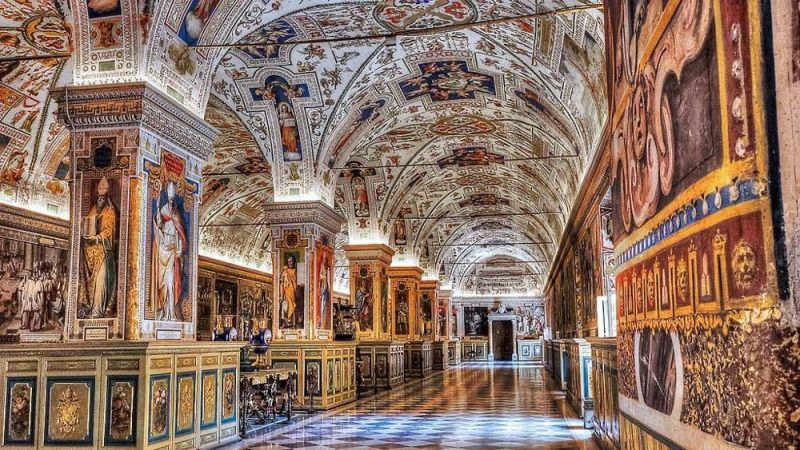
Benedict XVI on the Vatican Museums

Image result for vatican museum

"For many people a visit to the Vatican Museums during their stay in Rome represents their deepest and sometimes only contact with the Holy See. Therefore, is it a good opportunity to learn about the Christian message. We could say that the artistic heritage of Vatican City constitutes a kind of great 'parable' through which the Pope speaks to men and women from all over the world - and therefore from many cultural and religious backgrounds - people who perchance never read a papal address or homily. ... The language of art is a language of parables, possessing a special kind of universal openness. The 'Via Pulchtitudinis' can open people’s minds and hearts to the eternal, raising them to the heights of God.

I greatly appreciated the fact that the film makes repeated reference to the efforts of Roman Pontiffs to conserve and cherish artistic heritage, and to their efforts in modern times to renew the Church’s dialogue with artists. The collection of modern religious art in the Vatican Museums is living proof of the fruitfulness of that dialogue. Indeed, ... the entire great structure of the Vatican Museums ... possesses a dimension which we could define as 'evangelising'."


Benedict XVI, 25 October 2012

Sunday, September 2, 2018

Ratzinger on the Church of the Future


"From the crisis of today the Church of tomorrow will emerge—a Church that has lost much.
 
She will become small and will have to start afresh more or less from the beginning.
 
She will no longer be able to inhabit many of the edifices she built in prosperity.
 
As the number of her adherents diminishes, so will she lose many of her social privileges. In contrast to an earlier age, she will be seen much more as a voluntary society, entered only by free decision.

As a small society, she will make much bigger demands on the initiative of her individual members.
 
Undoubtedly she will discover new forms of ministry and will ordain to the priesthood approved Christians who pursue some profession. In many smaller congregations or in self-contained social groups, pastoral care will normally be provided in this fashion.
 
Alongside this, the full-time ministry of the priesthood will be indispensable as formerly.

But in all of the changes at which one might guess, the Church will find her essence afresh and with full conviction in that which was always at her center: faith in the triune God, in Jesus Christ, the Son of God made man, in the presence of the Spirit until the end of the world.
 
In faith and prayer she will again recognize her true center and experience the sacraments again as the worship of God and not as a subject for liturgical scholarship.

The Church will be a more spiritual Church, not presuming upon a political mandate, flirting as little with the Left as with the Right.
 
It will be hard going for the Church, for the process of crystalization and clarification will cost her much valuable energy.
 
It will make her poor and cause her to become the Church of the meek.

The process will be all the more arduous, for sectarian narrow-mindedness as well as pompous self-will will have to be shed.
 
One may predict that all of this will take time. The process will be long and wearisome as was the road from the false progressivism of the eve of the French Revolution—when a bishop might be thought smart if he made fun of dogmas and even insinuated that the existence of God was by no means certain—to the renewal of the nineteenth century.

But when the trial of this sifting is past, a great power will flow from a more spiritualized and simplified Church.

Men in a totally planned world will find themselves unspeakably lonely. If they have completely lost sight of God, they will feel the whole horror of their poverty.
 
Then they will discover the little flock of believers as something wholly new.
 
They will discover it as a hope that is meant for them, an answer for which they have always been searching in secret.

And so it seems certain to me that the Church is facing very hard times.
 
The real crisis has scarcely begun.
 
We will have to count on terrific upheavals.
 
But I am equally certain about what will remain at the end: not the Church of the political cult, which is dead already with Gobel, but the Church of faith.
 
She may well no longer be the dominant social power to the extent that she was until recently; but she will enjoy a fresh blossoming and be seen as man’s home, where he will find life and hope beyond death."

Father Joseph Ratzinger, Faith and the Future, (published originally in German in 1970 as Glaube und Zukunft), republished by the Vatican Press in 2006.


Friday, February 26, 2016

Cardinal Ratzinger on the Logos

"Christianity must always remember that it is the religion of the Logos. It is faith in the Creator Spiritus, (Creator Spirit), from which proceeds everything that exists. Today, this should be precisely its philosophical strength, in so far as the problem is whether the world comes from the irrational, and reason is not, therefore, other than a 'sub-product,' on occasion even harmful of its development, or whether the world comes from reason, and is, as a consequence, its criterion and goal. The Christian faith inclines toward this second thesis, thus having, from the purely philosophical point of view, really good cards to play, despite the fact that many today consider only the first thesis as the only modern and rational one par excellence. However, a reason that springs from the irrational, and that is, in the final analysis, itself irrational, does not constitute a solution for our problems. Only creative reason, which in the crucified God is manifested as love, can really show us the way. In the so necessary dialogue between secularists and Catholics, we Christians must be very careful to remain faithful to this fundamental line: to live a faith that comes from the Logos, from creative reason, and that, because of this, is also open to all that is truly rational." 

Joseph Cardinal Ratzinger, 1 April 2005.

Tuesday, May 19, 2015

Saint Francis of Assisi to His Followers before His Death


http://littleportionhermitage.org/wp-content/uploads/2014/10/transitus.jpg 

"Act bravely, my Brethren; take courage, and trust in the Lord. The time is fast approaching in which there will be great trials and afflictions; perplexities and dissensions, both spiritual and temporal, will abound; the charity of many will grow cold, and the malice of the wicked will increase.

The devils will have unusual power, the immaculate purity of our Order, and of others, will be so much obscured that there will be very few Christians who will obey the true Sovereign Pontiff and the Roman Church with loyal hearts and perfect charity. 

At the time of this tribulation a man, not canonically elected, will be raised to the Pontificate, who, by his cunning, will endeavour to draw many into error and death.

Then scandals will be multiplied, our Order will be divided, and many others will be entirely destroyed, because they will consent to error instead of opposing it.

There will be such diversity of opinions and schisms among the people, the religious and the clergy, that, except those days were shortened, according to the words of the Gospel, even the elect would be led into error, were they not specially guided, amid such great confusion, by the immense mercy of God.

Then our Rule and manner of life will be violently opposed by some, and terrible trials will come upon us. Those who are found faithful will receive the crown of life; but woe to those who, trusting solely in their Order, shall fall into tepidity, for they will not be able to support the temptations permitted for the proving of the elect.

Those who preserve their fervour and adhere to virtue with love and zeal for the truth, will suffer injuries and, persecutions as rebels and schismatics; for their persecutors, urged on by the evil spirits, will say they are rendering a great service to God by destroying such pestilent men from the face of the earth. but the Lord will be the refuge of the afflicted, and will save all who trust in Him. And in order to be like their Head, [Christ] these, the elect, will act with confidence, and by their death will purchase for themselves eternal life; choosing to obey God rather than man, they will fear nothing, and they will prefer to perish rather than consent to falsehood and perfidy.

Some preachers will keep silence about the truth, and others will trample it under foot and deny it. Sanctity of life will be held in derision even by those who outwardly profess it, for in those days Jesus Christ will send them not a true Pastor, but a destroyer."

Saturday, December 20, 2014

Cardinal Ratzinger on the Christian Faith

http://ecx.images-amazon.com/images/I/51k-iJXUF8L._SY344_BO1,204,203,200_.jpgThe Christian faith can never be separated from the soil of sacred events, from the choice made by God, who wanted to speak to us, to become man, to die and rise again, in a particular place and at a particular time. “Always” can only come from “once for all”. The Church does not pray in some kind of mythical omnitemporality. She cannot forsake her roots. She recognizes the true utterance of God precisely in the concreteness of its history, in time and place: to these God ties us, and by these we are all tied together. The diachronic aspect, praying with the Fathers and the apostles, is part of what we mean by rite, but it also includes a local aspect, extending from Jerusalem to Antioch, Rome, Alexandria, and Constantinople. Rites are not, therefore, just the products of inculturation, how­ever much they may have incorporated elements from different cultures. They are forms of the apostolic Tradition and of its unfolding in the great places of the Tradition

Cardinal Ratzinger, The Spirit of the Liturgy, (SF, CA, Ignatius, 2000), p. 164.