Showing posts with label Holy Spirit. Show all posts

Tuesday, December 10, 2019

Benedict XVI on the Holy Family of Nazareth

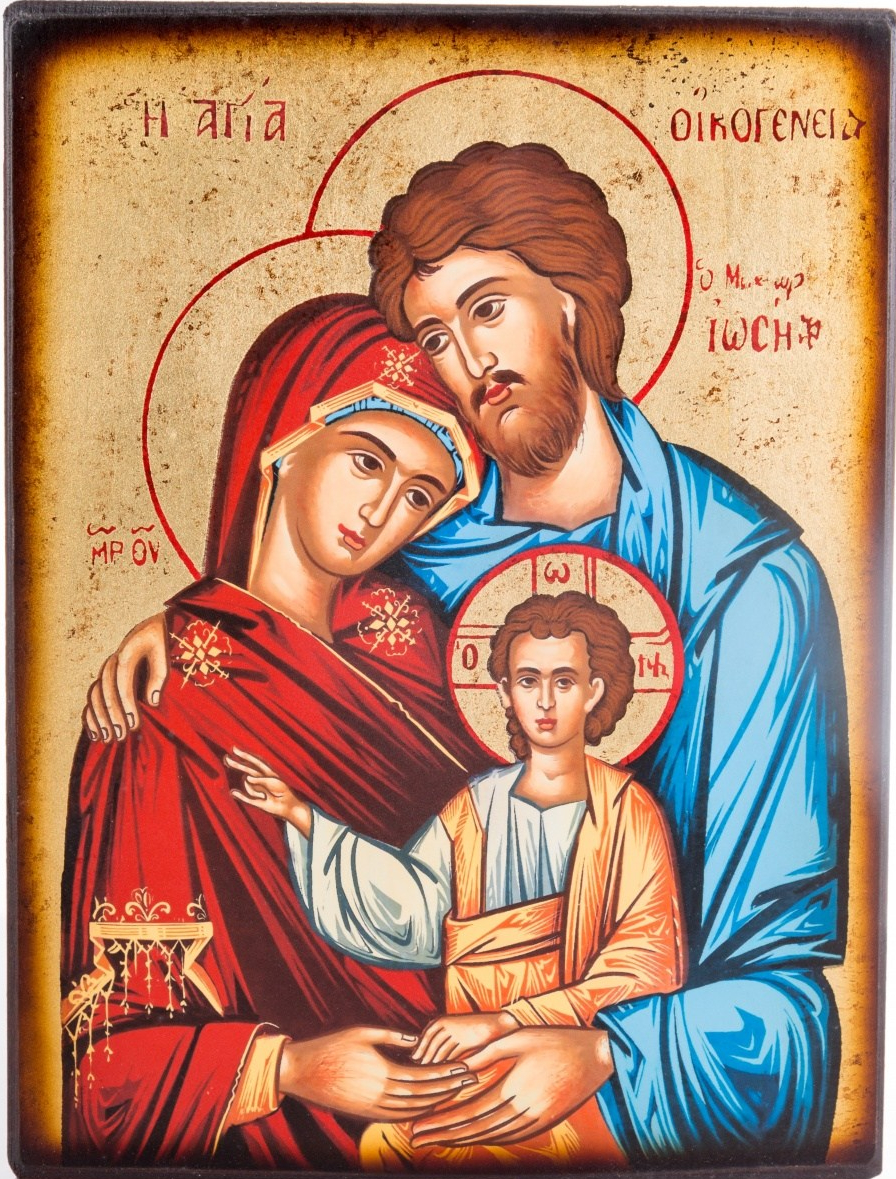
Image result for holy family


"Today’s meeting is taking place in the atmosphere of Christmas, imbued with deep joy at the Birth of the Saviour. We have just celebrated this Mystery whose echo ripples through the Liturgy of all these days. It is a Mystery of Light that all people in every era can relive with faith and prayer. It is through prayer itself that we become capable of drawing close to God with intimacy and depth.
 
Therefore, bearing in mind the theme of prayer that I am developing in the Catecheses in this period, I would therefore like to invite you to reflect today on the way that prayer was part of the life of the Holy Family of Nazareth. Indeed, the house of Nazareth is a school of prayer where one learns to listen, meditate on and penetrate the profound meaning of the manifestation of the Son of God, following the example of Mary, Joseph and Jesus.
 
The Discourse of the Servant of God Paul VI during his Visit to Nazareth is memorable. The Pope said that at the school of the Holy Family we “understand why we must maintain a spiritual discipline, if we wish to follow the teaching of the Gospel and become disciples of Christ”. He added: “In the first place it teaches us silence. Oh! If only esteem for silence, a wonderful and indispensable spiritual atmosphere, could be reborn within us! Whereas we are deafened by the din, the noise and discordant voices in the frenetic, turbulent life of our time. O silence of Nazareth! Teach us to be steadfast in good thoughts, attentive to our inner life, ready to hear God’s hidden inspiration clearly and the exhortations of true teachers” (Discourse in Nazareth, 5 January 1964).
 
We can draw various ideas for prayer and for the relationship with God and with the Holy Family from the Gospel narratives of the infancy of Jesus. We can begin with the episode of the Presentation of Jesus in the Temple. St Luke tells how “when the time came for their purification according to the law of Moses”, Mary and Joseph “brought him up to Jerusalem to present him to the Lord” (2:22). Like every Jewish family that observed the law, Jesus’ parents went to the Temple to consecrate their first-born son to God and to make the sacrificial offering. Motivated by their fidelity to the precepts of the Law, they set out from Bethlehem and went to Jerusalem with Jesus who was only 40 days old. Instead of a year-old lamb they presented the offering of simple families, namely, two turtle doves. The Holy Family’s pilgrimage was one of faith, of the offering of gifts — a symbol of prayer — and of the encounter with the Lord whom Mary and Joseph already perceived in their Son Jesus.
 
Mary was a peerless model of contemplation of Christ. The face of the Son belonged to her in a special way because he had been knit together in her womb and had taken a human likeness from her. No one has contemplated Jesus as diligently as Mary. The gaze of her heart was already focused on him at the moment of the Annunciation, when she conceived him through the action of the Holy Spirit; in the following months she gradually became aware of his presence, until, on the day of his birth, her eyes could look with motherly tenderness upon the face of her son as she wrapped him in swaddling clothes and laid him in the manger.
 
Memories of Jesus, imprinted on her mind and on her heart, marked every instant of Mary’s existence. She lived with her eyes fixed on Christ and cherished his every word. St Luke says: “Mary kept all these things, pondering them in her heart” (2:19) and thus describes Mary’s approach to the Mystery of the Incarnation which was to extend throughout her life: keeping these things, pondering on them in her heart. Luke is the Evangelist who acquaints us with Mary’s heart, with her faith (cf. 1:45), her hope and her obedience (cf. 1:38) and, especially, with her interiority and prayer (cf. 1:46-56), her free adherence to Christ (cf. 1:55).
 
And all this proceeded from the gift of the Holy Spirit who overshadowed her (cf. 1:35), as he was to come down on the Apostles in accordance with Christ’s promise (cf. Acts 1:8). This image of Mary which St Luke gives us presents Our Lady as a model for every believer who cherishes and compares Jesus’ words with his actions, a comparison which is always progress in the knowledge of Jesus. After Bl. Pope John Paul II’s example (cf. Apostolic Letter Rosarium Virginis Mariae) we can say that the prayer of the Rosary is modelled precisely on Mary, because it consists in contemplating the mysteries of Christ in spiritual union with the Mother of the Lord.
 
Mary’s ability to live by God’s gaze, is so to speak, contagious. The first to experience this was St Joseph. His humble and sincere love for his betrothed and his decision to join his life to Mary’s attracted and introduced him, “a just man”, (Mt 1:19), to a special intimacy with God. Indeed, with Mary and later, especially, with Jesus, he began a new way of relating to God, accepting him in his life, entering his project of salvation and doing his will. After trustfully complying with the Angel’s instructions “Do not fear to take Mary your wife” (Mt 1:20) — he took Mary to him and shared his life with her; he truly gave the whole of himself to Mary and to Jesus and this led him to perfect his response to the vocation he had received.
 
As we know, the Gospel has not recorded any of Joseph’s words: his is a silent and faithful, patient and hard-working presence. We may imagine that he too, like his wife and in close harmony with her, lived the years of Jesus’ childhood and adolescence savouring, as it were, his presence in their family.
 
Joseph fulfilled every aspect of his paternal role. He must certainly have taught Jesus to pray, together with Mary. In particular Joseph himself must have taken Jesus to the Synagogue for the rites of the Sabbath, as well as to Jerusalem for the great feasts of the people of Israel. Joseph, in accordance with the Jewish tradition, would have led the prayers at home both every day — in the morning, in the evening, at meals — and on the principal religious feasts. In the rhythm of the days he spent at Nazareth, in the simple home and in Joseph’s workshop, Jesus learned to alternate prayer and work, as well as to offer God his labour in earning the bread the family needed.
 
And lastly, there is another episode that sees the Holy Family of Nazareth gathered together in an event of prayer. When Jesus was 12 years old, as we have heard, he went with his parents to the Temple of Jerusalem. This episode fits into the context of pilgrimage, as St Luke stresses: “His parents went to Jerusalem every year at the feast of the Passover. And when he was twelve years old, they went up according to custom” (2:41-42).
 
Pilgrimage is an expression of religious devotion that is nourished by and at the same time nourishes prayer. Here, it is the Passover pilgrimage, and the Evangelist points out to us that the family of Jesus made this pilgrimage every year in order to take part in the rites in the Holy City. Jewish families, like Christian families, pray in the intimacy of the home but they also pray together with the community, recognizing that they belong to the People of God, journeying on; and the pilgrimage expresses exactly this state of the People of God on the move. Easter is the centre and culmination of all this and involves both the family dimension and that of liturgical and public worship.
 
In the episode of the 12-year-old Jesus, the first words of Jesus are also recorded: “How is it that you sought me? Did you not know that I must be in my Father’s house?” (2:49). After three days spent looking for him his parents found him in the temple, sitting among the teachers, listening to them and asking them questions (cf. 2:46). His answer to the question of why he had done this to his father and mother was that he had only done what the Son should do, that is, to be with his Father.
 
Thus he showed who is the true Father, what is the true home, and that he had done nothing unusual or disobedient. He had stayed where the Son ought to be, that is, with the Father, and he stressed who his Father was.
 
The term “Father” therefore dominates the tone of this answer and the Christological mystery appears in its entirety. Hence, this word unlocks the mystery, it is the key to the Mystery of Christ, who is the Son, and also the key to our mystery as Christians who are sons and daughters in the Son. At the same time Jesus teaches us to be children by being with the Father in prayer. The Christological mystery, the mystery of Christian existence, is closely linked to, founded on, prayer. Jesus was one day to teach his disciples to pray, telling them: when you pray say “Father”. And, naturally, do not just say the word say it with your life, learn to say it meaningfully with your life. “Father”; and in this way you will be true sons in the Son, true Christians.
 
It is important at this point, when Jesus was still fully integrated in the life of the Family of Nazareth, to note the resonance that hearing this word “Father” on Jesus’ lips must have had in the hearts of Mary and Joseph. It is also important to reveal, to emphasize, who the Father is, and, with his awareness, to hear this word on the lips of the Only-Begotten Son who, for this very reason, chose to stay on for three days in the Temple, which is the “Father’s house”.
 
We may imagine that from this time the life of the Holy Family must have been even fuller of prayer since from the heart of Jesus the boy — then an adolescent and a young man — this deep meaning of the relationship with God the Father would not cease to spread and to be echoed in the hearts of Mary and Joseph.
 
This episode shows us the real situation, the atmosphere of being with the Father. So it was that the Family of Nazareth became the first model of the Church in which, around the presence of Jesus and through his mediation, everyone experiences the filial relationship with God the Father which also transforms interpersonal, human relationships.
 
Dear friends, because of these different aspects that I have outlined briefly in the light of the Gospel, the Holy Family is the icon of the domestic Church, called to pray together. The family is the domestic Church and must be the first school of prayer. It is in the family that children, from the tenderest age, can learn to perceive the meaning of God, also thanks to the teaching and example of their parents: to live in an atmosphere marked by God’s presence. An authentically Christian education cannot dispense with the experience of prayer. If one does not learn how to pray in the family it will later be difficult to bridge this gap. And so I would like to address to you the invitation to pray together as a family at the school of the Holy Family of Nazareth and thereby really to become of one heart and soul, a true family. Many thanks."
 
Benedict XVI, General Audience (Paul VI Audience Hall), 28 December 2011


Thursday, February 28, 2019

Benedict XVI on the Year of Faith

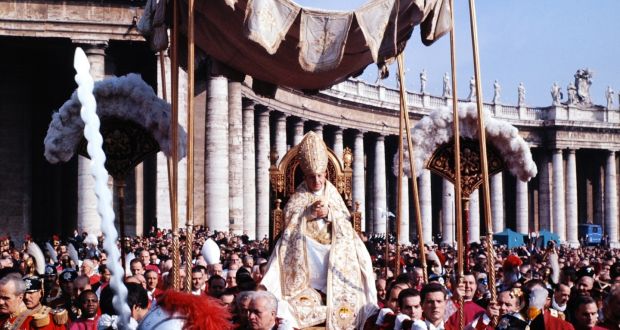
Pope John XXIII riding in procession to St Peter’s Basilica, at start of the Second Vatican Ecumenical Council. Photograph: Paul Schutzer/Time Life Pictures/Getty Images
Pope John XXIII riding in procession to St Peter’s Basilica, at the start of the Second Vatican Ecumenical Council.
 
"The Year of Faith which we launch today is linked harmoniously with the Church’s whole path over the last fifty years: from the Council, through the Magisterium of the Servant of God Paul VI, who proclaimed a Year of Faith in 1967, up to the Great Jubilee of the year 2000, with which Blessed John Paul II re-proposed to all humanity Jesus Christ as the one Saviour, yesterday, today and forever. Between these two Popes, Paul VI and John Paul II, there was a deep and profound convergence, precisely upon Christ as the centre of the cosmos and of history, and upon the apostolic eagerness to announce Him to the world. Jesus is the centre of the Christian faith. The Christian believes in God Whose face was revealed by Jesus Christ. He is the fulfilment of the Scriptures and their definitive interpreter".
 
"Today’s Gospel tells us that Jesus Christ, consecrated by the Father in the Holy Spirit, is the true and perennial subject of evangelisation. ... This mission of Christ, this movement of His continues in space and time, over centuries and continents. It is a movement which starts with the Father and, in the power of the Spirit, goes forth to bring the good news to the poor, in both a material and a spiritual sense. The Church is the first and necessary instrument of this work of Christ because it is united to Him as a body to its head".
 
"Vatican Council II did not wish to deal with the theme of faith in one specific document. It was, however, animated by a desire, as it were, to immerse itself anew in the Christian mystery so as to re-propose it fruitfully to contemporary man. ... In his opening speech Blessed John XXIII presented the principal purpose of the Council in this way: “What above all concerns the Ecumenical Council is this: that the sacred deposit of Christian doctrine be safeguarded and taught more effectively. … Therefore, the principal purpose of this Council is not the discussion of this or that doctrinal theme, a Council is not required for that, ... [but] this certain and immutable doctrine, which is to be faithfully respected, needs to be explored and presented in a way which responds to the needs of our time”.
 
"In the light of these words, we can understand what I myself felt at the time: during the Council there was an emotional tension as we faced the common task of making the truth and beauty of the faith shine out in our time, without sacrificing it to the demands of the present or leaving it tied to the past: the eternal presence of God resounds in the faith, transcending time, yet it can only be welcomed by us in our own unrepeatable today. Therefore I believe that the most important thing ... is to revive in the whole Church that positive tension, that yearning to announce Christ again to contemporary man. But, so that this interior thrust towards the new evangelisation neither remain just an idea nor be lost in confusion, ... I have often insisted on the need to return, as it were, to the “letter” of the Council - that is to its texts - also to draw from them its authentic spirit, and why I have repeated that the true legacy of Vatican II is to be found in them".
 
"The Council did not formulate anything new in matters of faith, nor did it wish to replace what was ancient. Rather, it concerned itself with seeing that the same faith might continue to be lived in the present day, that it might remain a living faith in a world of change. ... The Council Fathers wished to present the faith in a meaningful way; and if they opened themselves trustingly to dialogue with the modern world it is because they were certain of their faith, of the solid rock on which they stood. In the years following, however, many embraced uncritically the dominant mentality, placing in doubt the very foundations of the deposit of faith, which they sadly no longer felt able to accept as truths."
 
"If today the Church proposes a new Year of Faith and a new evangelisation, it is not to honour an anniversary, but because there is more need of it, even more than there was fifty years ago! ... Even the initiative to create a pontifical council for the promotion of the new evangelisation ... is to be understood in this context. Recent decades have seen the advance of a spiritual “desertification”. In the Council’s time it was already possible from a few tragic pages of history to know what a life or a world without God looked like, but now we see it every day around us. ... But it is in starting from the experience of this desert ... that we can again discover the joy of believing, its vital importance for us".
 
"In the desert we rediscover the value of what is essential for living; thus in today’s world there are innumerable signs, often expressed implicitly or negatively, of the thirst for God, for the ultimate meaning of life. And in the desert people of faith are needed who, with their own lives, point out the way to the Promised Land and keep hope alive. Living faith opens the heart to the grace of God which frees us from pessimism. Today, more than ever, evangelising means witnessing to the new life, transformed by God, and thus showing the path".
 
"The journey is a metaphor for life, and the wise wayfarer is one who has learned the art of living, and can share it with his brethren - as happens to pilgrims along the Way of St. James or similar routes which, not by chance, have again become popular in recent years. How come so many people today feel the need to make these journeys? Is it not because they find there, or at least intuit, the meaning of our existence in the world? This, then, is how we can picture the Year of Faith: a pilgrimage in the deserts of today’s world, taking with us only what is necessary: ... the Gospel and the faith of the Church, of which the Council documents are a luminous expression, as is the Catechism of the Catholic Church, published twenty years ago."
 
"Venerable and dear brothers, 11 October 1962 was the Feast of Mary Most Holy, Mother of God. Let us entrust to her the Year of Faith, as I did last week when I went on pilgrimage to Loreto. May the Virgin Mary always shine out as a star along the way of the new evangelisation".
 
Extracts from a homily by Pope Benedict XVI during the course of a Mass celebrated in St. Peter's Square on 11 October 2012.

Sunday, September 2, 2018

Ratzinger on the Church of the Future


"From the crisis of today the Church of tomorrow will emerge—a Church that has lost much.
 
She will become small and will have to start afresh more or less from the beginning.
 
She will no longer be able to inhabit many of the edifices she built in prosperity.
 
As the number of her adherents diminishes, so will she lose many of her social privileges. In contrast to an earlier age, she will be seen much more as a voluntary society, entered only by free decision.

As a small society, she will make much bigger demands on the initiative of her individual members.
 
Undoubtedly she will discover new forms of ministry and will ordain to the priesthood approved Christians who pursue some profession. In many smaller congregations or in self-contained social groups, pastoral care will normally be provided in this fashion.
 
Alongside this, the full-time ministry of the priesthood will be indispensable as formerly.

But in all of the changes at which one might guess, the Church will find her essence afresh and with full conviction in that which was always at her center: faith in the triune God, in Jesus Christ, the Son of God made man, in the presence of the Spirit until the end of the world.
 
In faith and prayer she will again recognize her true center and experience the sacraments again as the worship of God and not as a subject for liturgical scholarship.

The Church will be a more spiritual Church, not presuming upon a political mandate, flirting as little with the Left as with the Right.
 
It will be hard going for the Church, for the process of crystalization and clarification will cost her much valuable energy.
 
It will make her poor and cause her to become the Church of the meek.

The process will be all the more arduous, for sectarian narrow-mindedness as well as pompous self-will will have to be shed.
 
One may predict that all of this will take time. The process will be long and wearisome as was the road from the false progressivism of the eve of the French Revolution—when a bishop might be thought smart if he made fun of dogmas and even insinuated that the existence of God was by no means certain—to the renewal of the nineteenth century.

But when the trial of this sifting is past, a great power will flow from a more spiritualized and simplified Church.

Men in a totally planned world will find themselves unspeakably lonely. If they have completely lost sight of God, they will feel the whole horror of their poverty.
 
Then they will discover the little flock of believers as something wholly new.
 
They will discover it as a hope that is meant for them, an answer for which they have always been searching in secret.

And so it seems certain to me that the Church is facing very hard times.
 
The real crisis has scarcely begun.
 
We will have to count on terrific upheavals.
 
But I am equally certain about what will remain at the end: not the Church of the political cult, which is dead already with Gobel, but the Church of faith.
 
She may well no longer be the dominant social power to the extent that she was until recently; but she will enjoy a fresh blossoming and be seen as man’s home, where he will find life and hope beyond death."

Father Joseph Ratzinger, Faith and the Future, (published originally in German in 1970 as Glaube und Zukunft), republished by the Vatican Press in 2006.


Wednesday, September 14, 2016

Benedict XVI on the Second Vatican Council

Ratzinger was peritus of Archbishop of Cologne, Cardinal Joseph Frings, during the Second Vatican Council.

"It was a splendid day on 11 October 1962 when the Second Vatican Council opened with the solemn procession into St Peter’s Basilica in Rome of more than two thousand Council Fathers. In 1931 Pius XI had dedicated this day to the feast of the Divine Motherhood of Mary, mindful that 1,500 years earlier, in 431, the Council of Ephesus had solemnly recognized this title for Mary in order to express God’s indissoluble union with man in Christ. Pope John XXIII had chosen this day for the beginning of the Council so as to entrust the great ecclesial assembly, which he had convoked, to the motherly goodness of Mary and to anchor the Council’s work firmly in the mystery of Jesus Christ. It was impressive to see in the entrance procession bishops from all over the world, from all peoples and all races: an image of the Church of Jesus Christ which embraces the whole world, in which the peoples of the earth know they are united in his peace.

It was a moment of extraordinary expectation. Great things were about to happen. The previous Councils had almost always been convoked for a precise question to which they were to provide an answer. This time there was no specific problem to resolve. But precisely because of this, a general sense of expectation hovered in the air: Christianity, which had built and formed the Western world, seemed more and more to be losing its power to shape society. It appeared weary and it looked as if the future would be determined by other spiritual forces. The sense of this loss of the present on the part of Christianity, and of the task following on from that, was well summed up in the word aggiornamento (updating). Christianity must be in the present if it is to be able to form the future. So that it might once again be a force to shape the future, John XXIII had convoked the Council without indicating to it any specific problems or programmes. This was the greatness and at the same time the difficulty of the task that was set before the ecclesial assembly.

The various episcopates undoubtedly approached the great event with different ideas. Some of them arrived rather with an attitude of expectation regarding the programme that was to be developed. It was the episcopates of Central Europe – Belgium, France and Germany – that came with the clearest ideas. In matters of detail, they stressed completely different aspects, yet they had common priorities. A fundamental theme was ecclesiology, that needed to be studied in greater depth from a Trinitarian and sacramental viewpoint and in connection with salvation history; then there was a need to amplify the doctrine of primacy from the First Vatican Council by giving greater weight to the episcopal ministry. An important theme for the episcopates of Central Europe was liturgical renewal, which Pius XII had already started to implement. Another central aspect, especially for the German episcopate, was ecumenism: the shared experience of Nazi persecution had brought Protestant and Catholic Christians closer together; this now had to happen at the level of the whole Church, and to be developed further. Then there was also the group of themes: Revelation – Scripture – Tradition – Magisterium. For the French, the subject of the relationship between the Church and the modern world came increasingly to the fore – in other words the work of the so-called “Schema XIII”, from which the Pastoral Constitution on the Church in the Modern World later emerged. This point touches on the real expectations of the Council. The Church, which during the Baroque era was still, in a broad sense, shaping the world, had from the nineteenth century onwards visibly entered into a negative relationship with the modern era, which had only then properly begun. Did it have to remain so? Could the Church not take a positive step into the new era? Behind the vague expression “today’s world” lies the question of the relationship with the modern era. To clarify this, it would have been necessary to define more clearly the essential features that constitute the modern era. “Schema XIII” did not succeed in doing this. Although the Pastoral Constitution expressed many important elements for an understanding of the “world” and made significant contributions to the question of Christian ethics, it failed to offer substantial clarification on this point.

Unexpectedly, the encounter with the great themes of the modern epoch did not happen in the great Pastoral Constitution, but instead in two minor documents, whose importance has only gradually come to light in the context of the reception of the Council. First, there is the Declaration on Religious Liberty, which was urgently requested, and also drafted, by the American Bishops in particular. With developments in philosophical thought and in ways of understanding the modern State, the doctrine of tolerance, as worked out in detail by Pius XII, no longer seemed sufficient. At stake was the freedom to choose and practise religion and the freedom to change it, as fundamental human rights and freedoms. Given its inner foundation, such a concept could not be foreign to the Christian faith, which had come into being claiming that the State could neither decide on the truth nor prescribe any kind of worship. The Christian faith demanded freedom of religious belief and freedom of religious practice in worship, without thereby violating the law of the State in its internal ordering; Christians prayed for the emperor, but did not worship him. To this extent, it can be said that Christianity, at its birth, brought the principle of religious freedom into the world. Yet the interpretation of this right to freedom in the context of modern thought was not easy, since it could seem as if the modern version of religious freedom presupposed the inaccessibility of the truth to man and so, perforce, shifted religion into the sphere of the subjective. It was certainly providential that thirteen years after the conclusion of the Council, Pope John Paul II arrived from a country in which freedom of religion had been denied by Marxism, in other words by a particular form of modern philosophy of the State. The Pope had come, as it were, from a situation resembling that of the early Church, so that the inner orientation of the faith towards the theme of freedom, and especially freedom of religion and worship, became visible once more.

The second document that was to prove important for the Church’s encounter with the modern age came into being almost by chance and it developed in various phases. I am referring to the Declaration “Nostra Aetate” on the Relation of the Church to Non-Christian Religions. At the outset the intention was to draft a declaration on relations between the Church and Judaism, a text that had become intrinsically necessary after the horrors of the Shoah. The Council Fathers from Arab countries were not opposed to such a text, but they explained that if there were an intention to speak of Judaism, then there should also be some words on Islam. How right they were, we in the West have only gradually come to understand. Lastly the realization grew that it was also right to speak of two other great religions – Hinduism and Buddhism – as well as the theme of religion in general. Then, following naturally, came a brief indication regarding dialogue and collaboration with the religions, whose spiritual, moral, and socio-cultural values were to be respected, protected and encouraged (ibid., 2). Thus, in a precise and extraordinarily dense document, a theme is opened up whose importance could not be foreseen at the time. The task that it involves and the efforts that are still necessary in order to distinguish, clarify and understand, are appearing ever more clearly. In the process of active reception, a weakness of this otherwise extraordinary text has gradually emerged: it speaks of religion solely in a positive way and it disregards the sick and distorted forms of religion which, from the historical and theological viewpoints, are of far-reaching importance; for this reason the Christian faith, from the outset, adopted a critical stance towards religion, both internally and externally.

If at the beginning of the Council the dominant groups were the Central European Episcopates with their theologians, during the Council sessions the scope of the common endeavour and responsibility constantly broadened. The bishops considered themselves apprentices at the school of the Holy Spirit and at the school of reciprocal collaboration, but at the same time servants of the word of God who were living and working in faith. The Council Fathers neither could nor wished to create a new or different Church. They had neither the authority nor the mandate to do so. It was only in their capacity as bishops that they were now Council Fathers with a vote and decision-making powers, that is to say, on the basis of the Sacrament and in the Church of the Sacrament. For this reason they neither could nor wished to create a different faith or a new Church, but rather to understand these more deeply and hence truly to “renew them”. This is why a hermeneutic of rupture is absurd and is contrary to the spirit and the will of the Council Fathers.

In Cardinal Frings I had a “father” who lived this spirit of the Council in an exemplary way. He was a man of great openness and breadth, but he also knew that faith alone leads us out into the open, into that space which remains barred to the positivist spirit. This is the faith that he wished to serve with the authority he had received through the sacrament of Episcopal Ordination. I cannot but be ever grateful to him for having brought me – the youngest professor of the Catholic theology faculty of the University of Bonn – as his consultant to the great Church assembly, thereby enabling me, alongside the others, to attend that school and to walk the path of the Council from within. The present volume contains a collection of the various writings that I presented at that school. They are thoroughly fragmentary offerings, which also reveal the learning process that the Council and its reception meant and still means for me. I hope that despite all their limitations, these various offerings, combined, will help to make the Council better understood and to implement it in a healthy ecclesial life. I warmly thank Archbishop Gerhard Ludwig Müller and his collaborators at the Pope Benedict XVI Institute for the extraordinary commitment they have taken on in order to produce this volume.

Castel Gandolfo, on the Feast of Saint Eusebius, Bishop of Vercelli
2 August 2012

Benedictus PP. XVI"

Friday, February 26, 2016

Cardinal Ratzinger on the Logos

"Christianity must always remember that it is the religion of the Logos. It is faith in the Creator Spiritus, (Creator Spirit), from which proceeds everything that exists. Today, this should be precisely its philosophical strength, in so far as the problem is whether the world comes from the irrational, and reason is not, therefore, other than a 'sub-product,' on occasion even harmful of its development, or whether the world comes from reason, and is, as a consequence, its criterion and goal. The Christian faith inclines toward this second thesis, thus having, from the purely philosophical point of view, really good cards to play, despite the fact that many today consider only the first thesis as the only modern and rational one par excellence. However, a reason that springs from the irrational, and that is, in the final analysis, itself irrational, does not constitute a solution for our problems. Only creative reason, which in the crucified God is manifested as love, can really show us the way. In the so necessary dialogue between secularists and Catholics, we Christians must be very careful to remain faithful to this fundamental line: to live a faith that comes from the Logos, from creative reason, and that, because of this, is also open to all that is truly rational." 

Joseph Cardinal Ratzinger, 1 April 2005.

Monday, July 20, 2015

Benedict XVI on Charismatic Renewal


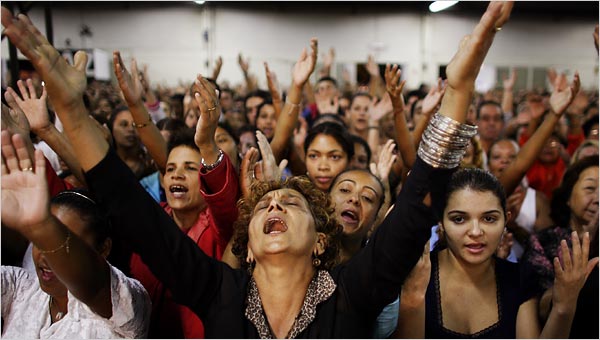
https://keithlannon.files.wordpress.com/2014/04/aaa1.jpg
"Young ecclesial communities are a gift from God and their contributions should be valued and welcomed with trust.…The ecclesial communities which bloomed after the Second Vatican Council, are a unique gift of the Lord and a precious resource for the life of the Church.…The movements and new communities are like an inrush of the Holy Spirit in the Church and in contemporary society. One of the positive elements and aspects of the communities of the Catholic Charismatic Renewal is precisely the importance given by them to the charisms and gifts of the Holy Spirit, and their merit lies in having reminded the Church of the actuality (of these gifts)."
Benedict XVI, on the occasion of the 13th international conference of the Catholic Fraternity of Covenant Charismatic Communities and Fellowships, October 2008).

Friday, March 27, 2015

Archives of the Order (4) - Chapter Generals of Fra. Jobert

http://shoebat.com/wp-content/uploads/2014/04/jerusalem.jpg
THE CHAPTER GENERAL OF 1176
THE PRIVILEGE OF THE SICK TO HAVE WHITE BREAD 
In the Name of the Father and of the Son and of the Holy Ghost. Amen.
  • Let all men know of those who are, and those in the future shall be sons of Holy Mother Church, that I Jobert, Master of the Hospital of Jerusalem, with the good will and unanimous consent of all our brethren assembled in our Common Chapter, before the presence and witness of the passion and resurrection of Our Lord, have given and granted in permanent possession to our blessed lords, that is to say to the poor of the hostels (Xenodocheum) of the Hospital of Jerusalem, and to Brother Steven the Hospitaller at the present time, and to their successors who shall come after them perpetually for all time, two casales, that is to say the casales of St. Mary and Caphaer, with all their possessions and appurtenances within and without, for the provision of white bread which should be given to them forever; and if by chance it should happen that the corn should fail in the casales or be insufficient to provide for the needs of the poor, enough should be taken from the Treasury to purchase white bread and to provide sufficient for the poor; and if should happen that the wheat from the casales should be mixed with evil herbs, good wheat should be taken measure for measure from the granary of the Hospital, and so sufficient should be provided for our lords the poor. And in order that this gift may be established and unaltered forever, we have caused this charter to be sealed with our seal; and if anyone from henceforward would go to contrary to this Holy Commandment, or would distort it, may he be damned with Judas the traitor in everlasting damnation, with Cain and Dathan and Abiron, whom the earth swallowed up, may he be cursed with the curse. Amen.
  • Each loaf should be the weight of two marks, and should be given to two poor persons.
  • This decree was made in the year of the Incarnation of Our Lord 1176. 

THE CHAPTER GENERAL OF 1177

THE CUSTOMS OF THE CHURCH OF THE HOSPITAL OF JERUSALEM

In the Name of the Father and of the Son and of the Holy Ghost. Amen.
These are the customs which should be observed in the House of the Hospital of Jerusalem.
  1. The first morning Mass should not be begun before it is day, nor should the Commander of any house order the priest to chant mass. And no priest should chant mass twice in a day, unless by chance the body of the dead person be there, and then in this manner, first should be chanted the mass for the day, if it be a Sunday or a day of Festival, and afterwards should be chanted that for the dead, if a body be present there. And everywhere where a deceased (brother) of the hospital shall be buried, the day of his death should be written in the calendar. And for thirty days masses should be chanted for his soul. And when the Trental shall be completed, the day the anniversary should always be celebrated for his soul, and when the church where the Trental shall be celebrated has three priests, one should celebrate the Trental, and the other two chant the masses for the day. And if two priests only be there where the Trental should be celebrated, the service should be shared between them, and the gratuity. And when there shall be there no more than one priest, they shall obtain another a stranger to celebrate the service of the Trental.
  2. And when it shall be celebrated, one besant and a new shirt and breeches, according to the custom of the House, should be given to him. And if it be impossible to find a stranger priest. and the priest of the house be without the company of another priest, the Trental should be celebrated in this manner, that is to say that every day he should chant for the dead except on Sundays and days of solemn festival; and then afterwards he should make the commemoration and remembrance for the brother that is departed. But when the thirty days shall be passed, and after the number of days on which commemoration should be made only for the soul of the brother shall be fulfilled by the Trental, and there should be given to the priest the charity aforesaid. And if by chance these things should happen in Lent in the houses where there shall be no more than one priest, let it be postponed until after Easter, and then let celebration be made for the soul of the brother without delay.
  3. And let the brethren always take care to have a light in the church, and let the chalice for administration be of silver, and the censor of silver.
  4. And it is commanded that the bodies of pilgrims or of other Christians, who shall die after the Hour of Vespers, should be left until the next day; and in the Hospital, where they shall have died, let them not lie upon their biers without a light. And the next day before Prime they should be carried to the church, and after Mass should be buried; the biers of the dead should be like those that are in Jerusalem.
  5. The bodies of the brethren should be watched in the church, and the clerics should be around them chanting their psalms, and the tapers should be lighted. Of the charity that is given to the priests for the Trental the house should retain nothing; but for the Trentals of strangers the brethren should retain the half.
  6. For the public and private masses the priests should have nothing for themselves, except so much as the brethren should wish to give them of their own free will.
  7. Of the payments from confessions the sixth part should be given to the priests and the clerics, not by contract but of grace; but in casales where there shall be no burgesses, and no one except one priest, the arrangements aforesaid shall be at the discretion of the Commander of the house, and the gratuity of the clerics he shall give as shall seem good to him.
  8. Of the wills and legacies, which shall be made to vicars up to one besant, the half should be given to them; but the legacies and wills, which shall be left to the Hospital , when they shall be paid over, the brethren should receive them without deduction.

Friday, February 21, 2014

Benedict XVI on the Chair of St. Peter

http://www.anglicanphiladelphia.org/stmichael/cathedrapetri.jpgDear Brothers and Sisters! The Latin liturgy celebrates today the feast of the Chair of Peter. It is a very ancient tradition, witnessed in Rome since the end of the fourth century, which renders thanksgiving to God for the mission entrusted to the Apostle Peter and his successors.

"Cathedra" literally means the established seat of the bishop, located in the mother church of a diocese, which for this reason is called "cathedral," and it is the symbol of the authority of the bishop and, in particular, of his "magisterium," that is, of the evangelical teaching that he, insofar as a successor of the apostles, is called to guard and transmit to the Christian community.

When the bishop takes possession of the local Church that is entrusted to him, he, bearing the miter and the shepherd's crosier, sits on the cathedra. From that seat he will guide, as teacher and shepherd, the journey of the faithful in faith, hope and charity.

Which was, then, the "cathedra" if St. Peter? He, chosen by Christ as "rock" on which to build the Church (cf. Matthew 16:18), began his ministry in Jerusalem, after the ascension of the Lord and Pentecost. The first "seat" of the Church was the Cenacle, and in all probability in that room, where Mary, the Mother of Jesus, also prayed with the disciples, a special place was reserved for Simon Peter.

Subsequently, the see of Peter was Antioch, a city situated on the Oronte River in Syria, today Turkey, which at the time was the third metropolis of the Roman Empire after Rome and Alexandria in Egypt. Of that city, evangelized by Barnabas and Paul, where "for the first time the disciples were called Christians" (Acts 11:26), Peter was the first Bishop.

In fact, the Roman Martyrology, before the reform of the calendar, established also a specific celebration of the Chair of Peter at Antioch. From there, Providence led Peter to Rome, where he concluded with martyrdom his course of service to the Gospel. For this reason, the See of Rome, which had received the greatest honor, received also the task entrusted by Christ to Peter of being at the service of all the local Churches for the building and unity of the whole People of God.

In this way the See of Rome came to be known as that of the Successor of Peter, and the "cathedra" of its Bishop represented that of the apostle charged by Christ to feed all his flock. It is attested by the most ancient Fathers of the Church, as for example St. Irenaeus, bishop of Lyon, who in his treatise "Against Heresies" describes the Church of Rome as "greatest and most ancient, known by all; … founded and constituted at Rome by the two glorious Apostles Peter and Paul"; and he adds: "With this Church, because of her outstanding superiority, the universal Church must be in agreement, that is, the faithful everywhere" (III, 3, 2-3).

Tertullian, for his part, affirms: "How blessed this Church of Rome is! The Apostles themselves shed on her, with their blood, the whole of the doctrine" ("La Prescrizione degli Eretici," 36). The Chair of the Bishop of Rome represents, therefore, not only his service to the Roman community, but also his mission of guide of the whole People of God.

To celebrate the "Chair" of Peter, as we do today, means, therefore, to attribute to it a strong spiritual significance and to recognize in it a privileged sign of the love of God, good and eternal Shepherd, who wants to gather the whole of his Church and guide her along the way of salvation.

Among so many testimonies of the Fathers, I would like to refer to that of St. Jerome, taken from a letter of his to the Bishop of Rome, particularly interesting because he makes explicit reference in fact to the "chair" of Peter, presenting it as the safe harbor of truth and peace. Jerome writes thus: "I decided to consult the chair of Peter, where that faith is found exalted by the lips of an Apostle; I now come to ask for nourishment for my soul there, where once you received the garment of Christ. I follow no leader save Christ, so I enter into communion with your beatitude, that is, with the chair of Peter for this I know is the rock upon which the Church is built! ("Le Lettere," I, 15,1-2).

Dear Brothers and Sisters, in the apse of St. Peter's Basilica, as you know, is found the monument to the Chair of the Apostle, a mature work of Bernini, made in the shape of a great bronze throne, supported by the statues of four Doctors of the Church, two from the West, St. Augustine and St. Ambrose, and two from the East, St. John Chrysostom and St. Athanasius.

I invite you to pause before that evocative work, which today it is possible to admire decorated with so many candles, and pray in a particular way for the ministry that God has entrusted to me. Raising one's gaze to the alabaster glass window that opens precisely above the chair, invoke the Holy Spirit, so that he will always sustain with his light and strength my daily service to the whole Church. 

Benedict XVI, General Audience, Rome, 22 February 2006.

Saturday, May 11, 2013

Benedict XVI on Liturgy (2)

http://www.catholicbible101.com/altar-at-vatican-ii1.gif
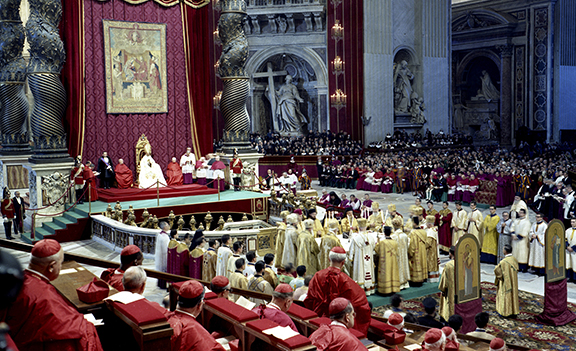
A session during the Second Vatican Council (1962-1965).
“Having focused for several weeks now on prayer as taught to us in the sacred Scriptures, we turn to another precious source of prayer, namely the liturgy. The word “liturgy” in Greek means “work done by the people and for the people”.  Here, this “people” is the new People of God, brought into being by Christ, a people which does not exist by itself and which is not bound by blood, territory or country, but is brought into being through the Paschal Mystery.

The liturgy is also the “work of God”. As the Second Vatican Council teaches, it is by means of the liturgy that Christ our Redeemer and High Priest continues the work of our redemption in, with, and through his Church. This is the great marvel of the liturgy: God acts, while we are caught up in his action.

The Council began its work by discussing the liturgy, and rightly so, for the liturgy reminds us of the primacy of God.  The fundamental criterion for it is its orientation towards the Father, whose saving love culminates in the death and resurrection of his Son. It is in the liturgy that we “lift up our hearts”, opening ourselves to the word of God as we gather with our brethren in a prayer which rises within us, and which is directed to the Father, through the Son, in the Spirit."

Benedict XVI, General Audience, 26 September 2012.