Showing posts with label liturgy. Show all posts

Thursday, April 13, 2023

Cardinal Ratzinger on true consciousness in liturgical matters


"For fostering a true consciousness in liturgical matters, it is also important that the proscription against the form of liturgy in valid use up to 1970 should be lifted. Anyone who nowadays advocates the continuing existence of this [older] liturgy or takes part in it is treated like a leper; all tolerance ends here. There has never been anything like this in history; in doing this we are despising and proscribing the Church’s whole past. How can one trust her at present if things are that way?"


Cardinal Joseph Ratzinger, God and the World, trans. Henry Taylor (San Francisco: Ignatius Press, 2002), p. 416.

Thursday, April 8, 2021

Eastern Christianity liturgy according to Saint John Paul II


In Venice, before the representatives of the ecclesiastical world, who held a rather narrow idea of the Church and were opposed to this vision, Saint Cyril defended it with courage. He showed that many peoples had already in the past introduced and now possessed a liturgy written and celebrated in their own language, such as " the Armenians, the Persians, the Abasgians, the Georgians, the Sogdians, the Goths, the Avars, the Tirsians, the Khazars, the Arabs, the Copts, the Syrians and many others".

Reminding them that God causes the sun to rise and the rain to fall on all people without exception, he said: "Do not all breathe the air in the same way? And you are not ashamed to decree only three languages (Hebrew, Greek and Latin), deciding that all other peoples and races should remain blind and deaf! Tell me: do you hold this because you consider God is so weak that he cannot grant it, or so envious that he does not wish it?". To the historical and logical arguments which they brought against him Cyril replied by referring to the inspired basis of Sacred Scripture: "Let every tongue confess that Jesus Christ is Lord, to the glory of God the Father"; "All the earth worships you; they sing praises to you, sing praises to your name"; "Praise the Lord, all nations! Extol him, all peoples!".

...

Furthermore, the translation of the sacred books, carried out by Cyril and Methodius together with their pupils, conferred a capacity and cultural dignity upon the Old Slavonic liturgical language, which became for many hundreds of years not only the ecclesiastical but also the official and literary language, and even the common language of the more educated classes of the greater part of the Slav nations, and in particular of all the Slavs of the Eastern Rite. It was also used in the Church of the Holy Cross in Cracow, where the Slav Benedictines had established themselves. Here were published the first liturgical books printed in this language. Up to the present day this is the language used in the Byzantine liturgy of the Slavonic Eastern Churches of the Rite of Constantinople, both Catholic and Orthodox, in Eastern and South Eastern Europe, as well as in various countries of Western Europe. It is also used in the Roman liturgy of the Catholics of Croatia.

22. In the historical development of the Slavs of Eastern Rite, this language played a role equal to that of the Latin language in the West. It also lasted longer than Latin in part until the nineteenth century-and exercised a much more direct influence on the formation of the local literary languages, thanks to its close kinship with them. These merits vis-à-vis the culture of all the Slav peoples and nations make the work of evangelization carried out by Saints Cyril and Methodius in a certain sense constantly present in the history and in the life of these peoples and nations.

John Paul II, Encyclical Slavorum Apostoli about two saintly brothers, Saints Cyril and Methodius (2 June 1985).


Tuesday, December 10, 2019

Benedict XVI on the Holy Family of Nazareth

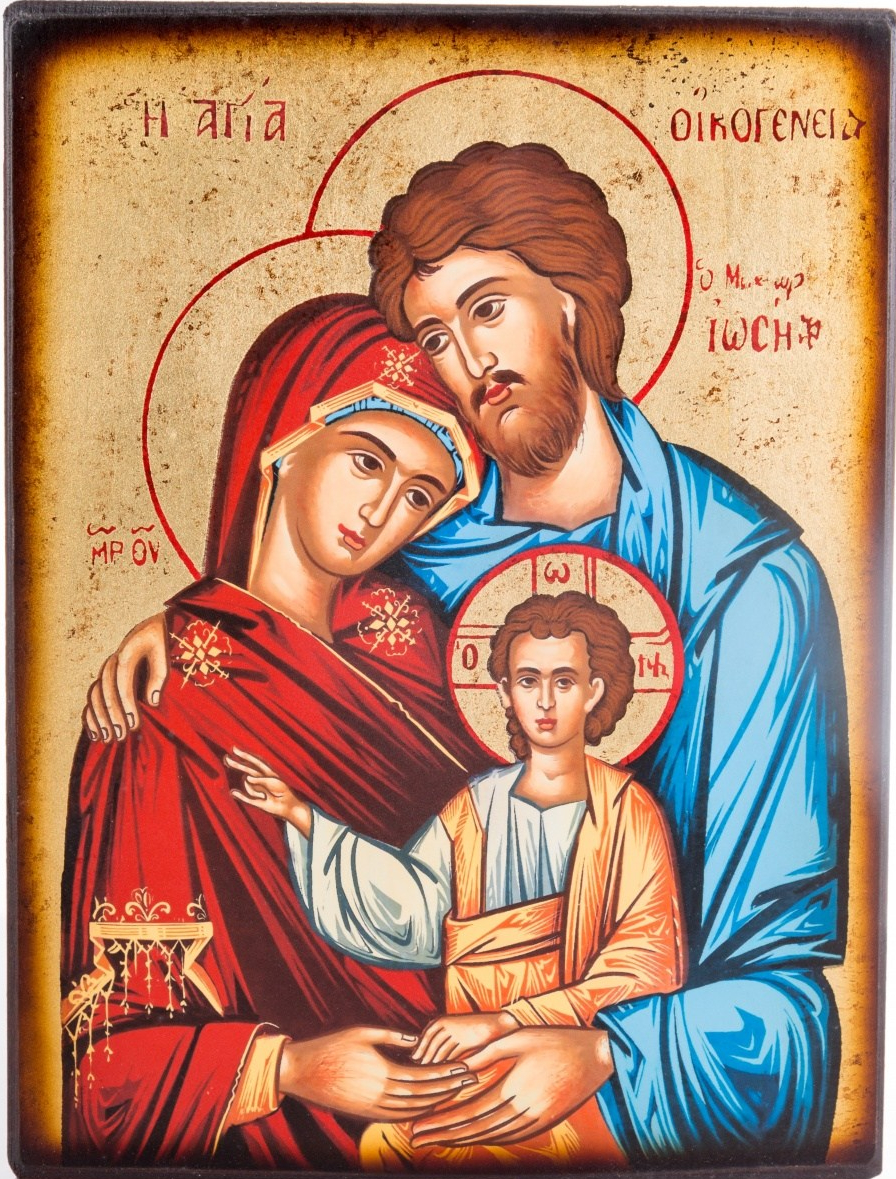
Image result for holy family


"Today’s meeting is taking place in the atmosphere of Christmas, imbued with deep joy at the Birth of the Saviour. We have just celebrated this Mystery whose echo ripples through the Liturgy of all these days. It is a Mystery of Light that all people in every era can relive with faith and prayer. It is through prayer itself that we become capable of drawing close to God with intimacy and depth.
 
Therefore, bearing in mind the theme of prayer that I am developing in the Catecheses in this period, I would therefore like to invite you to reflect today on the way that prayer was part of the life of the Holy Family of Nazareth. Indeed, the house of Nazareth is a school of prayer where one learns to listen, meditate on and penetrate the profound meaning of the manifestation of the Son of God, following the example of Mary, Joseph and Jesus.
 
The Discourse of the Servant of God Paul VI during his Visit to Nazareth is memorable. The Pope said that at the school of the Holy Family we “understand why we must maintain a spiritual discipline, if we wish to follow the teaching of the Gospel and become disciples of Christ”. He added: “In the first place it teaches us silence. Oh! If only esteem for silence, a wonderful and indispensable spiritual atmosphere, could be reborn within us! Whereas we are deafened by the din, the noise and discordant voices in the frenetic, turbulent life of our time. O silence of Nazareth! Teach us to be steadfast in good thoughts, attentive to our inner life, ready to hear God’s hidden inspiration clearly and the exhortations of true teachers” (Discourse in Nazareth, 5 January 1964).
 
We can draw various ideas for prayer and for the relationship with God and with the Holy Family from the Gospel narratives of the infancy of Jesus. We can begin with the episode of the Presentation of Jesus in the Temple. St Luke tells how “when the time came for their purification according to the law of Moses”, Mary and Joseph “brought him up to Jerusalem to present him to the Lord” (2:22). Like every Jewish family that observed the law, Jesus’ parents went to the Temple to consecrate their first-born son to God and to make the sacrificial offering. Motivated by their fidelity to the precepts of the Law, they set out from Bethlehem and went to Jerusalem with Jesus who was only 40 days old. Instead of a year-old lamb they presented the offering of simple families, namely, two turtle doves. The Holy Family’s pilgrimage was one of faith, of the offering of gifts — a symbol of prayer — and of the encounter with the Lord whom Mary and Joseph already perceived in their Son Jesus.
 
Mary was a peerless model of contemplation of Christ. The face of the Son belonged to her in a special way because he had been knit together in her womb and had taken a human likeness from her. No one has contemplated Jesus as diligently as Mary. The gaze of her heart was already focused on him at the moment of the Annunciation, when she conceived him through the action of the Holy Spirit; in the following months she gradually became aware of his presence, until, on the day of his birth, her eyes could look with motherly tenderness upon the face of her son as she wrapped him in swaddling clothes and laid him in the manger.
 
Memories of Jesus, imprinted on her mind and on her heart, marked every instant of Mary’s existence. She lived with her eyes fixed on Christ and cherished his every word. St Luke says: “Mary kept all these things, pondering them in her heart” (2:19) and thus describes Mary’s approach to the Mystery of the Incarnation which was to extend throughout her life: keeping these things, pondering on them in her heart. Luke is the Evangelist who acquaints us with Mary’s heart, with her faith (cf. 1:45), her hope and her obedience (cf. 1:38) and, especially, with her interiority and prayer (cf. 1:46-56), her free adherence to Christ (cf. 1:55).
 
And all this proceeded from the gift of the Holy Spirit who overshadowed her (cf. 1:35), as he was to come down on the Apostles in accordance with Christ’s promise (cf. Acts 1:8). This image of Mary which St Luke gives us presents Our Lady as a model for every believer who cherishes and compares Jesus’ words with his actions, a comparison which is always progress in the knowledge of Jesus. After Bl. Pope John Paul II’s example (cf. Apostolic Letter Rosarium Virginis Mariae) we can say that the prayer of the Rosary is modelled precisely on Mary, because it consists in contemplating the mysteries of Christ in spiritual union with the Mother of the Lord.
 
Mary’s ability to live by God’s gaze, is so to speak, contagious. The first to experience this was St Joseph. His humble and sincere love for his betrothed and his decision to join his life to Mary’s attracted and introduced him, “a just man”, (Mt 1:19), to a special intimacy with God. Indeed, with Mary and later, especially, with Jesus, he began a new way of relating to God, accepting him in his life, entering his project of salvation and doing his will. After trustfully complying with the Angel’s instructions “Do not fear to take Mary your wife” (Mt 1:20) — he took Mary to him and shared his life with her; he truly gave the whole of himself to Mary and to Jesus and this led him to perfect his response to the vocation he had received.
 
As we know, the Gospel has not recorded any of Joseph’s words: his is a silent and faithful, patient and hard-working presence. We may imagine that he too, like his wife and in close harmony with her, lived the years of Jesus’ childhood and adolescence savouring, as it were, his presence in their family.
 
Joseph fulfilled every aspect of his paternal role. He must certainly have taught Jesus to pray, together with Mary. In particular Joseph himself must have taken Jesus to the Synagogue for the rites of the Sabbath, as well as to Jerusalem for the great feasts of the people of Israel. Joseph, in accordance with the Jewish tradition, would have led the prayers at home both every day — in the morning, in the evening, at meals — and on the principal religious feasts. In the rhythm of the days he spent at Nazareth, in the simple home and in Joseph’s workshop, Jesus learned to alternate prayer and work, as well as to offer God his labour in earning the bread the family needed.
 
And lastly, there is another episode that sees the Holy Family of Nazareth gathered together in an event of prayer. When Jesus was 12 years old, as we have heard, he went with his parents to the Temple of Jerusalem. This episode fits into the context of pilgrimage, as St Luke stresses: “His parents went to Jerusalem every year at the feast of the Passover. And when he was twelve years old, they went up according to custom” (2:41-42).
 
Pilgrimage is an expression of religious devotion that is nourished by and at the same time nourishes prayer. Here, it is the Passover pilgrimage, and the Evangelist points out to us that the family of Jesus made this pilgrimage every year in order to take part in the rites in the Holy City. Jewish families, like Christian families, pray in the intimacy of the home but they also pray together with the community, recognizing that they belong to the People of God, journeying on; and the pilgrimage expresses exactly this state of the People of God on the move. Easter is the centre and culmination of all this and involves both the family dimension and that of liturgical and public worship.
 
In the episode of the 12-year-old Jesus, the first words of Jesus are also recorded: “How is it that you sought me? Did you not know that I must be in my Father’s house?” (2:49). After three days spent looking for him his parents found him in the temple, sitting among the teachers, listening to them and asking them questions (cf. 2:46). His answer to the question of why he had done this to his father and mother was that he had only done what the Son should do, that is, to be with his Father.
 
Thus he showed who is the true Father, what is the true home, and that he had done nothing unusual or disobedient. He had stayed where the Son ought to be, that is, with the Father, and he stressed who his Father was.
 
The term “Father” therefore dominates the tone of this answer and the Christological mystery appears in its entirety. Hence, this word unlocks the mystery, it is the key to the Mystery of Christ, who is the Son, and also the key to our mystery as Christians who are sons and daughters in the Son. At the same time Jesus teaches us to be children by being with the Father in prayer. The Christological mystery, the mystery of Christian existence, is closely linked to, founded on, prayer. Jesus was one day to teach his disciples to pray, telling them: when you pray say “Father”. And, naturally, do not just say the word say it with your life, learn to say it meaningfully with your life. “Father”; and in this way you will be true sons in the Son, true Christians.
 
It is important at this point, when Jesus was still fully integrated in the life of the Family of Nazareth, to note the resonance that hearing this word “Father” on Jesus’ lips must have had in the hearts of Mary and Joseph. It is also important to reveal, to emphasize, who the Father is, and, with his awareness, to hear this word on the lips of the Only-Begotten Son who, for this very reason, chose to stay on for three days in the Temple, which is the “Father’s house”.
 
We may imagine that from this time the life of the Holy Family must have been even fuller of prayer since from the heart of Jesus the boy — then an adolescent and a young man — this deep meaning of the relationship with God the Father would not cease to spread and to be echoed in the hearts of Mary and Joseph.
 
This episode shows us the real situation, the atmosphere of being with the Father. So it was that the Family of Nazareth became the first model of the Church in which, around the presence of Jesus and through his mediation, everyone experiences the filial relationship with God the Father which also transforms interpersonal, human relationships.
 
Dear friends, because of these different aspects that I have outlined briefly in the light of the Gospel, the Holy Family is the icon of the domestic Church, called to pray together. The family is the domestic Church and must be the first school of prayer. It is in the family that children, from the tenderest age, can learn to perceive the meaning of God, also thanks to the teaching and example of their parents: to live in an atmosphere marked by God’s presence. An authentically Christian education cannot dispense with the experience of prayer. If one does not learn how to pray in the family it will later be difficult to bridge this gap. And so I would like to address to you the invitation to pray together as a family at the school of the Holy Family of Nazareth and thereby really to become of one heart and soul, a true family. Many thanks."
 
Benedict XVI, General Audience (Paul VI Audience Hall), 28 December 2011


Thursday, May 3, 2018

Ratzinger on Kneeling

benedict_kneeling.jpg


It may well be that kneeling is alien to modern culture—insofar as it is a culture,
for this culture has turned away from the faith and no longer knows the One
before whom kneeling is the right, indeed the intrinsically necessary gesture.
The man who learns to believe learns also to kneel, and a faith or a liturgy no
longer familiar with kneeling would be sick at the core. Where it has been lost,
kneeling must be rediscovered, so that, in our prayer, we remain in fellowship
with the apostles and martyrs, in fellowship with the whole cosmos, indeed in
union with Jesus Christ Himself.

Joseph, Cardinal Ratzinger, The Spirit of the Liturgy (San Francisco: Ignatius Press, 2000), p. 194.

Wednesday, July 20, 2016

Cardinal Ratzinger on ad orientem


“To the ordinary churchgoer, the two most obvious effects of the liturgical reform of the Second Vatican Council seem to be the disappearance of Latin and the turning of the altars towards the people. Those who read the relevant texts will be astonished to learn that neither is in fact found in the decrees of the Council. The use of the vernacular is certainly permitted, especially for the Liturgy of the Word, but the preceding general rule of the Council text says, ‘Particular law remaining in force, the use of the Latin language is to be preserved in the Latin rites’ (Sacrosanctum Concilium, 36.1). There is nothing in the Council text about turning altars towards the people; that point is raised only in postconciliar instructions.”

Uwe Michael Lang, “Turning towards the Lord: Orientation in Liturgical Prayer,” Foreword by Joseph Ratzinger, Ignatius Press, San Francisco, 2004.

Sunday, February 7, 2016

Cardinal Ratzinger on Liturgy - 3


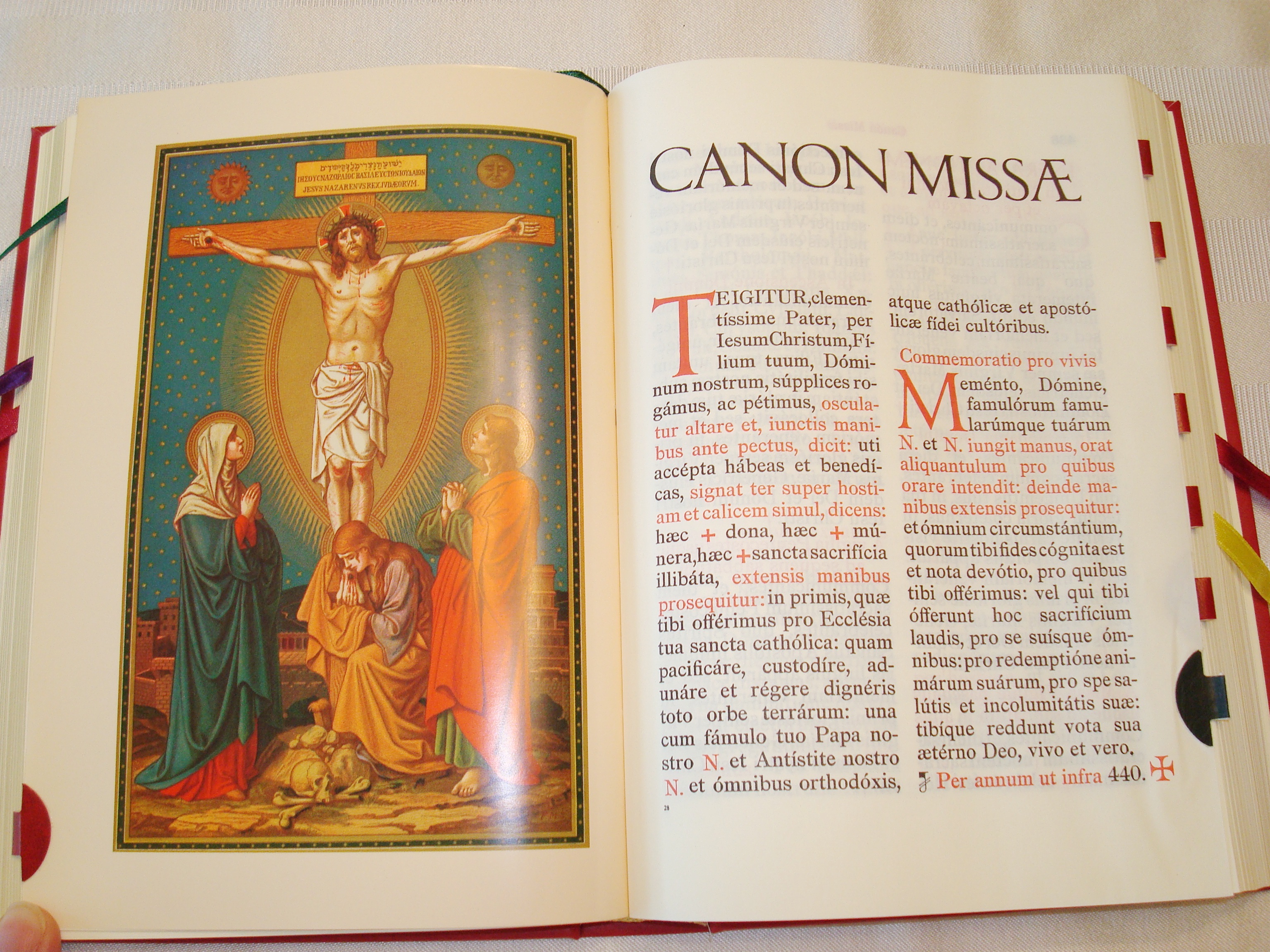
http://www.wdtprs.com/images/BLOG/07_09_01_MR62_7_100.jpg
Missale Romanum
"I was dumbfounded upon hearing about the interdiction of the old Missal, since such a move had never been seen in the entire history of Catholic liturgy. The impression was given that this was all quite normal. The previous Missal had been realized by Pope St. Pius V, in 1570, immediately following the Council of Trent (1545-1563); it was therefore considered normal that, after 400 years and a new Council, a new Pope should therefore also publish a new Missal. However, the historical truth is another matter altogether. Pius V had limited himself to republishing the Roman Missal then in use just as it had always been down through the centuries of history. Also, many of his successors, following his example, had also had the Missal republished, without ever opposing one Missal to another. It has always been a continuing process of historical growth and purification in which, however, essential continuity had never been destroyed. There does not exist, nor has there ever existed, a Missal completely made up by Pius V. There was only a new elaboration ordered by him, constituting merely a phase in a long process of historical growth.
Following the Council of Trent, the new reality was of a quite different nature: the eruption of the Protestant "reform" had occurred especially under the form of liturgical "reforms"...; so much so, in fact, that the limits between that which was still Catholic and that which was no longer so, were often difficult to define. In such a confused state of affairs, resulting from a lack of uniform liturgical norms, together with a liturgical plurality inherited from the Middle Ages, the Pope decided that the Missale Romanum, that is, the liturgical text then in use in Rome, was to be introduced everywhere that there existed a liturgy dating back to less than 200 years previously. The reason for this was that the timeless Roman liturgy was most assuredly Catholic in every sense of the term. Wherever it could be done, the preceding liturgy (i.e., that dating back 200 years or more) was allowed to be maintained since its truly Catholic character could be considered to be absolutely certain."  - Joseph Cardinal Ratzinger, La mia vita, pp. 111, 112.

Thursday, December 24, 2015

Benedict XVI on Christmas


"God becomes so close that it is possible to see and touch him. The Church contemplates this ineffable mystery and the liturgical texts of this Season are steeped in wonder and joy; all Christmas carols express this joy. Christmas is the point at which Heaven and earth converge."


Pope Benedict XVI, 4 January 2012, General Audience in Rome.

Wednesday, July 29, 2015

Cardinal Ratzinger on Liturgy - 2

https://c2.staticflickr.com/6/5286/5264390963_d00b8d71ed.jpg
“For fostering a true consciousness in liturgical matters, it is also important that the proscription against the form of liturgy in valid use up to 1970 should be lifted. Anyone who nowadays advocates the continuing existence of this liturgy or takes part in it is treated like a leper; all tolerance ends here. There has never been anything like this in history; in doing this we are despising and proscribing the Church’s whole past. How can one trust her present if things are that way? I must say, quite openly, that I don’t understand why so any of my episcopal brethren have to a great extent submitted to this rule of intolerance, which for no apparent reason is opposed to making the necessary inner reconciliations within the Church.”

God and the World: A Conversation with Peter Seewald, San Francisco: Ignatius Press, 2002, p. 416.

Tuesday, July 7, 2015

Ratzinger on Silence in Liturgy


"We are realizing more and more clearly that silence is part of the liturgy. We respond, by singing and praying, to the God who addresses us, but the greater mystery, surpassing all words, summons us to silence. It must, of course, be a silence with content, not just the absence of speech and action. We should expect the liturgy to give us a positive stillness that will restore us. Such stillness will not be just a pause, in which a thousand thoughts and desires assault us, but a time of recollection, giving us an inward peace, allowing us to draw breath and rediscover the one thing necessary, which we have forgotten. That is why silence cannot be simply “made”, organized as if it were one activity among many. It is no accident that on all sides people are seeking techniques of meditation, a spirituality for emptying the mind. One of man’s deepest needs is making its presence felt, a need that is manifestly not being met in our present form of the liturgy. For silence to be fruitful, as we have already said, it must not be just a pause in the action of the liturgy. No, it must be an integral part of the liturgical event." 

Josef Ratzinger, The Spirit of the Liturgy, (SF, CA: Ignatius, 2000), p. 209.

Tuesday, May 12, 2015

Ratzinger on Spontaneity and Creativity in Liturgy


http://blogs.telegraph.co.uk/news/files/2010/09/pope8_1717754c.jpgThe great­ness of the liturgy depends — we shall have to repeat this frequently — on its unspontaneity (Unbeliebigkeit) …. Only respect for the liturgy’s fundamental unspontaneity and pre-existing identity can give us what we hope for: the feast in which the great reality comes to us that we ourselves do not manufacture but receive as a gift. This means that “creativity” cannot be an authentic category for matters liturgical. In any case, this is a word that developed within the Marxist world view. Creativity means that in a universe that in itself is meaningless and came into existence through blind evolution, man can creatively fashion a new and better world.

Modern theo­ries of art think in terms of a nihilistic kind of creativity. Art is not meant to copy anything. Artistic creativity is under the free mastery of man, without being bound by norms or goals and subject to no questions of meaning. It may be that in such visions a cry for freedom is to be heard, a cry that in a world totally in the control of technology becomes a cry for help. Seen in this way, art appears as the final refuge of freedom. True, art has something to do with freedom, but freedom understood in the way we have been describing is empty. It is not redemptive, but makes despair sound like the last word of human existence. This kind of creativity has no place within the liturgy. The life of the liturgy does not come from what dawns upon the minds of individuals and plan­ning groups. On the contrary, it is God’s descent upon our world, the source of real liberation. He alone can open the door to freedom. The more priests and faithful humbly surrender themselves to this descent of God, the more “new” the liturgy will constantly be, and the more true and personal it becomes. Yes, the liturgy becomes personal, true, and new, not through tomfoolery and ba­nal experiments with the words, but through a coura­geous entry into the great reality that through the rite is always ahead of us and can never quite be overtaken.  

Cardinal Ratzinger, The Spirit of the Liturgy, (SF, CA: Ignatius, 2000), p. 170

Monday, February 23, 2015

Ratzinger on Liturgical Dancing

Liturgical dance - Maitland, New Castle 01
Liturgical dancing group for girls, at Sacred Heart Cathedral, New Castle, Australia (May 2014).
Dancing is not a form of expression for the Christian liturgy. In about the third century, there was an attempt in certain Gnostic-Docetic circles to introduce it into the liturgy. For these people, the Crucifixion was only an ap­pearance. Before the Passion, Christ had abandoned the body that in any case he had never really assumed. Danc­ing could take the place of the liturgy of the Cross, be­cause, after all, the Cross was only an appearance. The cultic dances of the different religions have different pur­poses—incantation, imitative magic, mystical ecstasy— none of which is compatible with the essential purpose of the liturgy of the “reasonable sacrifice”. It is totally absurd to try to make the liturgy “attractive” by introducing dancing pantomimes (wherever possible performed by professional dance troupes), which frequently (and rightly, from the professionals’ point of view) end with applause. 

Wherever applause breaks out in the liturgy because of some human achievement, it is a sure sign that the essence of liturgy has totally disappeared and been replaced by a kind of religious entertainment. Such attrac­tiveness fades quickly—it cannot compete in the market of leisure pursuits, incorporating as it increasingly does various forms of religious titillation. I myself have expe­rienced the replacing of the penitential rite by a dance performance, which, needless to say, received a round of applause. Could there be anything farther removed from true penitence? Liturgy can only attract people when it looks, not at itself, but at God, when it allows him to enter and act. Then something truly unique happens, beyond competition, and people have a sense that more has taken place than a recreational activity. None of the Christian rites includes dancing.  [The Spirit of the Liturgy, (SF, CA: Ignatius, 2000), p. 198]

Monday, September 22, 2014

Ratzinger on Michael Davies

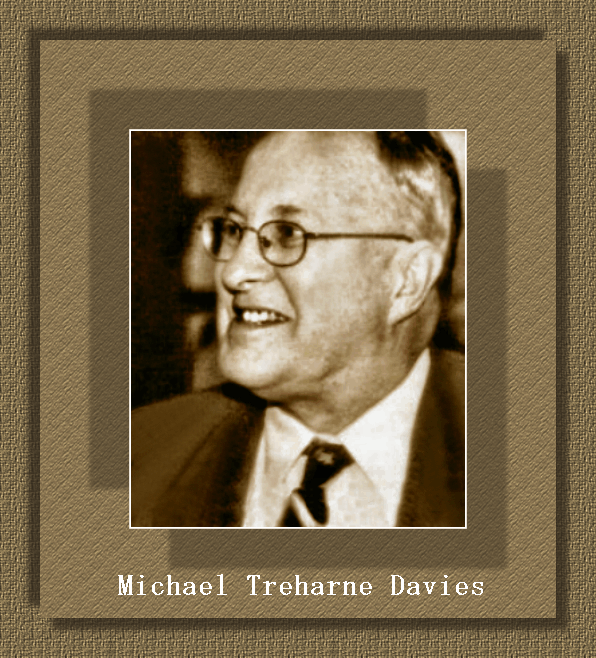
http://www.catholictradition.org/Tradition/davies.gif
Michael Davies, 2nd FIUV President
“I have been profoundly touched by the news of the death of Michael Davies. I had the good fortune to meet him several times and I found him as a man of deep faith and ready to embrace suffering. Ever since the Council he put all his energy into the service of the Faith and left us important publications especially about the Sacred Liturgy

Even though he suffered from the Church in many ways in his time, he always truly remained a man of the Church. He knew that the Lord founded His Church on the rock of St Peter and that the Faith can find its fullness and maturity only in union with the successor of St Peter. Therefore we can be confident that the Lord opened wide for him the gates of heaven. We commend his soul to the Lord’s mercy.”

Joseph Cardinal Ratzinger
9 November 2004

Friday, April 25, 2014

Cardinal Ratzinger on the Novus Ordo Missae

https://blogger.googleusercontent.com/img/b/R29vZ2xl/AVvXsEjhdVGapAM0zHRqqsaMiKSvHSj0dGqlrZ5Z0wQCU5Dih5ewQg9Z-bTDrRASvsseuj9T8gRf7ndk-OilN-g1HM5mWseOlHjaAXy7Kyqe9agtgN7fEXXryLgYKFfC5Gr0r8hmOtilU3ZUzejp/s1600/Wigratzbad199003a.jpg
Ratzinger celebrating the Tridentine Mass in Wigratzbad, Germany in 1990.
The liturgical reform, in its concrete realization, has distanced itself even more from its origin. The result has not been a reanimation, but devastation. In place of the liturgy, fruit of a continual development, they have placed a fabricated liturgy. They have deserted a vital process of growth and becoming in order to substitute a fabrication.They did not want to continue the development, the organic maturing of something living through the centuries, and they replaced it, in the manner of technical production, by a fabrication, a banal product of the moment.

(Revue Theologisches, Vol. 20, Feb. 1990, pp. 103-104)

Wednesday, March 12, 2014

Benedict XVI on St. Gregory the Great

https://blogger.googleusercontent.com/img/b/R29vZ2xl/AVvXsEhICQCb3rmacNxIRz-WxuT-Dk3lKLoYhveN3EEF5x2PUNbM-VsVTZr1YfjqzZJcXAYWu4rC8YTdGevDBR2f5gWyoLnEWYryp23JsOaxgF41XlwA9qXaWN-5ypEp-jbIy02kehdMDEsqxsM/s1600/gregory2+%2528small%2529.jpg
Pope Saint Gregory the Great
His exceptional, I would say, almost unique figure is an example to hold up both to pastors of the Church and to public administrators: indeed, he was first Prefect and then Bishop of Rome. As an imperial official, he was so distinguished for his administrative talents and moral integrity that he served in the highest civil office, Praefectus Urbis, when he was only 30 years old. 

Within him, however, the vocation to the monastic life was maturing; he embraced it in 574, upon his father's death. The Benedictine Rule then became the backbone of his existence. Even when the Pope sent him as his Representative to the Emperor of the East in Constantinople, he maintained a simple and poor monastic lifestyle.

Called back to Rome, Gregory, although living in a monastery, was a close collaborator of Pope Pelagius II, and when the Pope died, the victim of a plague epidemic, Gregory was acclaimed by all as his Successor.

He sought in every way to escape this appointment but in the end was obliged to yield. He left the cloister reluctantly and dedicated himself to the community, aware of doing his duty and being a simple and poor "servant of the servants of God".

"He is not really humble," he wrote, "who understands that he must be a leader of others by decree of the divine will and yet disdains this pre-eminence. If, on the contrary, he submits to divine dispositions, and does not have the vice of obstinacy, and is prepared to benefit others with those gifts when the highest dignity of governing souls is imposed on him, he must flee from it with his heart, but against his will, he must obey" ( Pastoral Rule, I, 6). It is like a dialogue that the Pope has with himself at that time.

With prophetic foresight, Gregory intuited that a new civilization was being born from the encounter of the Roman legacy with so-called "barbarian" peoples, thanks to the cohesive power and moral elevation of Christianity. Monasticism was proving to be a treasure not only for the Church but for the whole of society.

With delicate health but strong moral character St Gregory the Great carried out intense pastoral and civil action. He left a vast collection of letters, wonderful homilies, a famous commentary on the Book of Job and writings on the life of St Benedict, as well as numerous liturgical texts, famous for the reform of song that was called "Gregorian", after him.

However, his most famous work is certainly the Pastoral Rule, which had the same importance for the clergy as the Rule of St Benedict had for monks in the Middle Ages.

The life of a pastor of souls must be a balanced synthesis of contemplation and action, inspired by the love "that rises wonderfully to high things when it is compassionately drawn to the low things of neighbours; and the more kindly it descends to the weak things of this world, the more vigorously it recurs to the things on high" (II, 5).

In this ever timely teaching, the Fathers of the Second Vatican Council found inspiration to outline the image of today's Pastor.

Let us pray to the Virgin Mary that the example and teaching of St Gregory the Great may be followed by pastors of the Church and also by those in charge of civil institutions. 

Benedict XVI, Angelus, Castel Gandolfo, 3 September 2006.

Wednesday, August 7, 2013

Benedict XVI on Gregorian chant

Certainly as far as the liturgy is concerned, we cannot say that one song is as good as another. Generic improvisation or the introduction of musical genres which fail to respect the meaning of the liturgy should be avoided. … [W]hile respecting various styles and various sufficiently laudable traditions, we desire, as was requested by the Synod Fathers, that Gregorian chant be suitably esteemed and employed as the chant proper to the Roman liturgy. … Speaking more generally, I ask that future priests, from their time in the seminary, receive the preparation needed to understand and to celebrate Mass in Latin, and also to use Latin texts and execute Gregorian chant; nor should we forget that the faithful can be taught to recite the more common prayers in Latin, and also to sing parts of the liturgy to Gregorian chant. (Sacramentum Caritatis 42; 62)

Saturday, May 11, 2013

Benedict XVI on Liturgy (2)

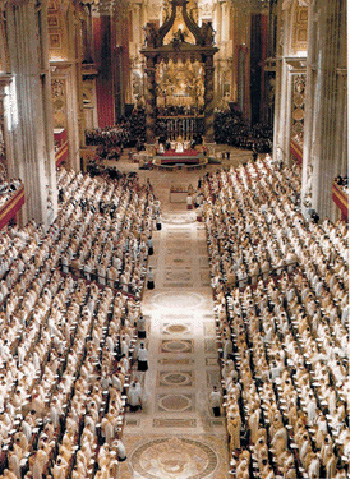
http://www.catholicbible101.com/altar-at-vatican-ii1.gif
A session during the Second Vatican Council (1962-1965).
“Having focused for several weeks now on prayer as taught to us in the sacred Scriptures, we turn to another precious source of prayer, namely the liturgy. The word “liturgy” in Greek means “work done by the people and for the people”.  Here, this “people” is the new People of God, brought into being by Christ, a people which does not exist by itself and which is not bound by blood, territory or country, but is brought into being through the Paschal Mystery.

The liturgy is also the “work of God”. As the Second Vatican Council teaches, it is by means of the liturgy that Christ our Redeemer and High Priest continues the work of our redemption in, with, and through his Church. This is the great marvel of the liturgy: God acts, while we are caught up in his action.

The Council began its work by discussing the liturgy, and rightly so, for the liturgy reminds us of the primacy of God.  The fundamental criterion for it is its orientation towards the Father, whose saving love culminates in the death and resurrection of his Son. It is in the liturgy that we “lift up our hearts”, opening ourselves to the word of God as we gather with our brethren in a prayer which rises within us, and which is directed to the Father, through the Son, in the Spirit."

Benedict XVI, General Audience, 26 September 2012.

Saturday, February 23, 2013

Benedict XVI on Liturgy (1)


https://blogger.googleusercontent.com/img/b/R29vZ2xl/AVvXsEgRszZtIfemdTYAlURzzhbXbXrHZjotbTlXhJxF4dPX6SGqtX1eucWip2qSbs-ZxfGw9hOTYrjlHgB9u11X2QlY1EJCiDuVmpz6smE9JHvNPmQMr5M7jiYYgAxWzmwhmzdKNECKv1B4zac/s1600/cw.jpg
The Church stands and falls with the Liturgy. When the adoration of the divine Trinity declines, when the faith no longer appears in its fullness in the Liturgy of the Church, when man’s words, his thoughts, his intentions are suffocating him, then faith will have lost the place where it is expressed and where it dwells. For that reason, the true celebration of the Sacred Liturgy is the center of any renewal of the Church whatsoever.

Wednesday, February 20, 2013

Cardinal Ratzinger on Liturgy - 1

In an interview with Raymond Arroyo (EWTN) in 2003, Joseph Cardinal Ratzinger argued that:

  • the liturgy post-Vatican II was not implemented correctly;
  • there were cases where priests 'invented' things during Mass and became self-centred;
  • ad orientem could in some cases help people to understand better Mass;
  • Mass in the vernacular was positive but the main prayers should remain in Latin so that Catholics around the world felt that they belong to the same Church;
  • the Tridentine Mass was never abrogated and faithful should have better access to it, in obedience with their Bishops.


Monday, February 18, 2013

Vatican Council II according to Benedict XVI

 Concluding remarks from the address to the priests of Rome (14 February 2013):

vatican Council ii... there was the Council of the Fathers - the true Council - but there was also the Council of the media. It was almost a Council in and of itself, and the world perceived the Council through them, through the media. So the immediately efficiently Council that got thorough to the people, was that of the media, not that of the Fathers. And while the Council of the Fathers evolved within the faith, it was a Council of the faith that sought the intellectus, that sought to understand and try to understand the signs of God at that moment, that tried to meet the challenge of God in this time to find the words for today and tomorrow.

So while the whole council - as I said - moved within the faith, as fides quaerens intellectum, the Council of journalists did not, naturally, take place within the world of faith but within the categories of the media of today, that is outside of the faith, with different hermeneutics. It was a hermeneutic of politics. The media saw the Council as a political struggle, a struggle for power between different currents within the Church. It was obvious that the media would take the side of whatever faction best suited their world. There were those who sought a decentralization of the Church, power for the bishops and then, through the Word for the "people of God", the power of the people, the laity. There was this triple issue: the power of the Pope, then transferred to the power of the bishops and then the power of all ... popular sovereignty. Naturally they saw this as the part to be approved, to promulgate, to help. This was the case for the liturgy: there was no interest in the liturgy as an act of faith, but as a something to be made understandable, similar to a community activity, something profane.

 And we know that there was a trend, which was also historically based, that said: "Sacredness is a pagan thing, possibly even from the Old Testament. In the New Testament the only important thing is that Christ died outside: that is, outside the gates, that is, in the secular world". Sacredness ended up as profanity even in worship: worship is not worship but an act that brings people together, communal participation and thus participation as activity. And these translations, trivializing the idea of the Council, were virulent in the practice of implementing the liturgical reform, born in a vision of the Council outside of its own key vision of faith. And it was so, also in the matter of Scripture: Scripture is a book, historical, to treat historically and nothing else, and so on.

And we know that this Council of the media was accessible to all. So, dominant, more efficient, this Council created many calamities, so many problems, so much misery, in reality: seminaries closed, convents closed liturgy trivialized ... and the true Council has struggled to materialize, to be realized: the virtual Council was stronger than the real Council. But the real strength of the Council was present and slowly it has emerged and is becoming the real power which is also true reform, true renewal of the Church. It seems to me that 50 years after the Council, we see how this Virtual Council is breaking down, getting lost and the true Council is emerging with all its spiritual strength. And it is our task, in this Year of Faith, starting from this Year of Faith, to work so that the true Council with the power of the Holy Spirit is realized and Church is really renewed. We hope that the Lord will help us. I, retired in prayer, will always be with you, and together we will move ahead with the Lord in certainty. The Lord is victorious. Thank you.