"Today’s meeting is taking place in the atmosphere of Christmas, imbued with deep joy at the Birth of the Saviour. We have just celebrated this Mystery whose echo ripples through the Liturgy of all these days. It is a Mystery of Light that all people in every era can relive with faith and prayer. It is through prayer itself that we become capable of drawing close to God with intimacy and depth.
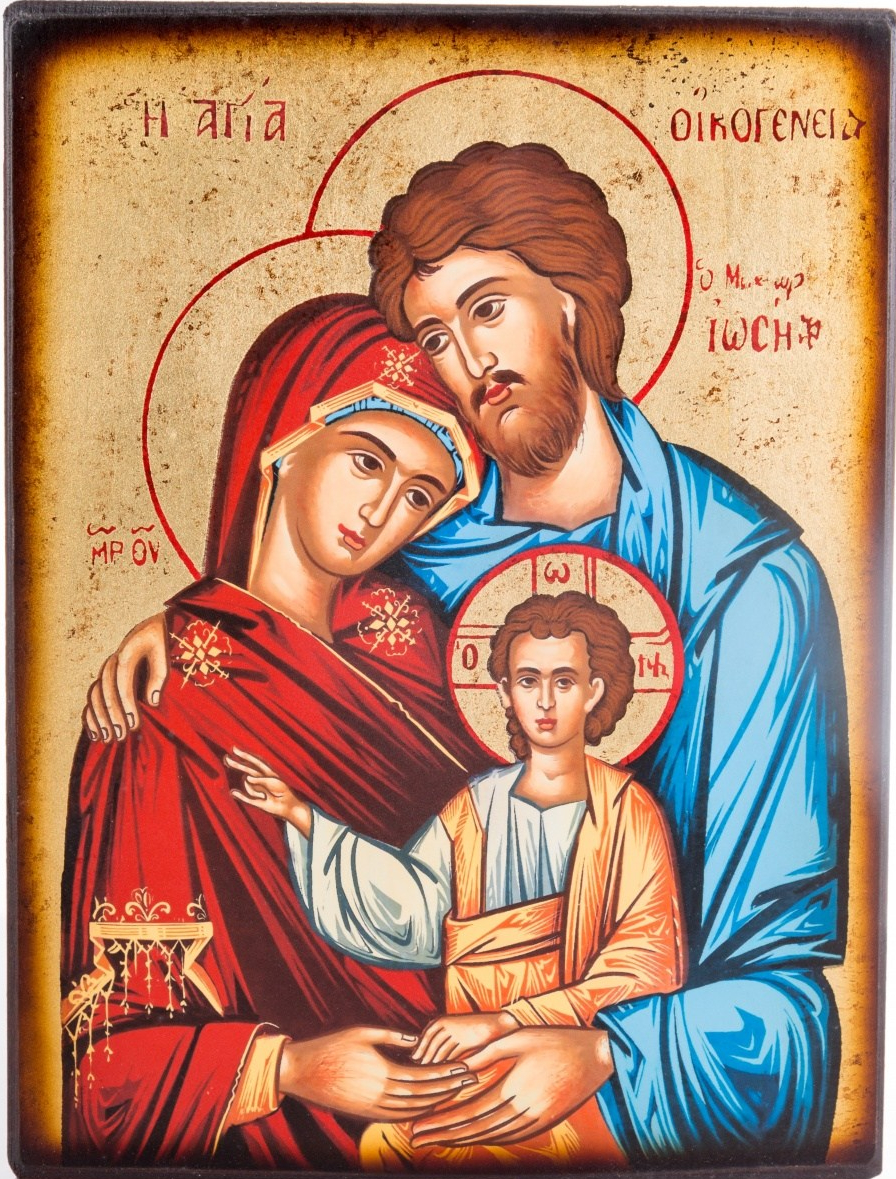
Therefore, bearing in mind the theme of prayer that I am developing in the Catecheses in this period, I would therefore like to invite you to reflect today on the way that prayer was part of the life of the Holy Family of Nazareth. Indeed, the house of Nazareth is a school of prayer where one learns to listen, meditate on and penetrate the profound meaning of the manifestation of the Son of God, following the example of Mary, Joseph and Jesus.
The Discourse of the Servant of God Paul VI during his Visit to Nazareth is memorable. The Pope said that at the school of the Holy Family we “understand why we must maintain a spiritual discipline, if we wish to follow the teaching of the Gospel and become disciples of Christ”. He added: “In the first place it teaches us silence. Oh! If only esteem for silence, a wonderful and indispensable spiritual atmosphere, could be reborn within us! Whereas we are deafened by the din, the noise and discordant voices in the frenetic, turbulent life of our time. O silence of Nazareth! Teach us to be steadfast in good thoughts, attentive to our inner life, ready to hear God’s hidden inspiration clearly and the exhortations of true teachers” (Discourse in Nazareth, 5 January 1964).
We can draw various ideas for prayer and for the relationship with God and with the Holy Family from the Gospel narratives of the infancy of Jesus. We can begin with the episode of the Presentation of Jesus in the Temple. St Luke tells how “when the time came for their purification according to the law of Moses”, Mary and Joseph “brought him up to Jerusalem to present him to the Lord” (2:22). Like every Jewish family that observed the law, Jesus’ parents went to the Temple to consecrate their first-born son to God and to make the sacrificial offering. Motivated by their fidelity to the precepts of the Law, they set out from Bethlehem and went to Jerusalem with Jesus who was only 40 days old. Instead of a year-old lamb they presented the offering of simple families, namely, two turtle doves. The Holy Family’s pilgrimage was one of faith, of the offering of gifts — a symbol of prayer — and of the encounter with the Lord whom Mary and Joseph already perceived in their Son Jesus.
Mary was a peerless model of contemplation of Christ. The face of the Son belonged to her in a special way because he had been knit together in her womb and had taken a human likeness from her. No one has contemplated Jesus as diligently as Mary. The gaze of her heart was already focused on him at the moment of the Annunciation, when she conceived him through the action of the Holy Spirit; in the following months she gradually became aware of his presence, until, on the day of his birth, her eyes could look with motherly tenderness upon the face of her son as she wrapped him in swaddling clothes and laid him in the manger.
Memories of Jesus, imprinted on her mind and on her heart, marked every instant of Mary’s existence. She lived with her eyes fixed on Christ and cherished his every word. St Luke says: “Mary kept all these things, pondering them in her heart” (2:19) and thus describes Mary’s approach to the Mystery of the Incarnation which was to extend throughout her life: keeping these things, pondering on them in her heart. Luke is the Evangelist who acquaints us with Mary’s heart, with her faith (cf. 1:45), her hope and her obedience (cf. 1:38) and, especially, with her interiority and prayer (cf. 1:46-56), her free adherence to Christ (cf. 1:55).
And all this proceeded from the gift of the Holy Spirit who overshadowed her (cf. 1:35), as he was to come down on the Apostles in accordance with Christ’s promise (cf. Acts 1:8). This image of Mary which St Luke gives us presents Our Lady as a model for every believer who cherishes and compares Jesus’ words with his actions, a comparison which is always progress in the knowledge of Jesus. After Bl. Pope John Paul II’s example (cf. Apostolic Letter Rosarium Virginis Mariae) we can say that the prayer of the Rosary is modelled precisely on Mary, because it consists in contemplating the mysteries of Christ in spiritual union with the Mother of the Lord.
Mary’s ability to live by God’s gaze, is so to speak, contagious. The first to experience this was St Joseph. His humble and sincere love for his betrothed and his decision to join his life to Mary’s attracted and introduced him, “a just man”, (Mt 1:19), to a special intimacy with God. Indeed, with Mary and later, especially, with Jesus, he began a new way of relating to God, accepting him in his life, entering his project of salvation and doing his will. After trustfully complying with the Angel’s instructions “Do not fear to take Mary your wife” (Mt 1:20) — he took Mary to him and shared his life with her; he truly gave the whole of himself to Mary and to Jesus and this led him to perfect his response to the vocation he had received.
As we know, the Gospel has not recorded any of Joseph’s words: his is a silent and faithful, patient and hard-working presence. We may imagine that he too, like his wife and in close harmony with her, lived the years of Jesus’ childhood and adolescence savouring, as it were, his presence in their family.
Joseph fulfilled every aspect of his paternal role. He must certainly have taught Jesus to pray, together with Mary. In particular Joseph himself must have taken Jesus to the Synagogue for the rites of the Sabbath, as well as to Jerusalem for the great feasts of the people of Israel. Joseph, in accordance with the Jewish tradition, would have led the prayers at home both every day — in the morning, in the evening, at meals — and on the principal religious feasts. In the rhythm of the days he spent at Nazareth, in the simple home and in Joseph’s workshop, Jesus learned to alternate prayer and work, as well as to offer God his labour in earning the bread the family needed.
And lastly, there is another episode that sees the Holy Family of Nazareth gathered together in an event of prayer. When Jesus was 12 years old, as we have heard, he went with his parents to the Temple of Jerusalem. This episode fits into the context of pilgrimage, as St Luke stresses: “His parents went to Jerusalem every year at the feast of the Passover. And when he was twelve years old, they went up according to custom” (2:41-42).
Pilgrimage is an expression of religious devotion that is nourished by and at the same time nourishes prayer. Here, it is the Passover pilgrimage, and the Evangelist points out to us that the family of Jesus made this pilgrimage every year in order to take part in the rites in the Holy City. Jewish families, like Christian families, pray in the intimacy of the home but they also pray together with the community, recognizing that they belong to the People of God, journeying on; and the pilgrimage expresses exactly this state of the People of God on the move. Easter is the centre and culmination of all this and involves both the family dimension and that of liturgical and public worship.
In the episode of the 12-year-old Jesus, the first words of Jesus are also recorded: “How is it that you sought me? Did you not know that I must be in my Father’s house?” (2:49). After three days spent looking for him his parents found him in the temple, sitting among the teachers, listening to them and asking them questions (cf. 2:46). His answer to the question of why he had done this to his father and mother was that he had only done what the Son should do, that is, to be with his Father.
Thus he showed who is the true Father, what is the true home, and that he had done nothing unusual or disobedient. He had stayed where the Son ought to be, that is, with the Father, and he stressed who his Father was.
The term “Father” therefore dominates the tone of this answer and the Christological mystery appears in its entirety. Hence, this word unlocks the mystery, it is the key to the Mystery of Christ, who is the Son, and also the key to our mystery as Christians who are sons and daughters in the Son. At the same time Jesus teaches us to be children by being with the Father in prayer. The Christological mystery, the mystery of Christian existence, is closely linked to, founded on, prayer. Jesus was one day to teach his disciples to pray, telling them: when you pray say “Father”. And, naturally, do not just say the word say it with your life, learn to say it meaningfully with your life. “Father”; and in this way you will be true sons in the Son, true Christians.
It is important at this point, when Jesus was still fully integrated in the life of the Family of Nazareth, to note the resonance that hearing this word “Father” on Jesus’ lips must have had in the hearts of Mary and Joseph. It is also important to reveal, to emphasize, who the Father is, and, with his awareness, to hear this word on the lips of the Only-Begotten Son who, for this very reason, chose to stay on for three days in the Temple, which is the “Father’s house”.
We may imagine that from this time the life of the Holy Family must have been even fuller of prayer since from the heart of Jesus the boy — then an adolescent and a young man — this deep meaning of the relationship with God the Father would not cease to spread and to be echoed in the hearts of Mary and Joseph.
This episode shows us the real situation, the atmosphere of being with the Father. So it was that the Family of Nazareth became the first model of the Church in which, around the presence of Jesus and through his mediation, everyone experiences the filial relationship with God the Father which also transforms interpersonal, human relationships.
Dear friends, because of these different aspects that I have outlined briefly in the light of the Gospel, the Holy Family is the icon of the domestic Church, called to pray together. The family is the domestic Church and must be the first school of prayer. It is in the family that children, from the tenderest age, can learn to perceive the meaning of God, also thanks to the teaching and example of their parents: to live in an atmosphere marked by God’s presence. An authentically Christian education cannot dispense with the experience of prayer. If one does not learn how to pray in the family it will later be difficult to bridge this gap. And so I would like to address to you the invitation to pray together as a family at the school of the Holy Family of Nazareth and thereby really to become of one heart and soul, a true family. Many thanks."
Benedict XVI, General Audience (Paul VI Audience Hall), 28 December 2011