Showing posts with label Devil. Show all posts

Saturday, July 25, 2015

Prayers of St. Anthony of Padua to Our Lady

http://uploads7.wikiart.org/images/alonzo-cano/vision-of-st-anthony-of-padua-1662.jpg 


We beg you, our Lady and our hope, you, who are the star of the sea, illumine your children, engulfed in the turbulent sea of sin; guide us to the safe harbor of forgiveness, so we may successfully complete the journey of our life with your protection. With his help whom you carried in your womb, and nourished at your holy breasts. To him be honor and glory throughout all ages. Amen.

We ask you, Our Lady, you who are called the morning star, dispel with your light the thick fog of allurements to evil which fills our souls. Like the light of the moon, replenish our emptiness, and dissipate the darkness of our sins, so that we may attain the fullness of eternal life and the light of never diminishing glory. With his help, who made you our light, and although born from you, gave you life. To him be honor and glory from age to age. Amen.

Our Lady, our only hope, we are asking you to illumine our souls with the brilliance of your grace, to cleanse us with the splendor of your purity, to cheer us with the warmth of your presence, and to reconcile us to your Son, that we may be worthy of his glory. With his help who assumed his glorious flesh from you and who wished to live in your womb for nine months. To him be honor and glory through all eternity. Amen.

Lady and Mother of God, your name is like a fortified tower in which every sinner finds refuge and salvation. O sweet name, a name which comforts sinners. O name of blessed hope. You, O Virgin, are in the recesses of the soul. Your name is like a shining light, like a sweet taste in the mouth, like a delightful song in the ears of your children. Amen.

O Mary, you are a throne in which is located the glory of the Father. On this throne Jesus Christ, true Wisdom, took his place, Glory Itself, greater than any of the angels, who lived on earth in our flesh. You, blessed Mary, became the seat of that Glory, Jesus Christ, to whom be honor and praise from age to age. Amen.

Wednesday, June 17, 2015

Quotes by St. Anthony of Padua

Image result for "remains of st. anthony of padua"
Remains of Saint Anthony of Padua, Doctor of the Church
"Grace awaits there where God calls us; if we are not present at this appointments though, we lose the grace which was due to us. "

“The gate of Heaven is low and those who wish to enter must bend down: this was taught to us by Jesus Himself, Who when dying, bowed His head.”

“Human life is similar to a bridge and a bridge is made for crossing and not for remaining upon.”

“Confession is the gate of Heaven. O truly the gate of Heaven and the gate of Paradise, since through it the penitent is invited to kiss the feet, hands and face of God: the feet of His mercy, the hands of His grace and the face of His pardon. O house of God, O gate of Heaven, O confession! Blessed is he who dwells in you! Blessed is he who humbles himself in you! Humble yourselves therefore dearest brethren, and enter through this mystical gate.”

 “The preaching of heretics is impure in comparison with the most pure teachings of the Church… They resemble a beast named Iamia, which has the face of a human and the body of an animal. They, in fact, in order to deceive more easily, show themselves with an amiable appearance saying courteous words, but beneath they are hiding their bad intentions.”

“Let us beseech Jesus Christ, dearest brethren, Who with His humility defeated diabolical pride, that He may grant us the grace to overcome pride and haughtiness of heart with humility, and to show in our attitude a sincere humility, in order thus to reach His glory: by the grace of He Who is the Blessed One for all eternity. Amen!”

Tuesday, May 19, 2015

Saint Francis of Assisi to His Followers before His Death


http://littleportionhermitage.org/wp-content/uploads/2014/10/transitus.jpg 

"Act bravely, my Brethren; take courage, and trust in the Lord. The time is fast approaching in which there will be great trials and afflictions; perplexities and dissensions, both spiritual and temporal, will abound; the charity of many will grow cold, and the malice of the wicked will increase.

The devils will have unusual power, the immaculate purity of our Order, and of others, will be so much obscured that there will be very few Christians who will obey the true Sovereign Pontiff and the Roman Church with loyal hearts and perfect charity. 

At the time of this tribulation a man, not canonically elected, will be raised to the Pontificate, who, by his cunning, will endeavour to draw many into error and death.

Then scandals will be multiplied, our Order will be divided, and many others will be entirely destroyed, because they will consent to error instead of opposing it.

There will be such diversity of opinions and schisms among the people, the religious and the clergy, that, except those days were shortened, according to the words of the Gospel, even the elect would be led into error, were they not specially guided, amid such great confusion, by the immense mercy of God.

Then our Rule and manner of life will be violently opposed by some, and terrible trials will come upon us. Those who are found faithful will receive the crown of life; but woe to those who, trusting solely in their Order, shall fall into tepidity, for they will not be able to support the temptations permitted for the proving of the elect.

Those who preserve their fervour and adhere to virtue with love and zeal for the truth, will suffer injuries and, persecutions as rebels and schismatics; for their persecutors, urged on by the evil spirits, will say they are rendering a great service to God by destroying such pestilent men from the face of the earth. but the Lord will be the refuge of the afflicted, and will save all who trust in Him. And in order to be like their Head, [Christ] these, the elect, will act with confidence, and by their death will purchase for themselves eternal life; choosing to obey God rather than man, they will fear nothing, and they will prefer to perish rather than consent to falsehood and perfidy.

Some preachers will keep silence about the truth, and others will trample it under foot and deny it. Sanctity of life will be held in derision even by those who outwardly profess it, for in those days Jesus Christ will send them not a true Pastor, but a destroyer."

Sunday, January 18, 2015

Archives of the Order (3) - The Rule of the Order of St. John

THE RULE OF THE ORDER OF ST. JOHN


This is the CONSTITUTION ORDAINED BY BROTHER RAYMOND.-
In the name of God, I Raymond Servant of Christ's poor and Warden of the Hospital of Jerusalem, with the counsel of all the Chapter, both clerical and lay brethren, have established these commandments in the House of the Hospital of Jerusalem.
  1. HOW THE BRETHREN SHOULD MAKE THEIR PROFESSION: Firstly, I ordain that all the brethren, engaging in the service of the poor, should keep the three thing with the aid of God which they have promised to God, that is to say, chastity and obedience, which means whatever thing is commanded them by their masters, and to live without property of their own: because God will require these three things of them at the Last Judgement.
  2. WHAT THE BRETHREN SHOULD CLAIM AS THEIR DUE: And let them not claim more as their due than bread and water and raiment, which things are promised to them. And their clothing should be humble, because Our Lord's poor, whose servants we confess ourselves to be, go naked. And it is a thing wrong and improper for the servant that he should be proud, and his Lord should be humble.
  3. CONCERNING THE CONDUCT OF THE BRETHREN AND THE SERVICE OF THE CHURCHES AND THE RECEPTION OF THE SICK: Moreover this is decreed that their conduct should be decorous in church, and that their conversation should be appropriate, that is to say, that the clerics, deacons and sub-deacons, should serve the priest at the altar in white raiment, and if the thing shall be necessary another cleric should render the service, and there should be a light every day in the church, both by day and by night, and the priest should go in white raiment to visit the sick, bearing reverently the Body of Our Lord, and the deacon and the sub-deacon, or at least an acolyte should go before, bearing a lantern with a candle burning, and the sponge with the holy water.
  4. HOW THE BRETHREN SHOULD GO ABROAD AND BEHAVE: Moreover, when the brethren shall go to the cities and castles, let them not go alone but two or three together, and they shall not go there with those whom they would, but with those whom their Master shall order, and when they shall become there where they would go, let them remain together as united in their conduct as in their dress. And let nothing be done in their movements which might offend the eyes of anyone, but only that which reveals their holiness. Moreover, when they shall be in a church or in a house or in any other place where there are women, let them keep guard over their modesty, and let no women wash their heads or their feet, or make their beds. May Our Lord, who dwells among his saints, keep guard over them in this matter.
  5. BY WHOM AND HOW ALMS SHOULD BE SOUGHT: Also let religious persons, both clerical and lay brethren, go forth to seek alms for the holy poor; also when they shall seek for a lodging (hostel), let them go to the church or to some suitable person and let them ask of him their food for charity sake, and let them buy nothing else. But if they should not find anyone who will give them the necessaries, let them buy by measure one meal only, on which they shall live.
  6. CONCERNING THE ALMS OBTAINED AND CONCERNING THE PRODUCE OF THE HOUSES: Also let them take neither land nor security from the alms collected, but let them deliver them up to the Master with an account in writing, and let the Master deliver them up with his own account in writing to the poor in the hospital; and let the Master receive from all the Obediences the third part of the bread and wine and of all food, and that which shall be surplus should be added to the alms, and let him hand it over in Jerusalem to the poor with his own account in writing.
  7. WHO AND IN WHAT MANNER THEY SHOULD GO ABROAD TO PREACH: And let not any of the brethren, of whatever Obedience they may be, go to preach or to make collections, except only those whom the Chapter and the Master of the Church shall send. And let those same brethren, who shall go to make collections, be received in whatever Obedience they shall come, and let them receive such food as the brethren have ordained among themselves, and let them demand no other thing. Also let them carry with them a light, and in whatever house they shall be lodged (herbergié), let them cause the light to burn before them.
  8. CONCERNING THE CLOTHING AND FOOD OF THE BRETHREN: Furthermore also we forbid the brethren to wear at any time brightly coloured cloth (dras ysambruns ne galembruns) or furs of animals (pennes sauvages) or fustian. Also let them not eat more than twice in the day, and let them eat no meat on Wednesdays or Saturdays, or from Septuagesima until Easter, except those who are sick or feeble; and let them never lie down naked, but clothed in shirts or linen or wool, or in other similar garments.
  9. CONCERNING BRETHREN GUILTY OF FORNICATION: But if any of the brethren, and may such a thing never happen, through sinful passion shall fall into fornication, if he shall sin in secret, let him do his penance in secret, and let him impose upon himself suitable penance; and if it shall be well known and proved absolutely for certain, then in that town in which he shall have committed the sin, on the Sunday after Mass, when the people shall have left the church, let him be severely beaten and flogged with hard rods (verges) or leather thongs (corroies) in the sight of all by his Master or by other brethren commanded by the Master, and let him be expelled out of all our company: and afterwards if Our Lord shall enlighten the heart of that man, and he shall return to the House of the Poor, and shall confess himself to be guilty and a sinner and the transgressor against the law of God, and shall promise amendment, he should be received and for a whole year should be treated as a stranger, and the brethren should observe during this period of time whether he be satisfactory, and afterwards let them do as shall seem good to them.
  10. CONCERNING BRETHREN QUARRELING AND STRIKING ONE ANOTHER: Also if any brother dispute with another brother, and the Procurator of the House shall have heard the complaint, the penance should be as follows: he shall fast for seven days, the Wednesday and the Friday on bread and water, and he shall eat seated on the ground without table and without napkin (toaille). And if the brother shall strike another brother he shall fast for forty days. And if he shall depart from the House, or the Master under whose authority he shall be, wilfully and without the leave of his Master, and afterwards he shall return, he shall eat for forty days seated on the ground, and shall fast on Wednesdays and Fridays on bread and water; and for as long a time as he has been absent, let him be treated as a stranger, unless by chance the time should have been so long that the Chapter should think proper to modify it.
  11. CONCERNING THE SILENCE OF THE BRETHREN: Also at table, as the Apostle says, let each one eat his bread in silence, and let him not drink after Compline. Also let the brethren keep silence in their beds.
  12. CONCERNING BRETHREN MISBEHAVING: And if any brother shall not conduct himself well, and shall be admonished and corrected by his Master or by other brethren twice or three times, and if, at the instigation of the Devil, he will not amend his ways not obey, he should be sent to us on foot with a written report of his sin; and always a small allowance (procuration) should be given to him sufficient to enable him to come to us, and we will correct him; and also no brother should strike the sergeants subject to him for any fault or sin they may commit, but let the Master of the House and the brethren exact vengeance in the presence of all; but always let the sentence (justice) of the House be maintained completely.
  13. CONCERNING BRETHREN FOUND WITH PRIVATE PROPERTY: And if any of the brethren have made a disposition of private property at his death, he shall have concealed it from his Master, and afterwards it shall be found upon him, let that money be tied round his neck, and let him be led naked through the Hospital of Jerusalem, or through the other houses where he dwells, and let him be beaten severely by another brother and do penance for forty days, and he shall fast on Wednesdays and Fridays on bread and water.
  14. WHAT OFFICE SHOULD BE CELEBRATED FOR THE DECEASED BRETHREN: Moreover we command that this statue should be made, which is most necessary for us all, and we ordain it in commanding that for all the brethren who die in your Obedience thirty Masses should be chanted for the soul of each; and at the first Mass each of the brethren, who shall be present, shall offer one candle with one Denier. Which Deniers, as many as there shall be, should be given to the poor for God's sake; and the priest who shall chant the Masses, if he be not of the House, should have provision in the Obedience on those days; and on completion of the office, the Master should render charity to the said priest, and let all the garments of the deceased brother be given to the poor; also let the brother priests, who shall sing the Masses, pray for his soul to Our Lord Jesus Christ, and let each of the clerics chant the Psalter, and each of the lay brothers 150 paternosters. And also concerning all other sins and matters and complaints let them judge and decide in Chapter with righteous judgement.
  15. HOW THE THINGS HERE DETAILED ARE TO BE FIRMLY MAINTAINED: All these things, just as we have detailed them above, we command and ordain in the Name of Almighty God, and of the Blessed Mary, and of the Blessed St. John, and of the poor, that these same things should be kept with the utmost strictness.
  16. HOW OUR LORDS THE SICK SHOULD BE RECEIVED AND SERVED: And in that Obedience in which the Master and the Chapter of the Hospital shall permit, when the sick man shall come there, let him be received thus, let him partake of the Holy Sacrament, first having confessed his sins to the priest, and afterwards let him be carried to bed, and there as if he were a Lord, each day before the brethren to eat, let him be refreshed with food charitably according to the ability of the House; also on every Sunday let the Epistle and the Gospel be chanted in that House, and let the House be sprinkled with holy water at the procession. Also if any of the brethren, who hold Obedience in different lands, coming to any secular person offering allegiance and giving him the money of the poor, in order that those persons should cause the said brethren to prevail by force against the Master, let such brethren be cast out of all the company
  17. IN WHAT MANNER BRETHREN MAY CORRECT BRETHREN: Also if two or more brethren shall be together, and one of them shall conduct himself outrageously by evil living, the other of the brethren should not denounce him to the people nor to the Prior, but first let him chastise him by himself, and if he would no be chastised, let him join with himself two or three brethren to chastise him. And if he should amend his ways, they should rejoice at it; but if he be not willing to amend his ways, then let him write down the guilt of the brother, and let him send it to the Master privately, and according at the Master and the Chapter shall order let it be done concerning him.
  18. HOW ONE BROTHER SHOULD ACCUSE ANOTHER BROTHER: Let no brother accuse another brother unless he be well able to prove it; and if he shall accuse him and be unable to prove it, he is no true brother.
  19. THAT THE BRETHREN BEAR ON THEIR BREASTS THE SIGN OF THE CROSS: Also let all the brethren of all the Obediences, who now and henceforward shall offer themselves to God and to the Holy Hospital of Jerusalem bear on their breasts the cross, on their cassocks (chapes) and on their mantles, to the honour of God and the Holy Cross that God by that banner (gonfanon), and through faith and works and obedience, may guard and defend us in soul and in body, with all our Christian benefactors from the power of the Devil in this world and the next. Amen.

Saturday, May 4, 2013

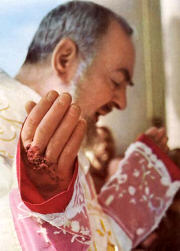
Benedict XVI on St. Pio of Pietrelcina

http://www.catholicculture.org/culture/liturgicalyear/pictures/9_23_pio2.jpg
“God never annihilates human beings but transforms them with his Spirit and orientates them to serving his plan of salvation. Padre Pio retained his own natural gifts and his own temperament, but he offered all things to God, who was able to make free use of them to extend Christ's work: to proclaim the Gospel, to forgive sins and to heal the sick in body and in mind.

Like Jesus, Padre Pio did not have to battle with earthly enemies, in radical combat, but rather with the spirit of evil (cf. Eph 6: 12). The greatest "storms" that threatened him were the assaults of the devil, from which he defended himself with 'the armour of God'

Benedict XVI, San Giovanni Rotondo, 21 June 2009.

Sunday, April 7, 2013

Benedict XVI on Prayer

http://iconreader.files.wordpress.com/2011/10/unknown-artist-agnus-dei-lamb-of-god-basilica-dei-santi-cosma-e-damiano-roma-italy-7th-century.jpg
Agnus Dei, Basilica dei Santi Cosma e Damiano, Rome
"Christ, the Lamb, Who was immolated in the sacrifice of the cross but stands in sign of His resurrection. The Lamb, Christ, Who died and rose again, will progressively open the seals so as to reveal the plan of God, the profound meaning of history.
...
Raising our gaze to God's heaven in an unbroken relationship with Christ, ... in individual and community prayer, we learn to see things in a new way and to grasp their most authentic significance. ...

The Lamb then opens the first four seals of the scroll and the Church sees the world of which she is part; a world containing ... the evils accomplished by man, such as violence ... and injustice, ... to which must be added the evils man suffers such as death, hunger, and sickness.

In the face of these often dramatic issues the ecclesial community is invited never to lose hope, but to remain firm in the belief that the apparent omnipotence of the Evil One in fact comes up against true omnipotence, that of God.
...

(T)he power of God has entered man's history, a power capable not only of counterbalancing evil, but also of overcoming it. ... God became so close as to descend into the darkness of death and illuminate it with the splendour of divine life. He took the evil of the world upon Himself to purify it with the fire of His love.
...
How can we progress in this Christian interpretation of reality? The Book of Revelation tells us that prayer nourishes this vision of light and profound hope in each one of us and in our communities. ... The Church lives in history, she is not closed in herself but courageously faces her journey amidst difficulties and sufferings, forcefully affirming that evil does not defeat good, that darkness does not shade God's splendour. This is an important point for us too: as Christians we can never be pessimists. ... Prayer, above all, educates us to see the signs of God, His presence and His action; or rather, it educates us to become lights of goodness, spreading hope and indicating that the victory is God's.
...

At the end of the vision an angel places grains of incense in a censer then throws it upon the earth. Those grains represent our prayers and we can be sure that there is no such thing as a superfluous or useless prayer. No prayer is lost. ... God is not oblivious to our prayers. ... When faced with evil we often have the sensation that we can do nothing, but our prayers are in fact the first and most effective response we can give, they strengthen our daily commitment to goodness. The power of God makes our weakness strong".

Benedict XVI, General Audience, Paul VI Hall, 12 September 2012.

Sunday, March 24, 2013

Benedict XVI on Judas Iscariot

http://saints.sqpn.com/ncd04475.jpg
Judas kissing Jesus
"I am the living bread which came down from heaven. He who eats my flesh and drinks my blood will live forever'. This revelation, as I have said, remained incomprehensible to them, because they understood it in a material sense.
...
The problem is that Judas did not go away, and his most serious fault was falsehood, which is the mark of the devil.” 
 
Benedict XVI, Angelus, Castel Gandolfo, 26 August 2012.