Showing posts with label Vatican Council II. Show all posts

Thursday, February 28, 2019

Benedict XVI on the Year of Faith

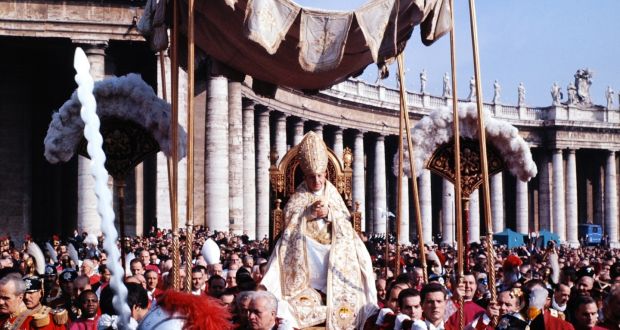
Pope John XXIII riding in procession to St Peter’s Basilica, at start of the Second Vatican Ecumenical Council. Photograph: Paul Schutzer/Time Life Pictures/Getty Images
Pope John XXIII riding in procession to St Peter’s Basilica, at the start of the Second Vatican Ecumenical Council.
 
"The Year of Faith which we launch today is linked harmoniously with the Church’s whole path over the last fifty years: from the Council, through the Magisterium of the Servant of God Paul VI, who proclaimed a Year of Faith in 1967, up to the Great Jubilee of the year 2000, with which Blessed John Paul II re-proposed to all humanity Jesus Christ as the one Saviour, yesterday, today and forever. Between these two Popes, Paul VI and John Paul II, there was a deep and profound convergence, precisely upon Christ as the centre of the cosmos and of history, and upon the apostolic eagerness to announce Him to the world. Jesus is the centre of the Christian faith. The Christian believes in God Whose face was revealed by Jesus Christ. He is the fulfilment of the Scriptures and their definitive interpreter".
 
"Today’s Gospel tells us that Jesus Christ, consecrated by the Father in the Holy Spirit, is the true and perennial subject of evangelisation. ... This mission of Christ, this movement of His continues in space and time, over centuries and continents. It is a movement which starts with the Father and, in the power of the Spirit, goes forth to bring the good news to the poor, in both a material and a spiritual sense. The Church is the first and necessary instrument of this work of Christ because it is united to Him as a body to its head".
 
"Vatican Council II did not wish to deal with the theme of faith in one specific document. It was, however, animated by a desire, as it were, to immerse itself anew in the Christian mystery so as to re-propose it fruitfully to contemporary man. ... In his opening speech Blessed John XXIII presented the principal purpose of the Council in this way: “What above all concerns the Ecumenical Council is this: that the sacred deposit of Christian doctrine be safeguarded and taught more effectively. … Therefore, the principal purpose of this Council is not the discussion of this or that doctrinal theme, a Council is not required for that, ... [but] this certain and immutable doctrine, which is to be faithfully respected, needs to be explored and presented in a way which responds to the needs of our time”.
 
"In the light of these words, we can understand what I myself felt at the time: during the Council there was an emotional tension as we faced the common task of making the truth and beauty of the faith shine out in our time, without sacrificing it to the demands of the present or leaving it tied to the past: the eternal presence of God resounds in the faith, transcending time, yet it can only be welcomed by us in our own unrepeatable today. Therefore I believe that the most important thing ... is to revive in the whole Church that positive tension, that yearning to announce Christ again to contemporary man. But, so that this interior thrust towards the new evangelisation neither remain just an idea nor be lost in confusion, ... I have often insisted on the need to return, as it were, to the “letter” of the Council - that is to its texts - also to draw from them its authentic spirit, and why I have repeated that the true legacy of Vatican II is to be found in them".
 
"The Council did not formulate anything new in matters of faith, nor did it wish to replace what was ancient. Rather, it concerned itself with seeing that the same faith might continue to be lived in the present day, that it might remain a living faith in a world of change. ... The Council Fathers wished to present the faith in a meaningful way; and if they opened themselves trustingly to dialogue with the modern world it is because they were certain of their faith, of the solid rock on which they stood. In the years following, however, many embraced uncritically the dominant mentality, placing in doubt the very foundations of the deposit of faith, which they sadly no longer felt able to accept as truths."
 
"If today the Church proposes a new Year of Faith and a new evangelisation, it is not to honour an anniversary, but because there is more need of it, even more than there was fifty years ago! ... Even the initiative to create a pontifical council for the promotion of the new evangelisation ... is to be understood in this context. Recent decades have seen the advance of a spiritual “desertification”. In the Council’s time it was already possible from a few tragic pages of history to know what a life or a world without God looked like, but now we see it every day around us. ... But it is in starting from the experience of this desert ... that we can again discover the joy of believing, its vital importance for us".
 
"In the desert we rediscover the value of what is essential for living; thus in today’s world there are innumerable signs, often expressed implicitly or negatively, of the thirst for God, for the ultimate meaning of life. And in the desert people of faith are needed who, with their own lives, point out the way to the Promised Land and keep hope alive. Living faith opens the heart to the grace of God which frees us from pessimism. Today, more than ever, evangelising means witnessing to the new life, transformed by God, and thus showing the path".
 
"The journey is a metaphor for life, and the wise wayfarer is one who has learned the art of living, and can share it with his brethren - as happens to pilgrims along the Way of St. James or similar routes which, not by chance, have again become popular in recent years. How come so many people today feel the need to make these journeys? Is it not because they find there, or at least intuit, the meaning of our existence in the world? This, then, is how we can picture the Year of Faith: a pilgrimage in the deserts of today’s world, taking with us only what is necessary: ... the Gospel and the faith of the Church, of which the Council documents are a luminous expression, as is the Catechism of the Catholic Church, published twenty years ago."
 
"Venerable and dear brothers, 11 October 1962 was the Feast of Mary Most Holy, Mother of God. Let us entrust to her the Year of Faith, as I did last week when I went on pilgrimage to Loreto. May the Virgin Mary always shine out as a star along the way of the new evangelisation".
 
Extracts from a homily by Pope Benedict XVI during the course of a Mass celebrated in St. Peter's Square on 11 October 2012.

Wednesday, September 14, 2016

Benedict XVI on the Second Vatican Council

Ratzinger was peritus of Archbishop of Cologne, Cardinal Joseph Frings, during the Second Vatican Council.

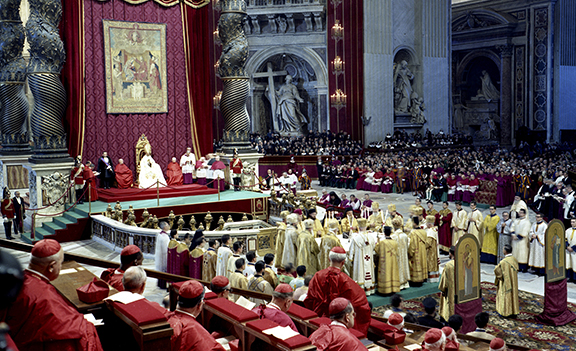
"It was a splendid day on 11 October 1962 when the Second Vatican Council opened with the solemn procession into St Peter’s Basilica in Rome of more than two thousand Council Fathers. In 1931 Pius XI had dedicated this day to the feast of the Divine Motherhood of Mary, mindful that 1,500 years earlier, in 431, the Council of Ephesus had solemnly recognized this title for Mary in order to express God’s indissoluble union with man in Christ. Pope John XXIII had chosen this day for the beginning of the Council so as to entrust the great ecclesial assembly, which he had convoked, to the motherly goodness of Mary and to anchor the Council’s work firmly in the mystery of Jesus Christ. It was impressive to see in the entrance procession bishops from all over the world, from all peoples and all races: an image of the Church of Jesus Christ which embraces the whole world, in which the peoples of the earth know they are united in his peace.

It was a moment of extraordinary expectation. Great things were about to happen. The previous Councils had almost always been convoked for a precise question to which they were to provide an answer. This time there was no specific problem to resolve. But precisely because of this, a general sense of expectation hovered in the air: Christianity, which had built and formed the Western world, seemed more and more to be losing its power to shape society. It appeared weary and it looked as if the future would be determined by other spiritual forces. The sense of this loss of the present on the part of Christianity, and of the task following on from that, was well summed up in the word aggiornamento (updating). Christianity must be in the present if it is to be able to form the future. So that it might once again be a force to shape the future, John XXIII had convoked the Council without indicating to it any specific problems or programmes. This was the greatness and at the same time the difficulty of the task that was set before the ecclesial assembly.

The various episcopates undoubtedly approached the great event with different ideas. Some of them arrived rather with an attitude of expectation regarding the programme that was to be developed. It was the episcopates of Central Europe – Belgium, France and Germany – that came with the clearest ideas. In matters of detail, they stressed completely different aspects, yet they had common priorities. A fundamental theme was ecclesiology, that needed to be studied in greater depth from a Trinitarian and sacramental viewpoint and in connection with salvation history; then there was a need to amplify the doctrine of primacy from the First Vatican Council by giving greater weight to the episcopal ministry. An important theme for the episcopates of Central Europe was liturgical renewal, which Pius XII had already started to implement. Another central aspect, especially for the German episcopate, was ecumenism: the shared experience of Nazi persecution had brought Protestant and Catholic Christians closer together; this now had to happen at the level of the whole Church, and to be developed further. Then there was also the group of themes: Revelation – Scripture – Tradition – Magisterium. For the French, the subject of the relationship between the Church and the modern world came increasingly to the fore – in other words the work of the so-called “Schema XIII”, from which the Pastoral Constitution on the Church in the Modern World later emerged. This point touches on the real expectations of the Council. The Church, which during the Baroque era was still, in a broad sense, shaping the world, had from the nineteenth century onwards visibly entered into a negative relationship with the modern era, which had only then properly begun. Did it have to remain so? Could the Church not take a positive step into the new era? Behind the vague expression “today’s world” lies the question of the relationship with the modern era. To clarify this, it would have been necessary to define more clearly the essential features that constitute the modern era. “Schema XIII” did not succeed in doing this. Although the Pastoral Constitution expressed many important elements for an understanding of the “world” and made significant contributions to the question of Christian ethics, it failed to offer substantial clarification on this point.

Unexpectedly, the encounter with the great themes of the modern epoch did not happen in the great Pastoral Constitution, but instead in two minor documents, whose importance has only gradually come to light in the context of the reception of the Council. First, there is the Declaration on Religious Liberty, which was urgently requested, and also drafted, by the American Bishops in particular. With developments in philosophical thought and in ways of understanding the modern State, the doctrine of tolerance, as worked out in detail by Pius XII, no longer seemed sufficient. At stake was the freedom to choose and practise religion and the freedom to change it, as fundamental human rights and freedoms. Given its inner foundation, such a concept could not be foreign to the Christian faith, which had come into being claiming that the State could neither decide on the truth nor prescribe any kind of worship. The Christian faith demanded freedom of religious belief and freedom of religious practice in worship, without thereby violating the law of the State in its internal ordering; Christians prayed for the emperor, but did not worship him. To this extent, it can be said that Christianity, at its birth, brought the principle of religious freedom into the world. Yet the interpretation of this right to freedom in the context of modern thought was not easy, since it could seem as if the modern version of religious freedom presupposed the inaccessibility of the truth to man and so, perforce, shifted religion into the sphere of the subjective. It was certainly providential that thirteen years after the conclusion of the Council, Pope John Paul II arrived from a country in which freedom of religion had been denied by Marxism, in other words by a particular form of modern philosophy of the State. The Pope had come, as it were, from a situation resembling that of the early Church, so that the inner orientation of the faith towards the theme of freedom, and especially freedom of religion and worship, became visible once more.

The second document that was to prove important for the Church’s encounter with the modern age came into being almost by chance and it developed in various phases. I am referring to the Declaration “Nostra Aetate” on the Relation of the Church to Non-Christian Religions. At the outset the intention was to draft a declaration on relations between the Church and Judaism, a text that had become intrinsically necessary after the horrors of the Shoah. The Council Fathers from Arab countries were not opposed to such a text, but they explained that if there were an intention to speak of Judaism, then there should also be some words on Islam. How right they were, we in the West have only gradually come to understand. Lastly the realization grew that it was also right to speak of two other great religions – Hinduism and Buddhism – as well as the theme of religion in general. Then, following naturally, came a brief indication regarding dialogue and collaboration with the religions, whose spiritual, moral, and socio-cultural values were to be respected, protected and encouraged (ibid., 2). Thus, in a precise and extraordinarily dense document, a theme is opened up whose importance could not be foreseen at the time. The task that it involves and the efforts that are still necessary in order to distinguish, clarify and understand, are appearing ever more clearly. In the process of active reception, a weakness of this otherwise extraordinary text has gradually emerged: it speaks of religion solely in a positive way and it disregards the sick and distorted forms of religion which, from the historical and theological viewpoints, are of far-reaching importance; for this reason the Christian faith, from the outset, adopted a critical stance towards religion, both internally and externally.

If at the beginning of the Council the dominant groups were the Central European Episcopates with their theologians, during the Council sessions the scope of the common endeavour and responsibility constantly broadened. The bishops considered themselves apprentices at the school of the Holy Spirit and at the school of reciprocal collaboration, but at the same time servants of the word of God who were living and working in faith. The Council Fathers neither could nor wished to create a new or different Church. They had neither the authority nor the mandate to do so. It was only in their capacity as bishops that they were now Council Fathers with a vote and decision-making powers, that is to say, on the basis of the Sacrament and in the Church of the Sacrament. For this reason they neither could nor wished to create a different faith or a new Church, but rather to understand these more deeply and hence truly to “renew them”. This is why a hermeneutic of rupture is absurd and is contrary to the spirit and the will of the Council Fathers.

In Cardinal Frings I had a “father” who lived this spirit of the Council in an exemplary way. He was a man of great openness and breadth, but he also knew that faith alone leads us out into the open, into that space which remains barred to the positivist spirit. This is the faith that he wished to serve with the authority he had received through the sacrament of Episcopal Ordination. I cannot but be ever grateful to him for having brought me – the youngest professor of the Catholic theology faculty of the University of Bonn – as his consultant to the great Church assembly, thereby enabling me, alongside the others, to attend that school and to walk the path of the Council from within. The present volume contains a collection of the various writings that I presented at that school. They are thoroughly fragmentary offerings, which also reveal the learning process that the Council and its reception meant and still means for me. I hope that despite all their limitations, these various offerings, combined, will help to make the Council better understood and to implement it in a healthy ecclesial life. I warmly thank Archbishop Gerhard Ludwig Müller and his collaborators at the Pope Benedict XVI Institute for the extraordinary commitment they have taken on in order to produce this volume.

Castel Gandolfo, on the Feast of Saint Eusebius, Bishop of Vercelli
2 August 2012

Benedictus PP. XVI"

Wednesday, July 20, 2016

Cardinal Ratzinger on ad orientem


“To the ordinary churchgoer, the two most obvious effects of the liturgical reform of the Second Vatican Council seem to be the disappearance of Latin and the turning of the altars towards the people. Those who read the relevant texts will be astonished to learn that neither is in fact found in the decrees of the Council. The use of the vernacular is certainly permitted, especially for the Liturgy of the Word, but the preceding general rule of the Council text says, ‘Particular law remaining in force, the use of the Latin language is to be preserved in the Latin rites’ (Sacrosanctum Concilium, 36.1). There is nothing in the Council text about turning altars towards the people; that point is raised only in postconciliar instructions.”

Uwe Michael Lang, “Turning towards the Lord: Orientation in Liturgical Prayer,” Foreword by Joseph Ratzinger, Ignatius Press, San Francisco, 2004.

Wednesday, October 7, 2015

Ratzinger on Modernism

http://arthistoryresources.net/modernism/modernism-images/Descent-Modernists-new.jpg

“The text was, if one may use the label, utterly the product of the 'anti-Modernist' mentality that had taken shape about the turn of the century. The text was written in a spirit of condemnation and negation, which ... had a frigid and even offensive tone to many of the Fathers. And this despite the fact that the content of the text was new to no one. It was exactly like dozens of text-books familiar to the bishops from their seminary days: and in some cases, their former professors were actually responsible for the texts now presented to them.”

...

“The real question behind the discussion can be put this way: Was the intellectual position of ‘anti-Modernism’ — the old policy of exclusiveness, condemnation and defense leading to an almost neurotic denial of all that was new — to be continued? Or would the Church, after it had taken all the necessary precautions to defend the Faith, turn over a new leaf and move on into a new and positive encounter with its own origins, with its brothers and with the world today?”


Father Jospeh Ratzinger, Theological Highlights of Vatican II, (1966, pp. 17-18)

Monday, July 20, 2015

Benedict XVI on Charismatic Renewal


https://keithlannon.files.wordpress.com/2014/04/aaa1.jpg
"Young ecclesial communities are a gift from God and their contributions should be valued and welcomed with trust.…The ecclesial communities which bloomed after the Second Vatican Council, are a unique gift of the Lord and a precious resource for the life of the Church.…The movements and new communities are like an inrush of the Holy Spirit in the Church and in contemporary society. One of the positive elements and aspects of the communities of the Catholic Charismatic Renewal is precisely the importance given by them to the charisms and gifts of the Holy Spirit, and their merit lies in having reminded the Church of the actuality (of these gifts)."
Benedict XVI, on the occasion of the 13th international conference of the Catholic Fraternity of Covenant Charismatic Communities and Fellowships, October 2008).

Monday, September 22, 2014

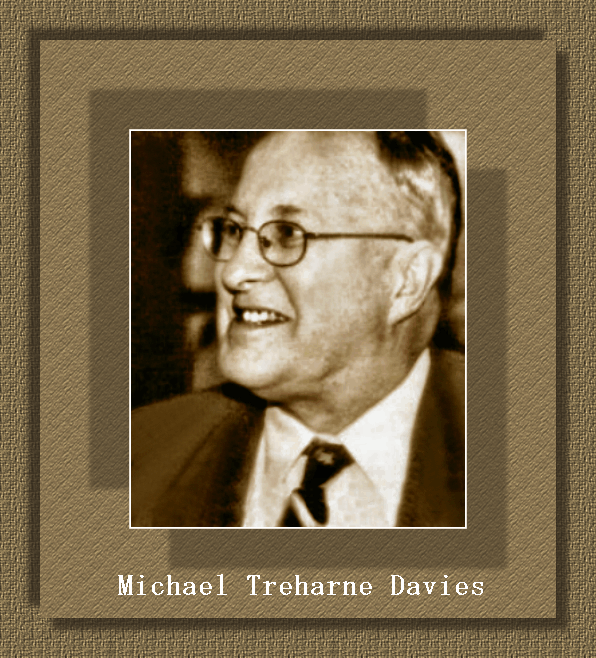
Ratzinger on Michael Davies

http://www.catholictradition.org/Tradition/davies.gif
Michael Davies, 2nd FIUV President
“I have been profoundly touched by the news of the death of Michael Davies. I had the good fortune to meet him several times and I found him as a man of deep faith and ready to embrace suffering. Ever since the Council he put all his energy into the service of the Faith and left us important publications especially about the Sacred Liturgy

Even though he suffered from the Church in many ways in his time, he always truly remained a man of the Church. He knew that the Lord founded His Church on the rock of St Peter and that the Faith can find its fullness and maturity only in union with the successor of St Peter. Therefore we can be confident that the Lord opened wide for him the gates of heaven. We commend his soul to the Lord’s mercy.”

Joseph Cardinal Ratzinger
9 November 2004

Wednesday, April 9, 2014

Cardinal Ratzinger on Ecumenical Councils

http://upload.wikimedia.org/wikipedia/commons/d/dd/THE_FIRST_COUNCIL_OF_NICEA.jpg 

 “Not every valid council in the history of the Church has been a fruitful one; in the last analysis many of them have been just a waste of time,” ...


“The last word about the historical value of Vatican Council II has yet to be spoken.” 

Joseph Ratzinger, Principles of Catholic Theology: Building Stones for a Fundamental Theology, (Ignatius Press, San Francisco, 1987), p. 378.