Showing posts with label Antioch. Show all posts

Monday, December 30, 2024

Benedict XVI on the Papacy (Petrus Apostolus)

On the second anniversary of Benedict XVI's death, this article serves as a testament to how Pope Benedict XVI viewed the Papacy.


Shortly before the announcement of Pope Benedict XVI's resignation, on 8 February 2013, he gave a deeply Roman, Petrine, lesson in his meeting with the seminarians of Rome in the chapel of the Pontifical Roman Seminary (photo above from that meeting). Three days later, in a morning meeting with his cardinals, he announced his decision to step down from the papacy.


Excerpts from the official translation by the Holy See below:


"We have heard three verses from the First Letter of St Peter (cf. 1:3-5). Before going into this text it seems to me important to be aware of the fact that it is Peter who is speaking. The first two words of the Letter are Petrus apostolus (cf. v.1): he speaks and he speaks to the Churches in Asia and calls the faithful “chosen”, and “exiles of the Dispersion” (ibid.).


Let us reflect a little on this. Peter is speaking and - as we hear at the end of the Letter - he is speaking from Rome, which he called “Babylon” (cf. 5:13). Peter speaks as if it were a first encyclical with which the first Apostle, Vicar of Christ, addresses the Church of all time.


Peter, an apostle: thus, the one who is speaking is the one who found the Messiah in Jesus Christ, who was the first to speak on behalf of the future Church: “You are the Christ, the Son of the living God” (cf. Mt 16:16).


The one who introduced us to this faith is speaking, the one to whom the Lord said: “I will give you the keys of the kingdom of heaven” (cf. Mt 16:19), to whom he entrusted his flock after the Resurrection, saying to him three times: “Feed my lambs...Tend my sheep” (cf. Jn 21:15-17).


And it is also the man who fell who is speaking, the man who denied Jesus three times and was granted the grace to see Jesus’ look, to feel deeply moved in his heart and to find forgiveness and a renewal of his mission.


However, above all it is important that this man, full of passion, full of longing for God, full of a desire for the Kingdom of God, for the Messiah, this man who has found Jesus, the Lord and the Messiah, is also the man who sinned, who fell; and yet he remained in God’s sight and in this way he remained responsible for the Lord’s Church, he remained the one assigned by Christ, he remained the messenger of Christ’s love.

Peter the Apostle is speaking, but the exegetes tell us: it is impossible for this Letter to have been written by Peter because the Greek is so good that it cannot be the Greek of a fisherman from the Sea of Galilee.


And it is not only the language — the syntax is excellent — but also the thought which is already quite mature, there are actual formulas in which the faith and the reflection of the Church are summed up. These exegetes say, therefore: it had already reached a degree of development that cannot be Peter’s.


How does one respond? There are two important positions: first, Peter himself — that is, the Letter — gives us a clue, for at the end of the writing he says I write to you: “By Silvanus... dia Silvanus”.


This “by” [dia] could mean various things. It may mean that he [Silvanus] brings or transmits; it may mean that Silvanus helped him write it; it may mean that in practice it was really Silvanus who wrote it. In any case, we may conclude that the Letter itself points out to us that Peter was not alone in writing this Letter but it expresses the faith of a Church, which is already on a journey of faith, a faith increasingly mature. He does not write alone, as an isolated individual; he writes with the assistance of the Church, of people who help him to deepen the faith, to enter into the depths of his thought, of his rationality, of his profundity.


And this is very important: Peter is not speaking as an individual, he is speaking ex persona Ecclesiae, he is speaking as a man of the Church, as an individual of course, with his personal responsibility, but also as a person who speaks on behalf of the Church; not only private and original ideas, not as a 19th century genius who wished to express only personal and original ideas that no one else could have expressed first.


No.


He does not speak as an individualistic genius, but speaks, precisely, in the communion of the Church. In the Apocalypse, in the initial vision of Christ, it is said that Christ’s voice is like the sound of many waters (cf. Rev 1:15). This means: Christ’s voice gathers together all the waters of the world, bears within it all the living waters that give life to the world; he is a Person, but this is the very greatness of the Lord, that he bears within him all the rivers of the Old Testament, indeed, of the wisdom of peoples. ...

I would like to say something more: St Peter writes from Rome. This is important.


Here we already have the Bishop of Rome, we have the beginning of Succession, we already have the beginning of the actual Primacy located in Rome, not only granted by the Lord but placed here, in this city, in this world capital.


How did Peter come to Rome? This is a serious question. The Acts of the Apostles tell us that after his escape from Herod’s prison, he went to another place (cf. 12:17) - eis eteron topon. Where he went is not known; some say to Antioch, others, to Rome.


In any case, in this capital it should also be said that before fleeing he entrusted the Judaeo-Christian Church, the Church of Jerusalem, to James, and in entrusting her to James he nevertheless remained Primate of the universal Church, of the Church of the Gentiles but also of the Judaeo-Christian Church.


And here in Rome he found a great Judaeo-Christian community.


The liturgists tell us that in the Roman Canon there are traces of a characteristically Judaeo-Christian language.


Thus we see that in Rome both parts of the Church were to be found: the Judaeo-Christian and the pagan-Christian, united, an expression of the universal Church. And for Peter, moving from Jerusalem to Rome meant moving to the universality of the Church, moving to the Church of the Gentiles and of all the epochs, to the Church that also still belongs to the Jews.

And I think that in going to Rome St Peter not only thought of this transfer: Jerusalem/Rome, Judaeo-Christian Church/universal Church.


He certainly also remembered Jesus’ last words to him, recorded by St John: “when you are old, you will stretch out your hands, and another will gird you and carry you where you do not wish to go” (cf. Jn 21:18).


It is a prophecy of the crucifixion. Philologists show us that “stretch out your hands” is a precise, technical expression for the crucifixion. St Peter knew that his end would be martyrdom, would be the cross: that it would therefore be following Christ completely.


Consequently, in going to Rome there is no doubt that he was also going to martyrdom: martyrdom awaited him in Babylon. The primacy, therefore, has this content of universality but it has a martyrological content as well.


Furthermore, Rome had been a place of martyrdom from the outset. In going to Rome, Peter once again accepts this word of the Lord: he heads for the cross and invites us too to accept the martyrological aspect of Christianity, which may have very different forms.


And the cross may have very different forms, but no one can be Christian without following the Crucified One, without accepting the martyrological moment too.
...


Perhaps today we are tempted to say: we do not want to rejoice at having been chosen, for this would be triumphalism. It would be triumphalism to think that God had chosen me because I was so important. This would really be erroneous triumphalism.


However, being glad because God wanted me is not triumphalism. Rather, it is gratitude, and I think we should re-learn this joy: God wanted me to be born in this way, into a Catholic family, he wanted me to know Jesus from the first.


What a gift to be wanted by God so that I could know his face, so that I could know Jesus Christ, the human face of God, the human history of God in this world! Being joyful because he has chosen me to be a Catholic, to be in this Church of his, where subsistit Ecclesia unica; we should rejoice because God has given me this grace, this beauty of knowing the fullness of God’s truth, the joy of his love.
...


Christians are certainly not only foreigners; we are also Christian nations, we are proud of having contributed to the formation of culture; there is a healthy patriotism, a healthy joy of belonging to a nation that has a great history of culture and of faith.


Yet, as Christians, we are always also foreigners - the destiny of Abraham, described in the Letter to the Hebrews. As Christians we are, even today, also always foreigners.


In the work place, Christians are a minority, they find themselves in an extraneous situation; it is surprising that a person today can still believe and live like this. This is also part of our life: it is a form of being with the Crucified Christ; this being foreigners, not living in the way that everyone else lives, but living — or at least seeking to live — in accordance with his Word, very differently from what everyone says.


And it is precisely this that is characteristic of Christians. They all say: “But everyone does this, why don’t I?”


No, I don’t, because I want to live in accordance with God. St Augustine once said: “Christians are those who do not have their roots below, like trees, but have their roots above, and they do not live this gravity in the natural downwards gravitation."


Let us pray the Lord that he help us to accept this mission of living as exiles, as a minority, in a certain sense, of living as foreigners and yet being responsible for others and, in this way, reinforcing the goodness in our world.
...


Inheritance. It is a very important word in the Old Testament, where Abraham is told that his seed will inherit the earth, and this was always the promise for his descendants.


You will have the earth, you will be heirs of the earth. In the New Testament, this word becomes a word for us; we are heirs, not of a specific country, but of the land of God, of the future of God.


Inheritance is something of the future, and thus this word tells us above all that as Christians we have a future, the future is ours, the future is God’s. Thus, being Christians, we know that the future is ours and the tree of the Church is not a tree that is dying but a tree that constantly puts out new shoots.


Therefore we have a reason not to let ourselves be upset, as Pope John said, by the prophets of doom who say: well, the Church is a tree that grew from the mustard seed, grew for 2,000 years, now she has time behind her, it is now time for her to die.


No.


The Church is ever renewed, she is always reborn. The future belongs to us. Of course, there is a false optimism and a false pessimism. A false pessimism tells us that the epoch of Christianity is over. No: it is beginning again!


The false optimism was the post-Council optimism, when convents closed, seminaries closed and they said “but... nothing, everything is fine!”.... No! Everything is not fine. There are also serious, dangerous omissions and we have to recognize with healthy realism that in this way things are not all right, it is not all right when errors are made.


However, we must also be certain at the same time that if, here and there, the Church is dying because of the sins of men and women, because of their non-belief, at the same time she is reborn.


The future really belongs to God: this is the great certainty of our life, the great, true optimism that we know. The Church is the tree of God that lives for ever and bears within her eternity and the true inheritance: eternal life.
...


And, lastly, “guarded through faith.” The New Testament text, from the Letter of St Peter, uses a rare word here, phrouroumenoi, which means: there are the “guards” and faith is like the guards who preserve the integrity of my being, of my faith.


This word interprets in particular “the guards” at the gates of a city, where they stand and keep watch over the city so that it is not invaded by destructive powers.


Thus faith is a “guard” of my being, of my life, of my inheritance.


We must be grateful for this vigilance of faith that protects us, helps us, guides us, gives us the security: God does not let me fall from his hands.


Saturday, December 20, 2014

Cardinal Ratzinger on the Christian Faith

http://ecx.images-amazon.com/images/I/51k-iJXUF8L._SY344_BO1,204,203,200_.jpgThe Christian faith can never be separated from the soil of sacred events, from the choice made by God, who wanted to speak to us, to become man, to die and rise again, in a particular place and at a particular time. “Always” can only come from “once for all”. The Church does not pray in some kind of mythical omnitemporality. She cannot forsake her roots. She recognizes the true utterance of God precisely in the concreteness of its history, in time and place: to these God ties us, and by these we are all tied together. The diachronic aspect, praying with the Fathers and the apostles, is part of what we mean by rite, but it also includes a local aspect, extending from Jerusalem to Antioch, Rome, Alexandria, and Constantinople. Rites are not, therefore, just the products of inculturation, how­ever much they may have incorporated elements from different cultures. They are forms of the apostolic Tradition and of its unfolding in the great places of the Tradition

Cardinal Ratzinger, The Spirit of the Liturgy, (SF, CA, Ignatius, 2000), p. 164.

Friday, February 21, 2014

Benedict XVI on the Chair of St. Peter

http://www.anglicanphiladelphia.org/stmichael/cathedrapetri.jpgDear Brothers and Sisters! The Latin liturgy celebrates today the feast of the Chair of Peter. It is a very ancient tradition, witnessed in Rome since the end of the fourth century, which renders thanksgiving to God for the mission entrusted to the Apostle Peter and his successors.

"Cathedra" literally means the established seat of the bishop, located in the mother church of a diocese, which for this reason is called "cathedral," and it is the symbol of the authority of the bishop and, in particular, of his "magisterium," that is, of the evangelical teaching that he, insofar as a successor of the apostles, is called to guard and transmit to the Christian community.

When the bishop takes possession of the local Church that is entrusted to him, he, bearing the miter and the shepherd's crosier, sits on the cathedra. From that seat he will guide, as teacher and shepherd, the journey of the faithful in faith, hope and charity.

Which was, then, the "cathedra" if St. Peter? He, chosen by Christ as "rock" on which to build the Church (cf. Matthew 16:18), began his ministry in Jerusalem, after the ascension of the Lord and Pentecost. The first "seat" of the Church was the Cenacle, and in all probability in that room, where Mary, the Mother of Jesus, also prayed with the disciples, a special place was reserved for Simon Peter.

Subsequently, the see of Peter was Antioch, a city situated on the Oronte River in Syria, today Turkey, which at the time was the third metropolis of the Roman Empire after Rome and Alexandria in Egypt. Of that city, evangelized by Barnabas and Paul, where "for the first time the disciples were called Christians" (Acts 11:26), Peter was the first Bishop.

In fact, the Roman Martyrology, before the reform of the calendar, established also a specific celebration of the Chair of Peter at Antioch. From there, Providence led Peter to Rome, where he concluded with martyrdom his course of service to the Gospel. For this reason, the See of Rome, which had received the greatest honor, received also the task entrusted by Christ to Peter of being at the service of all the local Churches for the building and unity of the whole People of God.

In this way the See of Rome came to be known as that of the Successor of Peter, and the "cathedra" of its Bishop represented that of the apostle charged by Christ to feed all his flock. It is attested by the most ancient Fathers of the Church, as for example St. Irenaeus, bishop of Lyon, who in his treatise "Against Heresies" describes the Church of Rome as "greatest and most ancient, known by all; … founded and constituted at Rome by the two glorious Apostles Peter and Paul"; and he adds: "With this Church, because of her outstanding superiority, the universal Church must be in agreement, that is, the faithful everywhere" (III, 3, 2-3).

Tertullian, for his part, affirms: "How blessed this Church of Rome is! The Apostles themselves shed on her, with their blood, the whole of the doctrine" ("La Prescrizione degli Eretici," 36). The Chair of the Bishop of Rome represents, therefore, not only his service to the Roman community, but also his mission of guide of the whole People of God.

To celebrate the "Chair" of Peter, as we do today, means, therefore, to attribute to it a strong spiritual significance and to recognize in it a privileged sign of the love of God, good and eternal Shepherd, who wants to gather the whole of his Church and guide her along the way of salvation.

Among so many testimonies of the Fathers, I would like to refer to that of St. Jerome, taken from a letter of his to the Bishop of Rome, particularly interesting because he makes explicit reference in fact to the "chair" of Peter, presenting it as the safe harbor of truth and peace. Jerome writes thus: "I decided to consult the chair of Peter, where that faith is found exalted by the lips of an Apostle; I now come to ask for nourishment for my soul there, where once you received the garment of Christ. I follow no leader save Christ, so I enter into communion with your beatitude, that is, with the chair of Peter for this I know is the rock upon which the Church is built! ("Le Lettere," I, 15,1-2).

Dear Brothers and Sisters, in the apse of St. Peter's Basilica, as you know, is found the monument to the Chair of the Apostle, a mature work of Bernini, made in the shape of a great bronze throne, supported by the statues of four Doctors of the Church, two from the West, St. Augustine and St. Ambrose, and two from the East, St. John Chrysostom and St. Athanasius.

I invite you to pause before that evocative work, which today it is possible to admire decorated with so many candles, and pray in a particular way for the ministry that God has entrusted to me. Raising one's gaze to the alabaster glass window that opens precisely above the chair, invoke the Holy Spirit, so that he will always sustain with his light and strength my daily service to the whole Church. 

Benedict XVI, General Audience, Rome, 22 February 2006.

Wednesday, November 13, 2013

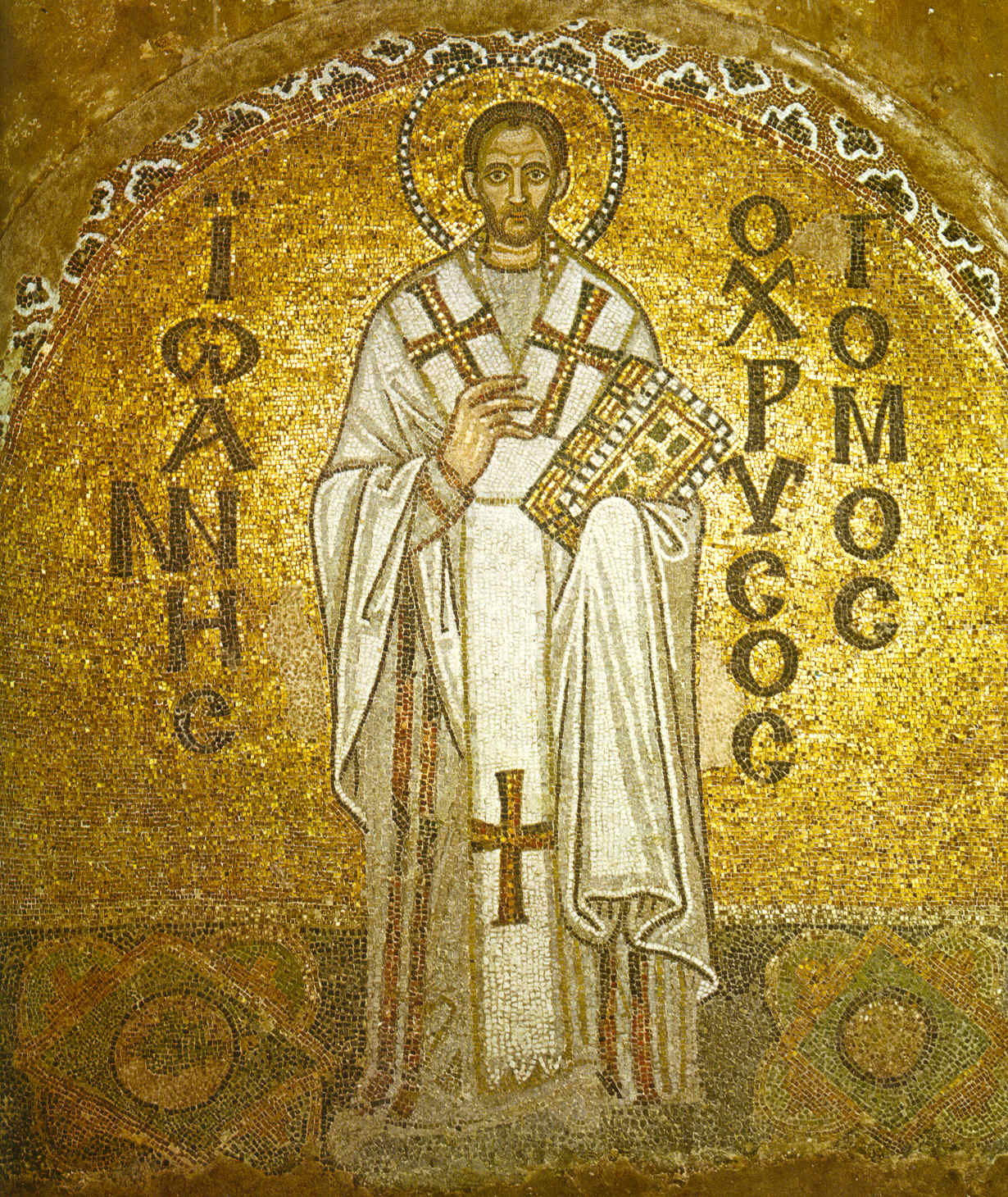
Benedict XVI on St. John Chrysostom


File:Johnchrysostom.jpg
Mosaic of St. John Chrysostom, Hagia Sophia, Istanbul
"It can be said that John of Antioch, nicknamed "Chrysostom", that is, "golden-mouthed", because of his eloquence, is also still alive today because of his works. An anonymous copyist left in writing that "they cross the whole globe like flashes of lightening".

Chrysostom's writings also enable us, as they did the faithful of his time whom his frequent exiles deprived of his presence, to live with his books, despite his absence. This is what he himself suggested in a letter when he was in exile (To Olympias, Letter 8, 45).

He was born in about the year 349 A.D. in Antioch, Syria (today Antakya in Southern Turkey). He carried out his priestly ministry there for about 11 years, until 397, when, appointed Bishop of Constantinople, he exercised his episcopal ministry in the capital of the Empire prior to his two exiles, which succeeded one close upon the other - in 403 and 407.
...
After completing his elementary and advanced studies crowned by courses in philosophy and rhetoric, he had as his teacher, Libanius, a pagan and the most famous rhetorician of that time. At his school John became the greatest orator of late Greek antiquity.

He was baptized in 368 and trained for the ecclesiastical life by Bishop Meletius, who instituted him as lector in 371. This event marked Chrysostom's official entry into the ecclesiastical cursus. From 367 to 372, he attended the Asceterius, a sort of seminary in Antioch, together with a group of young men, some of whom later became Bishops, under the guidance of the exegete Diodore of Tarsus, who initiated John into the literal and grammatical exegesis characteristic of Antiochean tradition.

He then withdrew for four years to the hermits on the neighbouring Mount Silpius. He extended his retreat for a further two years, living alone in a cave under the guidance of an "old hermit". In that period, he dedicated himself unreservedly to meditating on "the laws of Christ", the Gospels and especially the Letters of Paul. Having fallen ill, he found it impossible to care for himself unaided, and therefore had to return to the Christian community in Antioch (cf. Palladius, Dialogue on the Life of St John Chrysostom, 5).

The Lord, his biographer explains, intervened with the illness at the right moment to enable John to follow his true vocation. In fact, he himself was later to write that were he to choose between the troubles of Church government and the tranquillity of monastic life, he would have preferred pastoral service a thousand times (cf. On the Priesthood, 6, 7): it was precisely to this that Chrysostom felt called.
...
Between 378 and 379, he returned to the city. He was ordained a deacon in 381 and a priest in 386, and became a famous preacher in his city's churches. He preached homilies against the Arians, followed by homilies commemorating the Antiochean martyrs and other important liturgical celebrations: this was an important teaching of faith in Christ and also in the light of his Saints.

The year 387 was John's "heroic year", that of the so-called "revolt of the statues". As a sign of protest against levied taxes, the people destroyed the Emperor's statues. It was in those days of Lent and the fear of the Emperor's impending reprisal that Chrysostom gave his 22 vibrant Homilies on the Statues, whose aim was to induce repentance and conversion. This was followed by a period of serene pastoral care (387-397).

Chrysostom is among the most prolific of the Fathers: 17 treatises, more than 700 authentic homilies, commentaries on Matthew and on Paul (Letters to the Romans, Corinthians, Ephesians and Hebrews) and 241 letters are extant. He was not a speculative theologian.

Nevertheless, he passed on the Church's tradition and reliable doctrine in an age of theological controversies, sparked above all by Arianism or, in other words, the denial of Christ's divinity. He is therefore a trustworthy witness of the dogmatic development achieved by the Church from the fourth to the fifth centuries.

His is a perfectly pastoral theology in which there is constant concern for consistency between thought expressed via words and existential experience. It is this in particular that forms the main theme of the splendid catecheses with which he prepared catechumens to receive Baptism.

On approaching death, he wrote that the value of the human being lies in "exact knowledge of true doctrine and in rectitude of life" (Letter from Exile). Both these things, knowledge of truth and rectitude of life, go hand in hand: knowledge has to be expressed in life. All his discourses aimed to develop in the faithful the use of intelligence, of true reason, in order to understand and to put into practice the moral and spiritual requirements of faith.

John Chrysostom was anxious to accompany his writings with the person's integral development in his physical, intellectual and religious dimensions. The various phases of his growth are compared to as many seas in an immense ocean: "The first of these seas is childhood" (Homily, 81, 5 on Matthew's Gospel).

Indeed, "it is precisely at this early age that inclinations to vice or virtue are manifest". Thus, God's law must be impressed upon the soul from the outset "as on a wax tablet" (Homily 3, 1 on John's Gospel): This is indeed the most important age. We must bear in mind how fundamentally important it is that the great orientations which give man a proper outlook on life truly enter him in this first phase of life.

Chrysostom therefore recommended: "From the tenderest age, arm children with spiritual weapons and teach them to make the Sign of the Cross on their forehead with their hand" (Homily, 12, 7 on First Corinthians).

Then come adolescence and youth: "Following childhood is the sea of adolescence, where violent winds blow..., for concupiscence... grows within us" (Homily 81, 5 on Matthew's Gospel).

Lastly comes engagement and marriage: "Youth is succeeded by the age of the mature person who assumes family commitments: this is the time to seek a wife" (ibid.).

He recalls the aims of marriage, enriching them - referring to virtue and temperance - with a rich fabric of personal relationships. Properly prepared spouses therefore bar the way to divorce: everything takes place with joy and children can be educated in virtue. Then when the first child is born, he is "like a bridge; the three become one flesh, because the child joins the two parts" (Homily 12, 5 on the Letter to the Colossians), and the three constitute "a family, a Church in miniature" (Homily 20, 6 on the Letter to the Ephesians).

Chrysostom's preaching usually took place during the liturgy, the "place" where the community is built with the Word and the Eucharist. The assembly gathered here expresses the one Church (Homily 8, 7 on the Letter to the Romans), the same word is addressed everywhere to all (Homily 24, 2 on First Corinthians), and Eucharistic Communion becomes an effective sign of unity (Homily 32, 7 on Matthew's Gospel).

His pastoral project was incorporated into the Church's life, in which the lay faithful assume the priestly, royal and prophetic office with Baptism. To the lay faithful he said: "Baptism will also make you king, priest and prophet" (Homily 3, 5 on Second Corinthians).

From this stems the fundamental duty of the mission, because each one is to some extent responsible for the salvation of others: "This is the principle of our social life... not to be solely concerned with ourselves!" (Homily 9, 2 on Genesis). This all takes place between two poles: the great Church and the "Church in miniature", the family, in a reciprocal relationship."
Benedict XVI, General Audience, 19 September 2007.