Showing posts with label Church. Show all posts

Monday, September 8, 2025

St. Pope John Paul II on Fatima


When Pope John Paul II visited Germany in November 1980 he held a meeting with around 300 people. He was confronted with three questions which were:


1. Do you agree with the receiving of the Holy Eucharist in the hand?


2. What happened to the third secret of Fatima?


3. What is the future of the Catholic Church?


His answers were:

1. "No I do not agree. However my predecessors gave the hand receiving of the Holy Eucharist to some countries. I am not going to revoke the privilege."


2. "I and the Popes before me did not reveal the third secret of Fatima because we did not want to make the people give up and say "then what is the use to continue living". Furthermore, we did not want to create a sensationalism in the news media. Regarding the third secret of Fatima every Christian should know the following: Continents will disappear beneath the oceans. Whole Nations will be destroyed from moment to moment." 


3. The future of the Catholic Church is the following:


a) "The Church shall be greatly persecuted. Where the martyrs of the past are nothing compared with those of the future. This is the weapon (the Rosary) that the Christian must use against the terrible future. Not to stop what shall happen but, but, but perhaps to soften what is predicted to happen." 


b) "... the chastisements cannot be averted, it is too late... the die was cast. The chastisements can be mitigated by praying the Rosary."


On 13 May 1981, Pope John Paul II was seriously wounded. He missed two bullets aimed at his skull as he bent down to look at a medal of Our Lady of Fatima worn by a young girl in the crowd. In the recuperating room he read everything he could about Fatima, and he reread the Third Secret.


While recovering from his surgery due to the gun shot, the Pope stated that:


"... in these months, I have come to understand that only solution to all problems of the world, the deliverance from war, the deliverance from atheism, and from the defection from God is the conversion of Russia. The conversion of Russia is the content and meaning of the message of Fatima. Not until then will the triumph of Mary comes."

On 13 May 1982, Pope John Paul II publicly thanked the Blessed Mother for saving his life, during his visit to Fatima.


Monday, December 30, 2024

Benedict XVI on the Papacy (Petrus Apostolus)

On the second anniversary of Benedict XVI's death, this article serves as a testament to how Pope Benedict XVI viewed the Papacy.
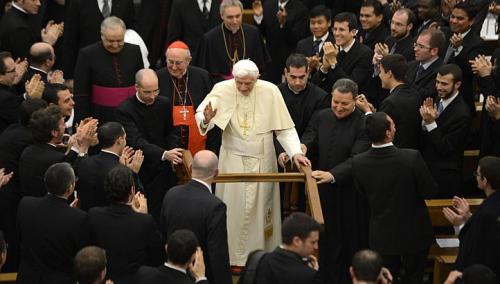
 

Shortly before the announcement of Pope Benedict XVI's resignation, on 8 February 2013, he gave a deeply Roman, Petrine, lesson in his meeting with the seminarians of Rome in the chapel of the Pontifical Roman Seminary (photo above from that meeting). Three days later, in a morning meeting with his cardinals, he announced his decision to step down from the papacy.


Excerpts from the official translation by the Holy See below:


"We have heard three verses from the First Letter of St Peter (cf. 1:3-5). Before going into this text it seems to me important to be aware of the fact that it is Peter who is speaking. The first two words of the Letter are Petrus apostolus (cf. v.1): he speaks and he speaks to the Churches in Asia and calls the faithful “chosen”, and “exiles of the Dispersion” (ibid.).


Let us reflect a little on this. Peter is speaking and - as we hear at the end of the Letter - he is speaking from Rome, which he called “Babylon” (cf. 5:13). Peter speaks as if it were a first encyclical with which the first Apostle, Vicar of Christ, addresses the Church of all time.


Peter, an apostle: thus, the one who is speaking is the one who found the Messiah in Jesus Christ, who was the first to speak on behalf of the future Church: “You are the Christ, the Son of the living God” (cf. Mt 16:16).


The one who introduced us to this faith is speaking, the one to whom the Lord said: “I will give you the keys of the kingdom of heaven” (cf. Mt 16:19), to whom he entrusted his flock after the Resurrection, saying to him three times: “Feed my lambs...Tend my sheep” (cf. Jn 21:15-17).


And it is also the man who fell who is speaking, the man who denied Jesus three times and was granted the grace to see Jesus’ look, to feel deeply moved in his heart and to find forgiveness and a renewal of his mission.


However, above all it is important that this man, full of passion, full of longing for God, full of a desire for the Kingdom of God, for the Messiah, this man who has found Jesus, the Lord and the Messiah, is also the man who sinned, who fell; and yet he remained in God’s sight and in this way he remained responsible for the Lord’s Church, he remained the one assigned by Christ, he remained the messenger of Christ’s love.

Peter the Apostle is speaking, but the exegetes tell us: it is impossible for this Letter to have been written by Peter because the Greek is so good that it cannot be the Greek of a fisherman from the Sea of Galilee.


And it is not only the language — the syntax is excellent — but also the thought which is already quite mature, there are actual formulas in which the faith and the reflection of the Church are summed up. These exegetes say, therefore: it had already reached a degree of development that cannot be Peter’s.


How does one respond? There are two important positions: first, Peter himself — that is, the Letter — gives us a clue, for at the end of the writing he says I write to you: “By Silvanus... dia Silvanus”.


This “by” [dia] could mean various things. It may mean that he [Silvanus] brings or transmits; it may mean that Silvanus helped him write it; it may mean that in practice it was really Silvanus who wrote it. In any case, we may conclude that the Letter itself points out to us that Peter was not alone in writing this Letter but it expresses the faith of a Church, which is already on a journey of faith, a faith increasingly mature. He does not write alone, as an isolated individual; he writes with the assistance of the Church, of people who help him to deepen the faith, to enter into the depths of his thought, of his rationality, of his profundity.


And this is very important: Peter is not speaking as an individual, he is speaking ex persona Ecclesiae, he is speaking as a man of the Church, as an individual of course, with his personal responsibility, but also as a person who speaks on behalf of the Church; not only private and original ideas, not as a 19th century genius who wished to express only personal and original ideas that no one else could have expressed first.


No.


He does not speak as an individualistic genius, but speaks, precisely, in the communion of the Church. In the Apocalypse, in the initial vision of Christ, it is said that Christ’s voice is like the sound of many waters (cf. Rev 1:15). This means: Christ’s voice gathers together all the waters of the world, bears within it all the living waters that give life to the world; he is a Person, but this is the very greatness of the Lord, that he bears within him all the rivers of the Old Testament, indeed, of the wisdom of peoples. ...

I would like to say something more: St Peter writes from Rome. This is important.


Here we already have the Bishop of Rome, we have the beginning of Succession, we already have the beginning of the actual Primacy located in Rome, not only granted by the Lord but placed here, in this city, in this world capital.


How did Peter come to Rome? This is a serious question. The Acts of the Apostles tell us that after his escape from Herod’s prison, he went to another place (cf. 12:17) - eis eteron topon. Where he went is not known; some say to Antioch, others, to Rome.


In any case, in this capital it should also be said that before fleeing he entrusted the Judaeo-Christian Church, the Church of Jerusalem, to James, and in entrusting her to James he nevertheless remained Primate of the universal Church, of the Church of the Gentiles but also of the Judaeo-Christian Church.


And here in Rome he found a great Judaeo-Christian community.


The liturgists tell us that in the Roman Canon there are traces of a characteristically Judaeo-Christian language.


Thus we see that in Rome both parts of the Church were to be found: the Judaeo-Christian and the pagan-Christian, united, an expression of the universal Church. And for Peter, moving from Jerusalem to Rome meant moving to the universality of the Church, moving to the Church of the Gentiles and of all the epochs, to the Church that also still belongs to the Jews.

And I think that in going to Rome St Peter not only thought of this transfer: Jerusalem/Rome, Judaeo-Christian Church/universal Church.


He certainly also remembered Jesus’ last words to him, recorded by St John: “when you are old, you will stretch out your hands, and another will gird you and carry you where you do not wish to go” (cf. Jn 21:18).


It is a prophecy of the crucifixion. Philologists show us that “stretch out your hands” is a precise, technical expression for the crucifixion. St Peter knew that his end would be martyrdom, would be the cross: that it would therefore be following Christ completely.


Consequently, in going to Rome there is no doubt that he was also going to martyrdom: martyrdom awaited him in Babylon. The primacy, therefore, has this content of universality but it has a martyrological content as well.


Furthermore, Rome had been a place of martyrdom from the outset. In going to Rome, Peter once again accepts this word of the Lord: he heads for the cross and invites us too to accept the martyrological aspect of Christianity, which may have very different forms.


And the cross may have very different forms, but no one can be Christian without following the Crucified One, without accepting the martyrological moment too.
...


Perhaps today we are tempted to say: we do not want to rejoice at having been chosen, for this would be triumphalism. It would be triumphalism to think that God had chosen me because I was so important. This would really be erroneous triumphalism.


However, being glad because God wanted me is not triumphalism. Rather, it is gratitude, and I think we should re-learn this joy: God wanted me to be born in this way, into a Catholic family, he wanted me to know Jesus from the first.


What a gift to be wanted by God so that I could know his face, so that I could know Jesus Christ, the human face of God, the human history of God in this world! Being joyful because he has chosen me to be a Catholic, to be in this Church of his, where subsistit Ecclesia unica; we should rejoice because God has given me this grace, this beauty of knowing the fullness of God’s truth, the joy of his love.
...


Christians are certainly not only foreigners; we are also Christian nations, we are proud of having contributed to the formation of culture; there is a healthy patriotism, a healthy joy of belonging to a nation that has a great history of culture and of faith.


Yet, as Christians, we are always also foreigners - the destiny of Abraham, described in the Letter to the Hebrews. As Christians we are, even today, also always foreigners.


In the work place, Christians are a minority, they find themselves in an extraneous situation; it is surprising that a person today can still believe and live like this. This is also part of our life: it is a form of being with the Crucified Christ; this being foreigners, not living in the way that everyone else lives, but living — or at least seeking to live — in accordance with his Word, very differently from what everyone says.


And it is precisely this that is characteristic of Christians. They all say: “But everyone does this, why don’t I?”


No, I don’t, because I want to live in accordance with God. St Augustine once said: “Christians are those who do not have their roots below, like trees, but have their roots above, and they do not live this gravity in the natural downwards gravitation."


Let us pray the Lord that he help us to accept this mission of living as exiles, as a minority, in a certain sense, of living as foreigners and yet being responsible for others and, in this way, reinforcing the goodness in our world.
...


Inheritance. It is a very important word in the Old Testament, where Abraham is told that his seed will inherit the earth, and this was always the promise for his descendants.


You will have the earth, you will be heirs of the earth. In the New Testament, this word becomes a word for us; we are heirs, not of a specific country, but of the land of God, of the future of God.


Inheritance is something of the future, and thus this word tells us above all that as Christians we have a future, the future is ours, the future is God’s. Thus, being Christians, we know that the future is ours and the tree of the Church is not a tree that is dying but a tree that constantly puts out new shoots.


Therefore we have a reason not to let ourselves be upset, as Pope John said, by the prophets of doom who say: well, the Church is a tree that grew from the mustard seed, grew for 2,000 years, now she has time behind her, it is now time for her to die.


No.


The Church is ever renewed, she is always reborn. The future belongs to us. Of course, there is a false optimism and a false pessimism. A false pessimism tells us that the epoch of Christianity is over. No: it is beginning again!


The false optimism was the post-Council optimism, when convents closed, seminaries closed and they said “but... nothing, everything is fine!”.... No! Everything is not fine. There are also serious, dangerous omissions and we have to recognize with healthy realism that in this way things are not all right, it is not all right when errors are made.


However, we must also be certain at the same time that if, here and there, the Church is dying because of the sins of men and women, because of their non-belief, at the same time she is reborn.


The future really belongs to God: this is the great certainty of our life, the great, true optimism that we know. The Church is the tree of God that lives for ever and bears within her eternity and the true inheritance: eternal life.
...


And, lastly, “guarded through faith.” The New Testament text, from the Letter of St Peter, uses a rare word here, phrouroumenoi, which means: there are the “guards” and faith is like the guards who preserve the integrity of my being, of my faith.


This word interprets in particular “the guards” at the gates of a city, where they stand and keep watch over the city so that it is not invaded by destructive powers.


Thus faith is a “guard” of my being, of my life, of my inheritance.


We must be grateful for this vigilance of faith that protects us, helps us, guides us, gives us the security: God does not let me fall from his hands.


Thursday, April 13, 2023

Cardinal Ratzinger on true consciousness in liturgical matters


"For fostering a true consciousness in liturgical matters, it is also important that the proscription against the form of liturgy in valid use up to 1970 should be lifted. Anyone who nowadays advocates the continuing existence of this [older] liturgy or takes part in it is treated like a leper; all tolerance ends here. There has never been anything like this in history; in doing this we are despising and proscribing the Church’s whole past. How can one trust her at present if things are that way?"


Cardinal Joseph Ratzinger, God and the World, trans. Henry Taylor (San Francisco: Ignatius Press, 2002), p. 416.

Saturday, January 14, 2023

Cardinal Ratzinger on the 9th Station of the Cross


NINTH STATION


Jesus falls for the third time

V/. Adoramus te, Christe, et benedicimus tibi.
R/. Quia per sanctam crucem tuam redemisti mundum.

From the Book of Lamentations. 3:27-32

It is good for a man that he bear the yoke in his youth. Let him sit alone in silence when he has laid it on him; let him put his mouth in the dust - there may yet be hope; let him give his cheek to the smiter, and be filled with insults. For the Lord will not cast off for ever, but, though he cause grief, he will have compassion, according to the abundance of his steadfast love.


MEDITATION


by Joseph Ratzinger

What can the third fall of Jesus under the Cross say to us?


We have considered the fall of man in general, and the falling of many Christians away from Christ and into a godless secularism. Should we not also think of how much Christ suffers in his own Church?


How often is the holy sacrament of his Presence abused, how often must he enter empty and evil hearts!


How often do we celebrate only ourselves, without even realizing that he is there!


How often is his Word twisted and misused!


What little faith is present behind so many theories, so many empty words!


How much filth there is in the Church, and even among those who, in the priesthood, ought to belong entirely to him!


How much pride, how much self-complacency!


What little respect we pay to the Sacrament of Reconciliation, where he waits for us, ready to raise us up whenever we fall!


All this is present in his Passion. His betrayal by his disciples, their unworthy reception of his Body and Blood, is certainly the greatest suffering endured by the Redeemer; it pierces his heart. We can only call to him from the depths of our hearts: Kyrie eleison ­ Lord, save us (cf. Mt 8: 25).


PRAYER

Lord, your Church often seems like a boat about to sink, a boat taking in water on every side.


In your field we see more weeds than wheat.


The soiled garments and face of your Church throw us into confusion.


Yet it is we ourselves who have soiled them! It is we who betray you time and time again, after all our lofty words and grand gestures.


Have mercy on your Church; within her too, Adam continues to fall.


When we fall, we drag you down to earth, and Satan laughs, for he hopes that you will not be able to rise from that fall; he hopes that being dragged down in the fall of your Church, you will remain prostrate and overpowered.


But you will rise again. You stood up, you arose and you can also raise us up.


Save and sanctify your Church. Save and sanctify us all.


Cardinal Ratzinger, Via Crucis, 25 March 2005, Rome.

Sunday, January 1, 2023

The Spiritual Testament of Pope Emeritus Benedict XVI


The Holy See releases the Spiritual Testament of Pope Emeritus Benedict XVI, dated 29 August 2006.

My spiritual testament

When, at this late hour of my life, I look back on the decades I have wandered through, I see first of all how much reason I have to give thanks. Above all, I thank God Himself, the giver of all good gifts, who has given me life and guided me through all kinds of confusion; who has always picked me up when I began to slip, who has always given me anew the light of his countenance. In retrospect, I see and understand that even the dark and arduous stretches of this path were for my salvation and that He guided me well in those very stretches.

I thank my parents, who gave me life in difficult times and prepared a wonderful home for me with their love, which shines through all my days as a bright light until today. My father's clear-sighted faith taught us brothers and sisters to believe and stood firm as a guide in the midst of all my scientific knowledge; my mother's heartfelt piety and great kindness remain a legacy for which I cannot thank her enough. My sister has served me selflessly and full of kind concern for decades; my brother has always paved the way for me with the clear-sightedness of his judgements, with his powerful determination, and with the cheerfulness of his heart; without this ever-new going ahead and going along, I would not have been able to find the right path.

I thank God from the bottom of my heart for the many friends, men and women, whom He has always placed at my side; for the co-workers at all stages of my path; for the teachers and students He has given me. I gratefully entrust them all to His goodness. And I would like to thank the Lord for my beautiful home in the Bavarian foothills of the Alps, in which I was able to see the splendour of the Creator Himself shining through time and again. I thank the people of my homeland for allowing me to experience the beauty of faith time and again. I pray that our country will remain a country of faith and I ask you, dear compatriots, not to let your faith be distracted. 

Finally, I thank God for all the beauty I was able to experience during the various stages of my journey, but especially in Rome and in Italy, which has become my second home.

I ask for forgiveness from the bottom of my heart from all those whom I have wronged in some way.

What I said earlier of my compatriots, I now say to all who were entrusted to my service in the Church: Stand firm in the faith! Do not be confused! Often it seems as if science - on the one hand, the natural sciences; on the other, historical research (especially the exegesis of the Holy Scriptures) - has irrefutable insights to offer that are contrary to the Catholic faith. I have witnessed from times long past the changes in natural science and have seen how apparent certainties against the faith vanished, proving themselves not to be science but philosophical interpretations only apparently belonging to science - just as, moreover, it is in dialogue with the natural sciences that faith has learned to understand the limits of the scope of its affirmations and thus its own specificity. For 60 years now, I have accompanied the path of theology, especially biblical studies, and have seen seemingly unshakeable theses collapse with the changing generations, which turned out to be mere hypotheses: the liberal generation (Harnack, Jülicher, etc.), the existentialist generation (Bultmann, etc.), the Marxist generation. I have seen, and see, how, out of the tangle of hypotheses, the reasonableness of faith has emerged and is emerging anew. Jesus Christ is truly the Way, the Truth, and the Life - and the Church, in all her shortcomings, is truly His Body.

Finally, I humbly ask: pray for me, so that the Lord may admit me to the eternal dwellings, despite all my sins and shortcomings. For all those entrusted to me, my heartfelt prayer goes out day after day.

Benedictus PP XVI


Saturday, August 27, 2022

Cardinal Ratzinger on Papal primacy


"Although it is not given us to halt the flight of history, to change the course of centuries, we may say, nevertheless, that what was possible for a thousand years is not impossible for Christians today.... In other words, Rome must not require more from the East with respect to the doctrine of primacy than had been formulated and was lived in the first millenniumWhen the Patriarch Athenagoras, on 25 July 1967, on the occasion of the Pope's visit to Phanar, designated him as the successor of St. Peter, as the most esteemed among us, as one also presides in charity, this great Church leader was expressing the essential content of the doctrine of primacy as it was known in the first millennium. Rome need not ask for more.


Reunion could take place in this context if, on the one hand, the East would cease to oppose as heretical the developments that took place in the West in the second millennium and would accept the Catholic Church as legitimate and orthodox in the form she had acquired in the course of that development, while, on the other hand, the West would recognize the Church of the East as orthodox and legitimate in the form she has always had."

Monday, July 15, 2019

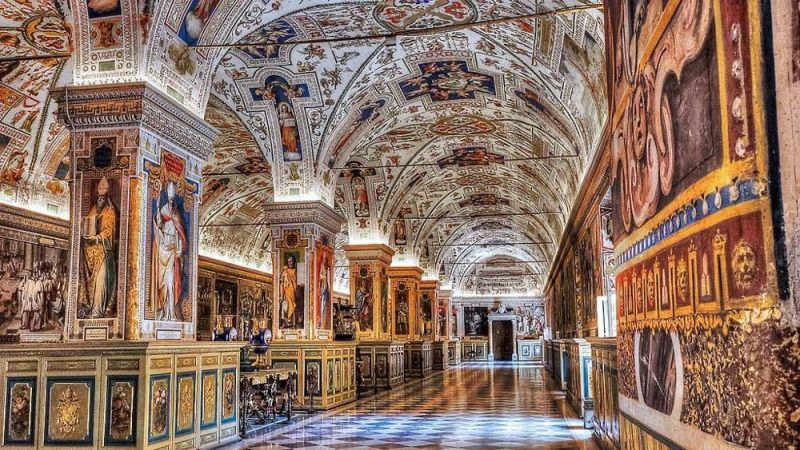
Benedict XVI on the Vatican Museums

Image result for vatican museum

"For many people a visit to the Vatican Museums during their stay in Rome represents their deepest and sometimes only contact with the Holy See. Therefore, is it a good opportunity to learn about the Christian message. We could say that the artistic heritage of Vatican City constitutes a kind of great 'parable' through which the Pope speaks to men and women from all over the world - and therefore from many cultural and religious backgrounds - people who perchance never read a papal address or homily. ... The language of art is a language of parables, possessing a special kind of universal openness. The 'Via Pulchtitudinis' can open people’s minds and hearts to the eternal, raising them to the heights of God.

I greatly appreciated the fact that the film makes repeated reference to the efforts of Roman Pontiffs to conserve and cherish artistic heritage, and to their efforts in modern times to renew the Church’s dialogue with artists. The collection of modern religious art in the Vatican Museums is living proof of the fruitfulness of that dialogue. Indeed, ... the entire great structure of the Vatican Museums ... possesses a dimension which we could define as 'evangelising'."


Benedict XVI, 25 October 2012

Thursday, February 28, 2019

Benedict XVI on the Year of Faith

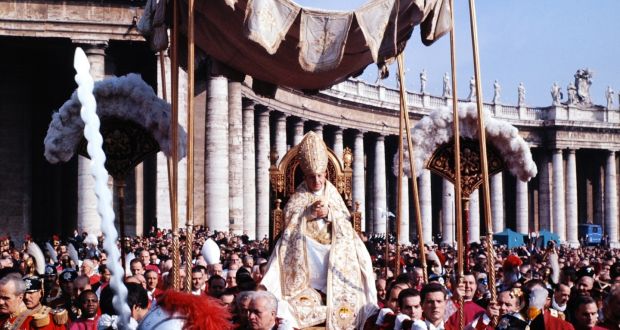
Pope John XXIII riding in procession to St Peter’s Basilica, at start of the Second Vatican Ecumenical Council. Photograph: Paul Schutzer/Time Life Pictures/Getty Images
Pope John XXIII riding in procession to St Peter’s Basilica, at the start of the Second Vatican Ecumenical Council.
 
"The Year of Faith which we launch today is linked harmoniously with the Church’s whole path over the last fifty years: from the Council, through the Magisterium of the Servant of God Paul VI, who proclaimed a Year of Faith in 1967, up to the Great Jubilee of the year 2000, with which Blessed John Paul II re-proposed to all humanity Jesus Christ as the one Saviour, yesterday, today and forever. Between these two Popes, Paul VI and John Paul II, there was a deep and profound convergence, precisely upon Christ as the centre of the cosmos and of history, and upon the apostolic eagerness to announce Him to the world. Jesus is the centre of the Christian faith. The Christian believes in God Whose face was revealed by Jesus Christ. He is the fulfilment of the Scriptures and their definitive interpreter".
 
"Today’s Gospel tells us that Jesus Christ, consecrated by the Father in the Holy Spirit, is the true and perennial subject of evangelisation. ... This mission of Christ, this movement of His continues in space and time, over centuries and continents. It is a movement which starts with the Father and, in the power of the Spirit, goes forth to bring the good news to the poor, in both a material and a spiritual sense. The Church is the first and necessary instrument of this work of Christ because it is united to Him as a body to its head".
 
"Vatican Council II did not wish to deal with the theme of faith in one specific document. It was, however, animated by a desire, as it were, to immerse itself anew in the Christian mystery so as to re-propose it fruitfully to contemporary man. ... In his opening speech Blessed John XXIII presented the principal purpose of the Council in this way: “What above all concerns the Ecumenical Council is this: that the sacred deposit of Christian doctrine be safeguarded and taught more effectively. … Therefore, the principal purpose of this Council is not the discussion of this or that doctrinal theme, a Council is not required for that, ... [but] this certain and immutable doctrine, which is to be faithfully respected, needs to be explored and presented in a way which responds to the needs of our time”.
 
"In the light of these words, we can understand what I myself felt at the time: during the Council there was an emotional tension as we faced the common task of making the truth and beauty of the faith shine out in our time, without sacrificing it to the demands of the present or leaving it tied to the past: the eternal presence of God resounds in the faith, transcending time, yet it can only be welcomed by us in our own unrepeatable today. Therefore I believe that the most important thing ... is to revive in the whole Church that positive tension, that yearning to announce Christ again to contemporary man. But, so that this interior thrust towards the new evangelisation neither remain just an idea nor be lost in confusion, ... I have often insisted on the need to return, as it were, to the “letter” of the Council - that is to its texts - also to draw from them its authentic spirit, and why I have repeated that the true legacy of Vatican II is to be found in them".
 
"The Council did not formulate anything new in matters of faith, nor did it wish to replace what was ancient. Rather, it concerned itself with seeing that the same faith might continue to be lived in the present day, that it might remain a living faith in a world of change. ... The Council Fathers wished to present the faith in a meaningful way; and if they opened themselves trustingly to dialogue with the modern world it is because they were certain of their faith, of the solid rock on which they stood. In the years following, however, many embraced uncritically the dominant mentality, placing in doubt the very foundations of the deposit of faith, which they sadly no longer felt able to accept as truths."
 
"If today the Church proposes a new Year of Faith and a new evangelisation, it is not to honour an anniversary, but because there is more need of it, even more than there was fifty years ago! ... Even the initiative to create a pontifical council for the promotion of the new evangelisation ... is to be understood in this context. Recent decades have seen the advance of a spiritual “desertification”. In the Council’s time it was already possible from a few tragic pages of history to know what a life or a world without God looked like, but now we see it every day around us. ... But it is in starting from the experience of this desert ... that we can again discover the joy of believing, its vital importance for us".
 
"In the desert we rediscover the value of what is essential for living; thus in today’s world there are innumerable signs, often expressed implicitly or negatively, of the thirst for God, for the ultimate meaning of life. And in the desert people of faith are needed who, with their own lives, point out the way to the Promised Land and keep hope alive. Living faith opens the heart to the grace of God which frees us from pessimism. Today, more than ever, evangelising means witnessing to the new life, transformed by God, and thus showing the path".
 
"The journey is a metaphor for life, and the wise wayfarer is one who has learned the art of living, and can share it with his brethren - as happens to pilgrims along the Way of St. James or similar routes which, not by chance, have again become popular in recent years. How come so many people today feel the need to make these journeys? Is it not because they find there, or at least intuit, the meaning of our existence in the world? This, then, is how we can picture the Year of Faith: a pilgrimage in the deserts of today’s world, taking with us only what is necessary: ... the Gospel and the faith of the Church, of which the Council documents are a luminous expression, as is the Catechism of the Catholic Church, published twenty years ago."
 
"Venerable and dear brothers, 11 October 1962 was the Feast of Mary Most Holy, Mother of God. Let us entrust to her the Year of Faith, as I did last week when I went on pilgrimage to Loreto. May the Virgin Mary always shine out as a star along the way of the new evangelisation".
 
Extracts from a homily by Pope Benedict XVI during the course of a Mass celebrated in St. Peter's Square on 11 October 2012.

Tuesday, January 22, 2019

John Paul II on salvation in Jesus Christ - 2

Image result for john paul 2

"For those, however, who have not received the Gospel proclamation, as I wrote in the Encyclical Redemptoris Missio, salvation is accessible in mysterious ways, inasmuch as divine grace is granted to them by virtue of Christ's redeeming sacrifice, without external membership in the Church, but nonetheless always in relation to her (cf. RM 10). It is a mysterious relationship. It is mysterious for those who receive the grace, because they do not know the Church and sometimes even outwardly reject her."

John Paul II, General Audience, 31 May 1995

Sunday, September 2, 2018

Ratzinger on the Church of the Future


"From the crisis of today the Church of tomorrow will emerge—a Church that has lost much.
 
She will become small and will have to start afresh more or less from the beginning.
 
She will no longer be able to inhabit many of the edifices she built in prosperity.
 
As the number of her adherents diminishes, so will she lose many of her social privileges. In contrast to an earlier age, she will be seen much more as a voluntary society, entered only by free decision.

As a small society, she will make much bigger demands on the initiative of her individual members.
 
Undoubtedly she will discover new forms of ministry and will ordain to the priesthood approved Christians who pursue some profession. In many smaller congregations or in self-contained social groups, pastoral care will normally be provided in this fashion.
 
Alongside this, the full-time ministry of the priesthood will be indispensable as formerly.

But in all of the changes at which one might guess, the Church will find her essence afresh and with full conviction in that which was always at her center: faith in the triune God, in Jesus Christ, the Son of God made man, in the presence of the Spirit until the end of the world.
 
In faith and prayer she will again recognize her true center and experience the sacraments again as the worship of God and not as a subject for liturgical scholarship.

The Church will be a more spiritual Church, not presuming upon a political mandate, flirting as little with the Left as with the Right.
 
It will be hard going for the Church, for the process of crystalization and clarification will cost her much valuable energy.
 
It will make her poor and cause her to become the Church of the meek.

The process will be all the more arduous, for sectarian narrow-mindedness as well as pompous self-will will have to be shed.
 
One may predict that all of this will take time. The process will be long and wearisome as was the road from the false progressivism of the eve of the French Revolution—when a bishop might be thought smart if he made fun of dogmas and even insinuated that the existence of God was by no means certain—to the renewal of the nineteenth century.

But when the trial of this sifting is past, a great power will flow from a more spiritualized and simplified Church.

Men in a totally planned world will find themselves unspeakably lonely. If they have completely lost sight of God, they will feel the whole horror of their poverty.
 
Then they will discover the little flock of believers as something wholly new.
 
They will discover it as a hope that is meant for them, an answer for which they have always been searching in secret.

And so it seems certain to me that the Church is facing very hard times.
 
The real crisis has scarcely begun.
 
We will have to count on terrific upheavals.
 
But I am equally certain about what will remain at the end: not the Church of the political cult, which is dead already with Gobel, but the Church of faith.
 
She may well no longer be the dominant social power to the extent that she was until recently; but she will enjoy a fresh blossoming and be seen as man’s home, where he will find life and hope beyond death."

Father Joseph Ratzinger, Faith and the Future, (published originally in German in 1970 as Glaube und Zukunft), republished by the Vatican Press in 2006.


Tuesday, October 25, 2016

Benedict XVI on ad orientem


“In the liturgy’s orientation to the East, we see that Christians, together with the Lord, want to progress toward the salvation of creation in its entirety.

...

Christ, the crucified and risen Lord, is at the same time also the ‘sun’ that illuminates the world. Faith is also always directed toward the totality of creation. Therefore, Patriarch Bartholomew fulfills an essential aspect of his priestly mission precisely with his commitment to creation.

...

A shepherd of the flock of Jesus Christ is never oriented merely to the circle of his own faithful. The community of the Church is universal also in the sense that it includes all of reality.”

Benedict XVI,  L'Osservatore Romano, 12 October 2016

Wednesday, September 14, 2016

Benedict XVI on the Second Vatican Council

Ratzinger was peritus of Archbishop of Cologne, Cardinal Joseph Frings, during the Second Vatican Council.

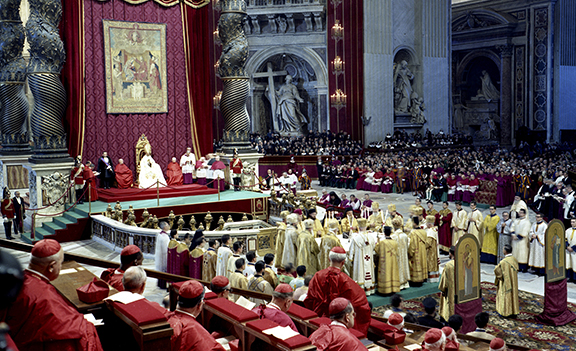
"It was a splendid day on 11 October 1962 when the Second Vatican Council opened with the solemn procession into St Peter’s Basilica in Rome of more than two thousand Council Fathers. In 1931 Pius XI had dedicated this day to the feast of the Divine Motherhood of Mary, mindful that 1,500 years earlier, in 431, the Council of Ephesus had solemnly recognized this title for Mary in order to express God’s indissoluble union with man in Christ. Pope John XXIII had chosen this day for the beginning of the Council so as to entrust the great ecclesial assembly, which he had convoked, to the motherly goodness of Mary and to anchor the Council’s work firmly in the mystery of Jesus Christ. It was impressive to see in the entrance procession bishops from all over the world, from all peoples and all races: an image of the Church of Jesus Christ which embraces the whole world, in which the peoples of the earth know they are united in his peace.

It was a moment of extraordinary expectation. Great things were about to happen. The previous Councils had almost always been convoked for a precise question to which they were to provide an answer. This time there was no specific problem to resolve. But precisely because of this, a general sense of expectation hovered in the air: Christianity, which had built and formed the Western world, seemed more and more to be losing its power to shape society. It appeared weary and it looked as if the future would be determined by other spiritual forces. The sense of this loss of the present on the part of Christianity, and of the task following on from that, was well summed up in the word aggiornamento (updating). Christianity must be in the present if it is to be able to form the future. So that it might once again be a force to shape the future, John XXIII had convoked the Council without indicating to it any specific problems or programmes. This was the greatness and at the same time the difficulty of the task that was set before the ecclesial assembly.

The various episcopates undoubtedly approached the great event with different ideas. Some of them arrived rather with an attitude of expectation regarding the programme that was to be developed. It was the episcopates of Central Europe – Belgium, France and Germany – that came with the clearest ideas. In matters of detail, they stressed completely different aspects, yet they had common priorities. A fundamental theme was ecclesiology, that needed to be studied in greater depth from a Trinitarian and sacramental viewpoint and in connection with salvation history; then there was a need to amplify the doctrine of primacy from the First Vatican Council by giving greater weight to the episcopal ministry. An important theme for the episcopates of Central Europe was liturgical renewal, which Pius XII had already started to implement. Another central aspect, especially for the German episcopate, was ecumenism: the shared experience of Nazi persecution had brought Protestant and Catholic Christians closer together; this now had to happen at the level of the whole Church, and to be developed further. Then there was also the group of themes: Revelation – Scripture – Tradition – Magisterium. For the French, the subject of the relationship between the Church and the modern world came increasingly to the fore – in other words the work of the so-called “Schema XIII”, from which the Pastoral Constitution on the Church in the Modern World later emerged. This point touches on the real expectations of the Council. The Church, which during the Baroque era was still, in a broad sense, shaping the world, had from the nineteenth century onwards visibly entered into a negative relationship with the modern era, which had only then properly begun. Did it have to remain so? Could the Church not take a positive step into the new era? Behind the vague expression “today’s world” lies the question of the relationship with the modern era. To clarify this, it would have been necessary to define more clearly the essential features that constitute the modern era. “Schema XIII” did not succeed in doing this. Although the Pastoral Constitution expressed many important elements for an understanding of the “world” and made significant contributions to the question of Christian ethics, it failed to offer substantial clarification on this point.

Unexpectedly, the encounter with the great themes of the modern epoch did not happen in the great Pastoral Constitution, but instead in two minor documents, whose importance has only gradually come to light in the context of the reception of the Council. First, there is the Declaration on Religious Liberty, which was urgently requested, and also drafted, by the American Bishops in particular. With developments in philosophical thought and in ways of understanding the modern State, the doctrine of tolerance, as worked out in detail by Pius XII, no longer seemed sufficient. At stake was the freedom to choose and practise religion and the freedom to change it, as fundamental human rights and freedoms. Given its inner foundation, such a concept could not be foreign to the Christian faith, which had come into being claiming that the State could neither decide on the truth nor prescribe any kind of worship. The Christian faith demanded freedom of religious belief and freedom of religious practice in worship, without thereby violating the law of the State in its internal ordering; Christians prayed for the emperor, but did not worship him. To this extent, it can be said that Christianity, at its birth, brought the principle of religious freedom into the world. Yet the interpretation of this right to freedom in the context of modern thought was not easy, since it could seem as if the modern version of religious freedom presupposed the inaccessibility of the truth to man and so, perforce, shifted religion into the sphere of the subjective. It was certainly providential that thirteen years after the conclusion of the Council, Pope John Paul II arrived from a country in which freedom of religion had been denied by Marxism, in other words by a particular form of modern philosophy of the State. The Pope had come, as it were, from a situation resembling that of the early Church, so that the inner orientation of the faith towards the theme of freedom, and especially freedom of religion and worship, became visible once more.

The second document that was to prove important for the Church’s encounter with the modern age came into being almost by chance and it developed in various phases. I am referring to the Declaration “Nostra Aetate” on the Relation of the Church to Non-Christian Religions. At the outset the intention was to draft a declaration on relations between the Church and Judaism, a text that had become intrinsically necessary after the horrors of the Shoah. The Council Fathers from Arab countries were not opposed to such a text, but they explained that if there were an intention to speak of Judaism, then there should also be some words on Islam. How right they were, we in the West have only gradually come to understand. Lastly the realization grew that it was also right to speak of two other great religions – Hinduism and Buddhism – as well as the theme of religion in general. Then, following naturally, came a brief indication regarding dialogue and collaboration with the religions, whose spiritual, moral, and socio-cultural values were to be respected, protected and encouraged (ibid., 2). Thus, in a precise and extraordinarily dense document, a theme is opened up whose importance could not be foreseen at the time. The task that it involves and the efforts that are still necessary in order to distinguish, clarify and understand, are appearing ever more clearly. In the process of active reception, a weakness of this otherwise extraordinary text has gradually emerged: it speaks of religion solely in a positive way and it disregards the sick and distorted forms of religion which, from the historical and theological viewpoints, are of far-reaching importance; for this reason the Christian faith, from the outset, adopted a critical stance towards religion, both internally and externally.

If at the beginning of the Council the dominant groups were the Central European Episcopates with their theologians, during the Council sessions the scope of the common endeavour and responsibility constantly broadened. The bishops considered themselves apprentices at the school of the Holy Spirit and at the school of reciprocal collaboration, but at the same time servants of the word of God who were living and working in faith. The Council Fathers neither could nor wished to create a new or different Church. They had neither the authority nor the mandate to do so. It was only in their capacity as bishops that they were now Council Fathers with a vote and decision-making powers, that is to say, on the basis of the Sacrament and in the Church of the Sacrament. For this reason they neither could nor wished to create a different faith or a new Church, but rather to understand these more deeply and hence truly to “renew them”. This is why a hermeneutic of rupture is absurd and is contrary to the spirit and the will of the Council Fathers.

In Cardinal Frings I had a “father” who lived this spirit of the Council in an exemplary way. He was a man of great openness and breadth, but he also knew that faith alone leads us out into the open, into that space which remains barred to the positivist spirit. This is the faith that he wished to serve with the authority he had received through the sacrament of Episcopal Ordination. I cannot but be ever grateful to him for having brought me – the youngest professor of the Catholic theology faculty of the University of Bonn – as his consultant to the great Church assembly, thereby enabling me, alongside the others, to attend that school and to walk the path of the Council from within. The present volume contains a collection of the various writings that I presented at that school. They are thoroughly fragmentary offerings, which also reveal the learning process that the Council and its reception meant and still means for me. I hope that despite all their limitations, these various offerings, combined, will help to make the Council better understood and to implement it in a healthy ecclesial life. I warmly thank Archbishop Gerhard Ludwig Müller and his collaborators at the Pope Benedict XVI Institute for the extraordinary commitment they have taken on in order to produce this volume.

Castel Gandolfo, on the Feast of Saint Eusebius, Bishop of Vercelli
2 August 2012

Benedictus PP. XVI"