Showing posts with label Catholic. Show all posts

Tuesday, December 10, 2024

Archives of the Order (10) - Decree of the Sacred Council of the Sovereign Order of St. John of Jerusalem (1801)


In order to contribute as soon as possible to the restoration of a Grand Master, and the primitive constitution to the Order of St. John of Jerusalem, the sovereign council of the said Order, in the meeting of the 22nd of June 1801, has inquired into the form of convocation for a general chapter, and finds that the statutes are as follows on that subject:


"A General Chapter must consist of the Grand Master, the Bishop of Malta, the Prior of the Church, the Conventual Bailiffs or Pillars of the Languages, the Grand Priors or Capitular Bailiffs who have a decisive vote, a Solicitor for the Knights of each Language, and a Solicitor for the Commanders of each Priory.”

The sovereign council, in consideration that all the elements of a general chapter are dispersed, and knowing that, in the present situation of things, it would be impossible to assemble them, according to the form expressed in the statutes, has resolved to adopt a mode of election which shall differ as little as possible from the ancient one, prevent delay, spare the priories all unnecessary expense and convenience, and immediately fix upon a chief for the sovereign Order to govern it, and take possession of the island of Malta, whenever circumstances shall make it possible to do so.

For this purpose, the sovereign council enjoins all the Grand Priors immediately to convene their chapters, and to carry before them the following propositions:

1st. The provincial chapter shall mark out, among the professed Knights of every language, those whom they think most capable of filling the dignity of Grand Master with due courage and firmness. The Grand Priors shall acquaint the sovereign council as soon as possible with this opinion, that a list may be formed from all the different priories of those who are candidates for the Grand Mastership.

2nd. The council proposes to send this list to the court of Rome, and His Holiness, as supreme chief of the Roman Church, and as superior of all religious Orders, shall be entreated to select a Grand Master from among the candidates; specifying at the same time, that this is only to be the case on this one occasion, and without derogating in any degree from the rights and privileges of the sovereign Order.

His Holiness shall also be requested to notify this election to all Catholic countries by a pontifical brief, commanding the Knights to obey the Grand Master thus chosen, according to the statutes of holy obedience.

All the sovereign chapters shall be summoned by their Grand Priors to declare their opinions formally and with precision, on the question of referring to the Pope to elect a Grand Master from the number of professed Knights pointed out by the different priories.

By these means the Order will be assured of having a Grand Master of its own choice, and from among its own members; and the sovereign council may proceed with confidence, according to the wishes and opinions of all the capitular chapters. Moreover, the sovereign council represents to all the Grand Priors, that it is more important than ever to employ all their authority and prudence to prevent every kind of division and intrigue, to choose a candidate truly worthy of the sovereign command, endowed with the necessary qualities to make the Order of general utility, and to restore a severe discipline.

Lastly, the sovereign council has in its wisdom judged that this was the only method to conciliate the members in general, to avoid all pretences for schisms, and to unite all the scattered members of the Order of St. John of Jerusalem.

Given at St. Petersburg, the 20th day of July 1801.

Source: A History of the Knights of Malta, Vol 2., Porter, Wintworth., (c) 1858, Longman, Brown, Green, Longmans, & Roberts, London.

Wednesday, December 6, 2023

Papal supremacy and the Orthodox Church


The Eastern Orthodox Church is opposed to the Roman Catholic doctrine of papal supremacy. While not denying that primacy does exist for the Bishop of Rome, Eastern Orthodox Christians argue that the tradition of Rome's primacy in the early Church was not equivalent to the current doctrine of supremacy.

The Bishop of Rome, according to the Orthodox, is simply “first among equals” (primus inter pares). 

This Blog will post important documents from the Orthodox tradition on this issue, from time to time. They are the following:

The Role of the Bishop of Rome in the Communion of the Church in the First Millennium

Position of the Moscow Patriarchate on the problem of primacy in the Universal Church

Wednesday, April 14, 2021

Orthodox Church and Purgatory


The Orthodox Church does not believe in purgatory (a place of purging), that is, the inter-mediate state after death in which the souls of the saved (those who have not received temporal punishment for their sins) are purified of all taint preparatory to entering into Heaven, where every soul is perfect and fit to see God.

Also, the Orthodox Church does not believe in indulgences as remissions from purgatorial punishment. Both purgatory and indulgences are inter-correlated theories, and according to the Orthodox, unwitnessed in the Bible or in the Ancient Church. However, the below decree does seem to indicate that the Orthodox position - if not the same -  seems similar to Purgatory.

Orthodox Council of Jerusalem 1672
Decree 18
We believe that the souls of those that have fallen asleep are either at rest or in torment, according to what each has done; — for when they are separated from their bodies, they depart immediately either to joy, or to sorrow and lamentation; though confessedly neither their enjoyment nor condemnation are complete. For after the common resurrection, when the soul shall be united with the body, with which it had behaved itself well or ill, each shall receive the completion of either enjoyment or of condemnation.
And the souls of those involved in mortal sins, who have not departed in despair but while still living in the body, though without bringing forth any fruits of repentance, have repented — by pouring forth tears, by kneeling while watching in prayers, by afflicting themselves, by relieving the poor, and finally by showing forth by their works their love towards God and their neighbor, and which the Catholic Church has from the beginning rightly called satisfaction — [their souls] depart into Hades, and there endure the punishment due to the sins they have committed. But they are aware of their future release from there, and are delivered by the Supreme Goodness, through the prayers of the Priests, and the good works which the relatives of each do for their Departed; especially the unbloody Sacrifice benefiting the most; which each offers particularly for his relatives that have fallen asleep, and which the Catholic and Apostolic Church offers daily for all alike. Of course, it is understood that we do not know the time of their release. We know and believe that there is deliverance for such from their direful condition, and that before the common resurrection and judgment, but when we know not.

Friday, February 22, 2019

Benedict XVI on Pope Pius XII


"Here in this place, how could we not remember the Roman Jews who were snatched from their homes, before these very walls, and who with tremendous brutality were killed at Auschwitz? How could one ever forget their faces, their names, their tears, the desperation faced by these men, women and children? The extermination of the people of the Covenant of Moses, at first announced, then systematically programmed and put into practice in Europe under the Nazi regime, on that day tragically reached as far as Rome. Unfortunately, many remained indifferent, but many, including Italian Catholics, sustained by their faith and by Christian teaching, reacted with courage, often at risk of their lives, opening their arms to assist the Jewish fugitives who were being hunted down, and earning perennial gratitude. The Apostolic See (the Holy See under Pius XII helped the Jews) itself provided assistance, often in a hidden and discreet way".
 
Pope Benedict XVI during his visit to the Roman Synagogue on 17 January 2010.

Sunday, February 7, 2016

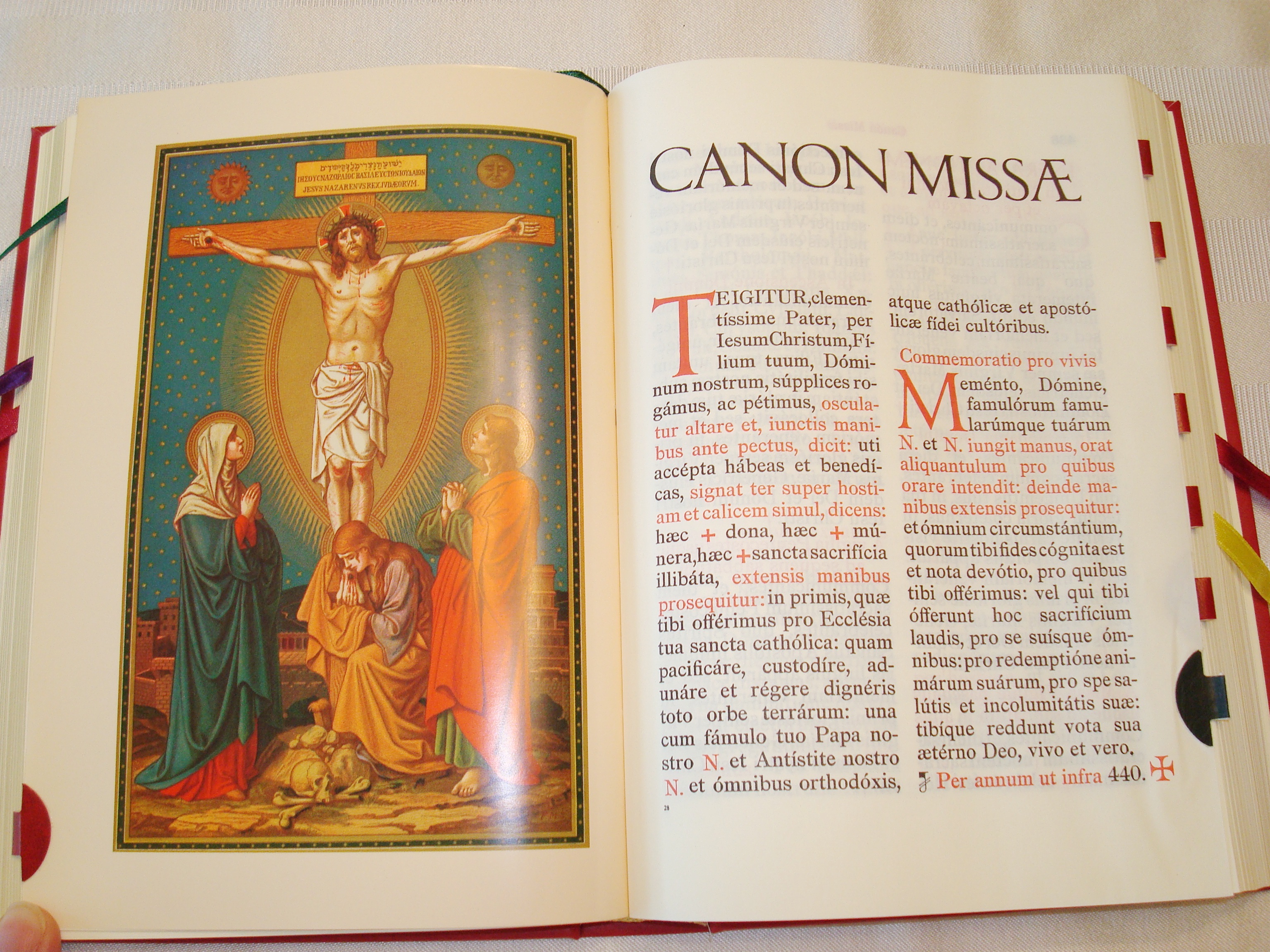
Cardinal Ratzinger on Liturgy - 3


http://www.wdtprs.com/images/BLOG/07_09_01_MR62_7_100.jpg
Missale Romanum
"I was dumbfounded upon hearing about the interdiction of the old Missal, since such a move had never been seen in the entire history of Catholic liturgy. The impression was given that this was all quite normal. The previous Missal had been realized by Pope St. Pius V, in 1570, immediately following the Council of Trent (1545-1563); it was therefore considered normal that, after 400 years and a new Council, a new Pope should therefore also publish a new Missal. However, the historical truth is another matter altogether. Pius V had limited himself to republishing the Roman Missal then in use just as it had always been down through the centuries of history. Also, many of his successors, following his example, had also had the Missal republished, without ever opposing one Missal to another. It has always been a continuing process of historical growth and purification in which, however, essential continuity had never been destroyed. There does not exist, nor has there ever existed, a Missal completely made up by Pius V. There was only a new elaboration ordered by him, constituting merely a phase in a long process of historical growth.
Following the Council of Trent, the new reality was of a quite different nature: the eruption of the Protestant "reform" had occurred especially under the form of liturgical "reforms"...; so much so, in fact, that the limits between that which was still Catholic and that which was no longer so, were often difficult to define. In such a confused state of affairs, resulting from a lack of uniform liturgical norms, together with a liturgical plurality inherited from the Middle Ages, the Pope decided that the Missale Romanum, that is, the liturgical text then in use in Rome, was to be introduced everywhere that there existed a liturgy dating back to less than 200 years previously. The reason for this was that the timeless Roman liturgy was most assuredly Catholic in every sense of the term. Wherever it could be done, the preceding liturgy (i.e., that dating back 200 years or more) was allowed to be maintained since its truly Catholic character could be considered to be absolutely certain."  - Joseph Cardinal Ratzinger, La mia vita, pp. 111, 112.