Showing posts with label Year of Faith. Show all posts

Thursday, February 28, 2019

Benedict XVI on the Year of Faith

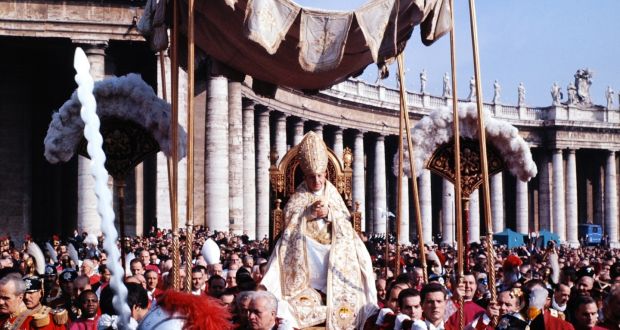
Pope John XXIII riding in procession to St Peter’s Basilica, at start of the Second Vatican Ecumenical Council. Photograph: Paul Schutzer/Time Life Pictures/Getty Images
Pope John XXIII riding in procession to St Peter’s Basilica, at the start of the Second Vatican Ecumenical Council.
 
"The Year of Faith which we launch today is linked harmoniously with the Church’s whole path over the last fifty years: from the Council, through the Magisterium of the Servant of God Paul VI, who proclaimed a Year of Faith in 1967, up to the Great Jubilee of the year 2000, with which Blessed John Paul II re-proposed to all humanity Jesus Christ as the one Saviour, yesterday, today and forever. Between these two Popes, Paul VI and John Paul II, there was a deep and profound convergence, precisely upon Christ as the centre of the cosmos and of history, and upon the apostolic eagerness to announce Him to the world. Jesus is the centre of the Christian faith. The Christian believes in God Whose face was revealed by Jesus Christ. He is the fulfilment of the Scriptures and their definitive interpreter".
 
"Today’s Gospel tells us that Jesus Christ, consecrated by the Father in the Holy Spirit, is the true and perennial subject of evangelisation. ... This mission of Christ, this movement of His continues in space and time, over centuries and continents. It is a movement which starts with the Father and, in the power of the Spirit, goes forth to bring the good news to the poor, in both a material and a spiritual sense. The Church is the first and necessary instrument of this work of Christ because it is united to Him as a body to its head".
 
"Vatican Council II did not wish to deal with the theme of faith in one specific document. It was, however, animated by a desire, as it were, to immerse itself anew in the Christian mystery so as to re-propose it fruitfully to contemporary man. ... In his opening speech Blessed John XXIII presented the principal purpose of the Council in this way: “What above all concerns the Ecumenical Council is this: that the sacred deposit of Christian doctrine be safeguarded and taught more effectively. … Therefore, the principal purpose of this Council is not the discussion of this or that doctrinal theme, a Council is not required for that, ... [but] this certain and immutable doctrine, which is to be faithfully respected, needs to be explored and presented in a way which responds to the needs of our time”.
 
"In the light of these words, we can understand what I myself felt at the time: during the Council there was an emotional tension as we faced the common task of making the truth and beauty of the faith shine out in our time, without sacrificing it to the demands of the present or leaving it tied to the past: the eternal presence of God resounds in the faith, transcending time, yet it can only be welcomed by us in our own unrepeatable today. Therefore I believe that the most important thing ... is to revive in the whole Church that positive tension, that yearning to announce Christ again to contemporary man. But, so that this interior thrust towards the new evangelisation neither remain just an idea nor be lost in confusion, ... I have often insisted on the need to return, as it were, to the “letter” of the Council - that is to its texts - also to draw from them its authentic spirit, and why I have repeated that the true legacy of Vatican II is to be found in them".
 
"The Council did not formulate anything new in matters of faith, nor did it wish to replace what was ancient. Rather, it concerned itself with seeing that the same faith might continue to be lived in the present day, that it might remain a living faith in a world of change. ... The Council Fathers wished to present the faith in a meaningful way; and if they opened themselves trustingly to dialogue with the modern world it is because they were certain of their faith, of the solid rock on which they stood. In the years following, however, many embraced uncritically the dominant mentality, placing in doubt the very foundations of the deposit of faith, which they sadly no longer felt able to accept as truths."
 
"If today the Church proposes a new Year of Faith and a new evangelisation, it is not to honour an anniversary, but because there is more need of it, even more than there was fifty years ago! ... Even the initiative to create a pontifical council for the promotion of the new evangelisation ... is to be understood in this context. Recent decades have seen the advance of a spiritual “desertification”. In the Council’s time it was already possible from a few tragic pages of history to know what a life or a world without God looked like, but now we see it every day around us. ... But it is in starting from the experience of this desert ... that we can again discover the joy of believing, its vital importance for us".
 
"In the desert we rediscover the value of what is essential for living; thus in today’s world there are innumerable signs, often expressed implicitly or negatively, of the thirst for God, for the ultimate meaning of life. And in the desert people of faith are needed who, with their own lives, point out the way to the Promised Land and keep hope alive. Living faith opens the heart to the grace of God which frees us from pessimism. Today, more than ever, evangelising means witnessing to the new life, transformed by God, and thus showing the path".
 
"The journey is a metaphor for life, and the wise wayfarer is one who has learned the art of living, and can share it with his brethren - as happens to pilgrims along the Way of St. James or similar routes which, not by chance, have again become popular in recent years. How come so many people today feel the need to make these journeys? Is it not because they find there, or at least intuit, the meaning of our existence in the world? This, then, is how we can picture the Year of Faith: a pilgrimage in the deserts of today’s world, taking with us only what is necessary: ... the Gospel and the faith of the Church, of which the Council documents are a luminous expression, as is the Catechism of the Catholic Church, published twenty years ago."
 
"Venerable and dear brothers, 11 October 1962 was the Feast of Mary Most Holy, Mother of God. Let us entrust to her the Year of Faith, as I did last week when I went on pilgrimage to Loreto. May the Virgin Mary always shine out as a star along the way of the new evangelisation".
 
Extracts from a homily by Pope Benedict XVI during the course of a Mass celebrated in St. Peter's Square on 11 October 2012.

Wednesday, February 27, 2013

Benedict XVI on temptations


"In this Year of Faith, Lent is a favorable time to rediscover faith in God as the fundamental criterion of our life and of the life of the Church. This always entails a struggle, a spiritual combat, because the spirit of evil naturally sets itself against our sanctification and seeks to make us deviate from the way of God.

At the beginning of his public ministry Jesus had to unmask and reject the false images of the Messiah that the tempter proposed to him. But these temptations are also false images of man, which always assail our conscience, disguising themselves as suitable and efficacious, even good, proposals.

The evangelists Matthew and Luke present three temptations of Jesus, differing in part only in their order. The nucleus of these temptations always consists in using God for one's own ends, giving more importance to success or to material goods. The tempter is deceptive: he does not direct us immediately toward evil, but toward a false good, making us believe that the true realities are power and what satisfies primary needs.

In this way, God becomes secondary; he is reduced to a means, in the end he becomes unreal, no longer counts, disappears. In the final analysis, in temptations, faith is at stake, because God is at stake. In the decisive moments of life and, if we see clearly, at every moment of life, we are faced with a choice: do we want to follow the “I” or God? Do we want to follow individual interest or the true Good, that which is really good?

As the Fathers of the Church teach us, temptations are part of Jesus's 'descent' into our human condition, into the abyss of sin and its consequences. A 'descent' that Jesus undertook to the very end, to the point of death on the cross and the descent into the netherworld of extreme distance from God. In this way, he is the hand that God stretched out to man, to the lost sheep, to bring him back to safety.

As St. Augustine teaches, Jesus has taken temptations from us, to give us his victory (cf. Enarr. in Psalmos, 60,3: PL 36, 724).

We are not, therefore, afraid to face, we also, the combat against the spirit of evil: the important thing is that we do it with Him, with Christ, the Victor.

And to stand with Him we turn to the Mother, Mary: let us invoke her with filial confidence in the hour of trial, and she will make us feel the powerful presence her divine Son, to reject the temptations with the Word of Christ, and so to put God once again at the center of our life."  Benedict XVI, Angelus, 17 February 2013.

Thursday, February 21, 2013

Benedict XVI to the youth in Lebanon

Benedict XVI in Lebanon, September 2012


Dear friends,

you are living today in this part of the world which witnessed the birth of Jesus and the growth of Christianity. It is a great honour! It is also a summons to fidelity, to love of this region and, above all, to your calling to be witnesses and messengers of the joy of Christ. The faith handed down from the Apostles leads to complete freedom and joy, as the many Saints and Blesseds of this country have shown. Their message lights up the universal Church. It can light up your lives as well. Many of the Apostles and saints lived in troubled times and their faith was the source of their courage and their witness. Find in their example and intercession the inspiration and support that you need!
...

You have a special place in my heart and in the whole Church, because the Church is always young! The Church trusts you. She counts on you! Be young in the Church! Be young with the Church! The Church needs your enthusiasm and your creativity! Youth is the time when we aspire to great ideals, when we study and train for our future work. All this is important and it takes time. Seek beauty and strive for goodness! Bear witness to the grandeur and the dignity of your body which "is for the Lord" (1 Cor 6:13b). Be thoughtful, upright and pure of heart! In the words of Blessed John Paul II, I say to you: "Do not be afraid! Open the doors of your minds and hearts to Christ!" An encounter with Jesus "gives life a new horizon and a decisive direction" (Deus Caritas Est, 1). In Christ you will find the strength and courage to advance along the paths of life, and to overcome difficulties and suffering. In him you will find the source of joy. Christ says to you: "Salàmi ō-tīkum" This is the true revolution brought by Christ: that of love.
...

Bring the love of Christ to everyone! How? By turning unreservedly to God the Father, who is the measure of everything that is right, true and good. Meditate on God’s word! Discover how relevant and real the Gospel can be. Pray! Prayer and the sacraments are the sure and effective means to be a Christian and to live "rooted and built up in Christ, and established in the faith" (Col 2:7). The Year of Faith, which is about to begin, will be a time to rediscover the treasure of the faith which you received at Baptism. You can grow in knowledge and understanding of this treasure by studying the Catechism, so that your faith can be both living and lived. You will then become witnesses to others of the love of Christ. In him, all men and women are our brothers and sisters. The universal brotherhood which he inaugurated on the cross lights up in a resplendent and challenging way the revolution of love. "Love one another as I have loved you" (Jn 13:35). This is the legacy of Jesus and the sign of the Christian. This is the true revolution of love!

Christ asks you, then, to do as he did: to be completely open to others, even if they belong to a different cultural, religious or national group. Making space for them, respecting them, being good to them, making them ever more rich in humanity and firm in the peace of the Lord. I know that many among you take part in various activities sponsored by parishes, schools, movements and associations. It is a fine thing to be engaged with and for others. Experiencing together moments of friendship and joy enables us to resist the onset of division, which must always be rejected! Brotherhood is a foretaste of heaven!
...

Yesterday I signed the Apostolic Exhortation Ecclesia in Medio Oriente. This letter is also addressed to you, dear young people, as it is to the entire People of God. Read it carefully and meditate upon it so as to put it into practice. To help you, I remind you of the words of Saint Paul to the Corinthians: "You yourselves are our letter of recommendation, written in your hearts, to be known and read by all men; and you show that you are a letter from Christ delivered by us, written not with ink but with the Spirit of the living God, not on tablets of stone but on tablets of human hearts" (2 Cor 3:2-3). Dear friends, you too can be a living letter of Christ. This letter will not be written with pen and paper, but with the witness of your lives and your faith. In this way, with courage and enthusiasm, you will enable those around you to understand that God wants the happiness of all without distinction and that Christians are his servants and his faithful witnesses.

Young people of Lebanon, you are the hope and the future of your country. You are Lebanon, a land of welcome, of openness, with a remarkable power of adaptation. At this moment, we cannot forget those millions of individuals who make up the Lebanese diaspora and maintain solid bonds with their land of origin. Young people of Lebanon, be welcoming and open, as Christ asks you and as your country teaches you.

I should like now to greet the young Muslims who are with us this evening. I thank you for your presence, which is so important. Together with the young Christians, you are the future of this fine country and of the Middle East in general. Seek to build it up together! And when you are older, continue to live in unity and harmony with Christians. For the beauty of Lebanon is found in this fine symbiosis. It is vital that the Middle East in general, looking at you, should understand that Muslims and Christians, Islam and Christianity, can live side by side without hatred, with respect for the beliefs of each person, so as to build together a free and humane society.

I understand, too, that present among us there are some young people from Syria. I want to say how much I admire your courage. Tell your families and friends back home that the Pope has not forgotten you. Tell those around you that the Pope is saddened by your sufferings and your griefs. He does not forget Syria in his prayers and concerns, he does not forget those in the Middle East who are suffering. It is time for Muslims and Christians to come together so as to put an end to violence and war.

In conclusion, let us turn to Mary, the Mother of the Lord, our Lady of Lebanon. From the heights of Mount Harissa she protects and accompanies you with a mother’s love. She watches over all the Lebanese people and over the many pilgrims who come from all directions to entrust to her their joys and their sorrows! This evening, let us once more entrust to the Virgin Mary and to Blessed John Paul II, who came here before me, your own lives and the lives of all the young people of Lebanon and the countries of the region, particularly those suffering from violence or from loneliness, those in need of strength and consolation. May God bless you all! And now together, let us lift up our prayer to Mary: "A salamou á-laïki ya Mariam" (Hail Mary)

 Benedict XVI, Meeting with the youth of Lebanon, 15 September 2012

Monday, February 18, 2013

Vatican Council II according to Benedict XVI

 Concluding remarks from the address to the priests of Rome (14 February 2013):

vatican Council ii... there was the Council of the Fathers - the true Council - but there was also the Council of the media. It was almost a Council in and of itself, and the world perceived the Council through them, through the media. So the immediately efficiently Council that got thorough to the people, was that of the media, not that of the Fathers. And while the Council of the Fathers evolved within the faith, it was a Council of the faith that sought the intellectus, that sought to understand and try to understand the signs of God at that moment, that tried to meet the challenge of God in this time to find the words for today and tomorrow.

So while the whole council - as I said - moved within the faith, as fides quaerens intellectum, the Council of journalists did not, naturally, take place within the world of faith but within the categories of the media of today, that is outside of the faith, with different hermeneutics. It was a hermeneutic of politics. The media saw the Council as a political struggle, a struggle for power between different currents within the Church. It was obvious that the media would take the side of whatever faction best suited their world. There were those who sought a decentralization of the Church, power for the bishops and then, through the Word for the "people of God", the power of the people, the laity. There was this triple issue: the power of the Pope, then transferred to the power of the bishops and then the power of all ... popular sovereignty. Naturally they saw this as the part to be approved, to promulgate, to help. This was the case for the liturgy: there was no interest in the liturgy as an act of faith, but as a something to be made understandable, similar to a community activity, something profane.

 And we know that there was a trend, which was also historically based, that said: "Sacredness is a pagan thing, possibly even from the Old Testament. In the New Testament the only important thing is that Christ died outside: that is, outside the gates, that is, in the secular world". Sacredness ended up as profanity even in worship: worship is not worship but an act that brings people together, communal participation and thus participation as activity. And these translations, trivializing the idea of the Council, were virulent in the practice of implementing the liturgical reform, born in a vision of the Council outside of its own key vision of faith. And it was so, also in the matter of Scripture: Scripture is a book, historical, to treat historically and nothing else, and so on.

And we know that this Council of the media was accessible to all. So, dominant, more efficient, this Council created many calamities, so many problems, so much misery, in reality: seminaries closed, convents closed liturgy trivialized ... and the true Council has struggled to materialize, to be realized: the virtual Council was stronger than the real Council. But the real strength of the Council was present and slowly it has emerged and is becoming the real power which is also true reform, true renewal of the Church. It seems to me that 50 years after the Council, we see how this Virtual Council is breaking down, getting lost and the true Council is emerging with all its spiritual strength. And it is our task, in this Year of Faith, starting from this Year of Faith, to work so that the true Council with the power of the Holy Spirit is realized and Church is really renewed. We hope that the Lord will help us. I, retired in prayer, will always be with you, and together we will move ahead with the Lord in certainty. The Lord is victorious. Thank you.