Showing posts with label Castel Gandolfo. Show all posts

Wednesday, March 12, 2014

Benedict XVI on St. Gregory the Great

https://blogger.googleusercontent.com/img/b/R29vZ2xl/AVvXsEhICQCb3rmacNxIRz-WxuT-Dk3lKLoYhveN3EEF5x2PUNbM-VsVTZr1YfjqzZJcXAYWu4rC8YTdGevDBR2f5gWyoLnEWYryp23JsOaxgF41XlwA9qXaWN-5ypEp-jbIy02kehdMDEsqxsM/s1600/gregory2+%2528small%2529.jpg
Pope Saint Gregory the Great
His exceptional, I would say, almost unique figure is an example to hold up both to pastors of the Church and to public administrators: indeed, he was first Prefect and then Bishop of Rome. As an imperial official, he was so distinguished for his administrative talents and moral integrity that he served in the highest civil office, Praefectus Urbis, when he was only 30 years old. 

Within him, however, the vocation to the monastic life was maturing; he embraced it in 574, upon his father's death. The Benedictine Rule then became the backbone of his existence. Even when the Pope sent him as his Representative to the Emperor of the East in Constantinople, he maintained a simple and poor monastic lifestyle.

Called back to Rome, Gregory, although living in a monastery, was a close collaborator of Pope Pelagius II, and when the Pope died, the victim of a plague epidemic, Gregory was acclaimed by all as his Successor.

He sought in every way to escape this appointment but in the end was obliged to yield. He left the cloister reluctantly and dedicated himself to the community, aware of doing his duty and being a simple and poor "servant of the servants of God".

"He is not really humble," he wrote, "who understands that he must be a leader of others by decree of the divine will and yet disdains this pre-eminence. If, on the contrary, he submits to divine dispositions, and does not have the vice of obstinacy, and is prepared to benefit others with those gifts when the highest dignity of governing souls is imposed on him, he must flee from it with his heart, but against his will, he must obey" ( Pastoral Rule, I, 6). It is like a dialogue that the Pope has with himself at that time.

With prophetic foresight, Gregory intuited that a new civilization was being born from the encounter of the Roman legacy with so-called "barbarian" peoples, thanks to the cohesive power and moral elevation of Christianity. Monasticism was proving to be a treasure not only for the Church but for the whole of society.

With delicate health but strong moral character St Gregory the Great carried out intense pastoral and civil action. He left a vast collection of letters, wonderful homilies, a famous commentary on the Book of Job and writings on the life of St Benedict, as well as numerous liturgical texts, famous for the reform of song that was called "Gregorian", after him.

However, his most famous work is certainly the Pastoral Rule, which had the same importance for the clergy as the Rule of St Benedict had for monks in the Middle Ages.

The life of a pastor of souls must be a balanced synthesis of contemplation and action, inspired by the love "that rises wonderfully to high things when it is compassionately drawn to the low things of neighbours; and the more kindly it descends to the weak things of this world, the more vigorously it recurs to the things on high" (II, 5).

In this ever timely teaching, the Fathers of the Second Vatican Council found inspiration to outline the image of today's Pastor.

Let us pray to the Virgin Mary that the example and teaching of St Gregory the Great may be followed by pastors of the Church and also by those in charge of civil institutions. 

Benedict XVI, Angelus, Castel Gandolfo, 3 September 2006.

Tuesday, April 2, 2013

Benedict XVI on St. John the Baptist


http://forallsaints.files.wordpress.com/2011/08/saint-john-the-baptists-head.jpeg
“Today, the Church celebrates the Martyrdom of Saint John the Baptist. John, whose birth we celebrate on the twenty-fourth of June, gave himself totally to Christ, by preparing the way for him through the preaching of repentance, by leading others to him once he arrived, and by giving the ultimate sacrifice.
Dear friends, may we follow John’s example by allowing Christ to penetrate every part of our lives so that we may boldly proclaim him to the world. May God bless all of you!

In the Roman Martyrology, reference is made to a second finding of the precious relic, transported, on this occasion, in the church of San Silvestro in Rome. These little historical references help us to understand how how and deeply St. John the Baptist is venerated.”
 
Benedict XVI, General Audience, Castel Gandolfo, 29 August 2012.

Sunday, March 24, 2013

Benedict XVI on Judas Iscariot

http://saints.sqpn.com/ncd04475.jpg
Judas kissing Jesus
"I am the living bread which came down from heaven. He who eats my flesh and drinks my blood will live forever'. This revelation, as I have said, remained incomprehensible to them, because they understood it in a material sense.
...
The problem is that Judas did not go away, and his most serious fault was falsehood, which is the mark of the devil.” 
 
Benedict XVI, Angelus, Castel Gandolfo, 26 August 2012.

Tuesday, March 19, 2013

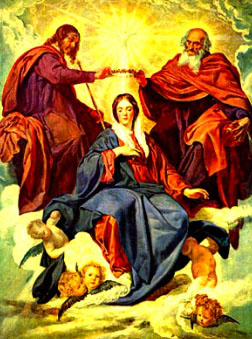
Benedict XVI on the Queenship of Mary

http://www.roman-catholic-saints.com/images/Queenship-of-Mary.jpg
“It (the Feast of the Queenship of Mary) was established eight days after the Assumption, to show the strong bond between the royalty of Mary and her glorification in body and soul with her son Jesus.

...
 
There is the notion that a king or a queen are people of power and riches, but these are not the riches of Jesus and Mary. The Kingdom of Christ is built on humility, service and love.
...  
May the prayers of Our Lady guide us along our pilgrimage of faith, that we may share in her Son’s victory and reign with Him in His eternal Kingdom.”

Benedict XVI, General Audience, Castel Gandolfo, 22 August 2012.

Friday, March 15, 2013

Benedict XVI on the Assumption of Mary

http://www.domestic-church.com/CONTENT.DCC/19980701.GRAPHICS/assumption.jpg“It is Mary herself who prophetically pronounces some words that lead us in this direction: 'henceforth all generations shall call me blessed "(Lk 1.48). It is a prophecy for the entire history of the Church.
...
 
In the Assumption we see that in God there is room for man, God himself is the house with many rooms that Jesus tells us: God is man's house. Opening up to God we do not lose anything. On the contrary, our life becomes more rich and great.
...
It's certain that a world away from God will not be better, but worse. Only the presence of God can ensure a good world.
...

Let us entrust ourselves to her maternal intercession, that she might ask the Lord to strengthen our belief in eternal life, help us to live well and with hope the time that God gives to us – a Christian hope, which is not just nostalgia for Heaven, but living and active desire for God here in the world, a desire that makes us indefatigable pilgrims, feeding in us the courage and strength of faith, a fortitude that is at once the power of love.

Benedict XVI, Mass for the Solemnity of the Assumption of Mary in the parish of San Tommaso da Villanova at Castel Gandolfo, 15 August 2012.


Friday, February 22, 2013

Benedict XVI on Music


“This evening's concert has given us an idea of the  multiplicity of musical creativity and its vast harmony. Music is not just a succession of sounds-it has a rhythm, at the same time cohesion and harmony. It has its own structure and depth.
...

Music is an expression of spirit, a place inside the person, created for all that is true, good and beautiful. It is no coincidence that music often accompanies our prayers. It awakens our senses and our soul when, in prayer we find God.”
 
Benedict XVI, Concert organized by Caritas and by musician Thomas Beckmann, Castel Gandolfo, 13 August, 2012.

Tuesday, February 19, 2013

Benedict XVI on St. Dominic

"Today we celebrate the feast of Saint Dominic, the founder of the Order of Preachers.  In his life, Saint Dominic was able to combine constant prayer and zealous activity in the service of the Lord and his Church.  By his example and intercession, may all of us rediscover the importance and beauty of daily prayer, and bear joyful witness to our faith in Christ the Saviour!”. 

Benedict XVI, General Audience, Castel Gandolfo, 8 August 2012

Sunday, February 17, 2013

Benedict XVI on Faith

“In the days full of worries and problems, but also in those of rest and relaxation, the Lord invites us not forget that it's necessary to worry about the material bread and restoring forces, even more fundamental is growing in a relationship with God, strengthening our faith in Him who is the 'bread of life.”
 
“Faith is fundamental. This is not about to follow an idea, or a project, but to find Jesus as a living person and become willingly involved totally for Him and His Gospel.” 

Benedict XVI, Angelus, 5 August 2012