Wednesday, July 20, 2016

Cardinal Ratzinger on ad orientem


“To the ordinary churchgoer, the two most obvious effects of the liturgical reform of the Second Vatican Council seem to be the disappearance of Latin and the turning of the altars towards the people. Those who read the relevant texts will be astonished to learn that neither is in fact found in the decrees of the Council. The use of the vernacular is certainly permitted, especially for the Liturgy of the Word, but the preceding general rule of the Council text says, ‘Particular law remaining in force, the use of the Latin language is to be preserved in the Latin rites’ (Sacrosanctum Concilium, 36.1). There is nothing in the Council text about turning altars towards the people; that point is raised only in postconciliar instructions.”

Uwe Michael Lang, “Turning towards the Lord: Orientation in Liturgical Prayer,” Foreword by Joseph Ratzinger, Ignatius Press, San Francisco, 2004.

Friday, February 26, 2016

Cardinal Ratzinger on the Logos

"Christianity must always remember that it is the religion of the Logos. It is faith in the Creator Spiritus, (Creator Spirit), from which proceeds everything that exists. Today, this should be precisely its philosophical strength, in so far as the problem is whether the world comes from the irrational, and reason is not, therefore, other than a 'sub-product,' on occasion even harmful of its development, or whether the world comes from reason, and is, as a consequence, its criterion and goal. The Christian faith inclines toward this second thesis, thus having, from the purely philosophical point of view, really good cards to play, despite the fact that many today consider only the first thesis as the only modern and rational one par excellence. However, a reason that springs from the irrational, and that is, in the final analysis, itself irrational, does not constitute a solution for our problems. Only creative reason, which in the crucified God is manifested as love, can really show us the way. In the so necessary dialogue between secularists and Catholics, we Christians must be very careful to remain faithful to this fundamental line: to live a faith that comes from the Logos, from creative reason, and that, because of this, is also open to all that is truly rational." 

Joseph Cardinal Ratzinger, 1 April 2005.

Sunday, February 7, 2016

Cardinal Ratzinger on Liturgy - 3


http://www.wdtprs.com/images/BLOG/07_09_01_MR62_7_100.jpg
Missale Romanum
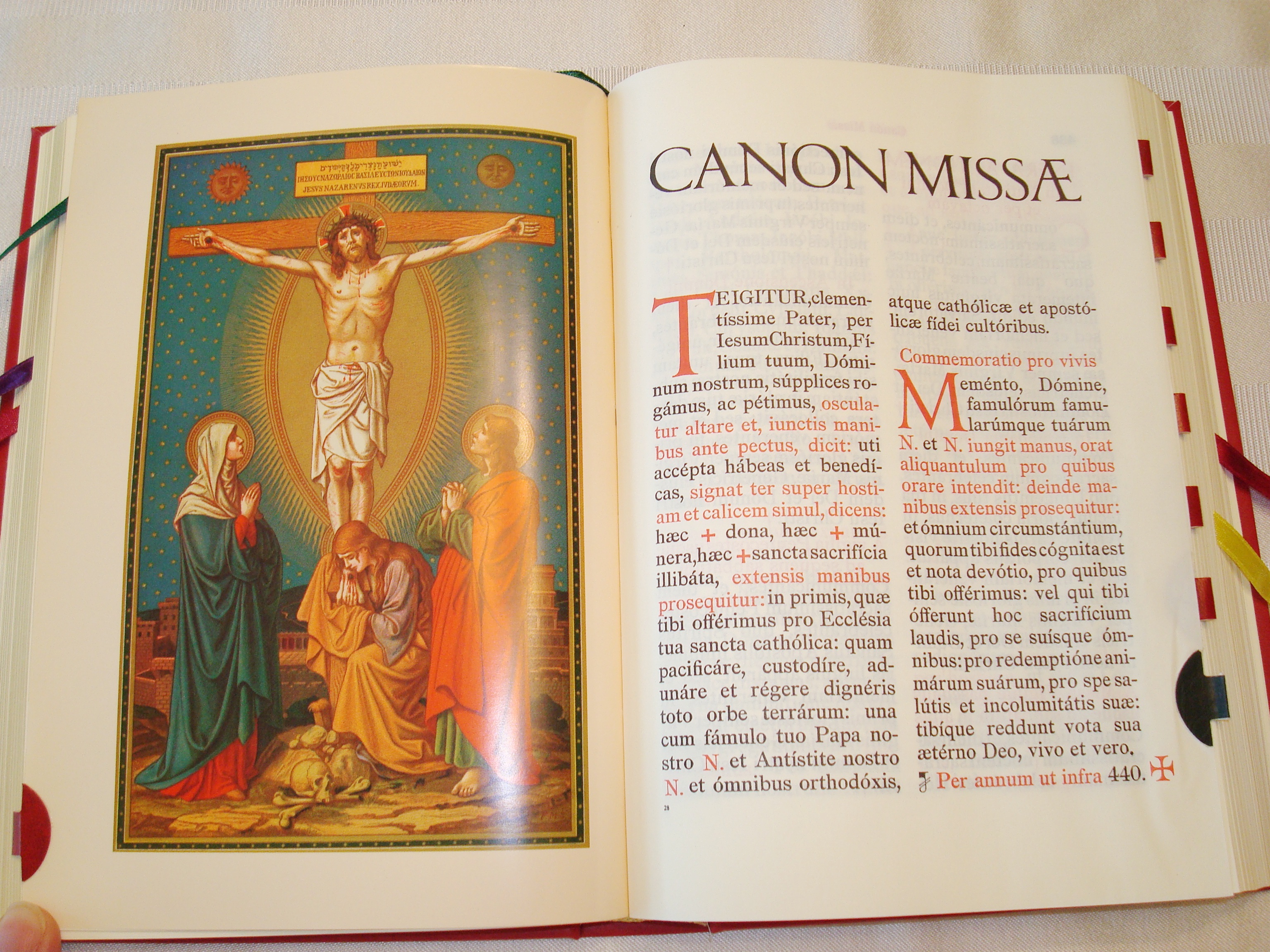
"I was dumbfounded upon hearing about the interdiction of the old Missal, since such a move had never been seen in the entire history of Catholic liturgy. The impression was given that this was all quite normal. The previous Missal had been realized by Pope St. Pius V, in 1570, immediately following the Council of Trent (1545-1563); it was therefore considered normal that, after 400 years and a new Council, a new Pope should therefore also publish a new Missal. However, the historical truth is another matter altogether. Pius V had limited himself to republishing the Roman Missal then in use just as it had always been down through the centuries of history. Also, many of his successors, following his example, had also had the Missal republished, without ever opposing one Missal to another. It has always been a continuing process of historical growth and purification in which, however, essential continuity had never been destroyed. There does not exist, nor has there ever existed, a Missal completely made up by Pius V. There was only a new elaboration ordered by him, constituting merely a phase in a long process of historical growth.
Following the Council of Trent, the new reality was of a quite different nature: the eruption of the Protestant "reform" had occurred especially under the form of liturgical "reforms"...; so much so, in fact, that the limits between that which was still Catholic and that which was no longer so, were often difficult to define. In such a confused state of affairs, resulting from a lack of uniform liturgical norms, together with a liturgical plurality inherited from the Middle Ages, the Pope decided that the Missale Romanum, that is, the liturgical text then in use in Rome, was to be introduced everywhere that there existed a liturgy dating back to less than 200 years previously. The reason for this was that the timeless Roman liturgy was most assuredly Catholic in every sense of the term. Wherever it could be done, the preceding liturgy (i.e., that dating back 200 years or more) was allowed to be maintained since its truly Catholic character could be considered to be absolutely certain."  - Joseph Cardinal Ratzinger, La mia vita, pp. 111, 112.

Thursday, December 24, 2015

Benedict XVI on Christmas


"God becomes so close that it is possible to see and touch him. The Church contemplates this ineffable mystery and the liturgical texts of this Season are steeped in wonder and joy; all Christmas carols express this joy. Christmas is the point at which Heaven and earth converge."


Pope Benedict XVI, 4 January 2012, General Audience in Rome.

Wednesday, October 7, 2015

Ratzinger on Modernism

http://arthistoryresources.net/modernism/modernism-images/Descent-Modernists-new.jpg

“The text was, if one may use the label, utterly the product of the 'anti-Modernist' mentality that had taken shape about the turn of the century. The text was written in a spirit of condemnation and negation, which ... had a frigid and even offensive tone to many of the Fathers. And this despite the fact that the content of the text was new to no one. It was exactly like dozens of text-books familiar to the bishops from their seminary days: and in some cases, their former professors were actually responsible for the texts now presented to them.”

...

“The real question behind the discussion can be put this way: Was the intellectual position of ‘anti-Modernism’ — the old policy of exclusiveness, condemnation and defense leading to an almost neurotic denial of all that was new — to be continued? Or would the Church, after it had taken all the necessary precautions to defend the Faith, turn over a new leaf and move on into a new and positive encounter with its own origins, with its brothers and with the world today?”


Father Jospeh Ratzinger, Theological Highlights of Vatican II, (1966, pp. 17-18)

Saturday, September 5, 2015

Ratzinger on Gaudium et Spes


If it is desirable to offer a diagnosis of the text (Gaudium et Spes) as a whole, we might say that (in conjunction with the texts on religious liberty, and world religions) it is a revision of the Syllabus of Pius IX, a kind of countersyllabus ... Let us be content to say here that the text serves as a countersyllabus and, as such, represents on the part of the Church, an attempt at an official reconciliation with the new era inaugurated in 1789. … the one-sidedness of the position adopted by the Church under Pius IX and Pius X in response to the situation created by the new phase of history inaugurated by the French Revolution was, to a large extent, corrected via facti, especially in Central Europe, but there was still no basic statement of the relationship that should exist between the Church and the world that had come into existence after 1789. In fact, an attitude that was largely pre-revolutionary continued to exist in countries with strong Catholic majorities. Hardly anyone will deny today that the Spanish and Italian Concordat strove to preserve too much of a view of the world that no longer corresponded to the facts. Hardly anyone will deny today that, in the field of education and with respect to the historico-critical method in modern science, anachronisms existed that corresponded closely to this adherence to an obsolete Church-state relationship.

 Cardinal Joseph Ratzinger, Principles of Catholic Theology, pp. 381-382.

Wednesday, July 29, 2015

Cardinal Ratzinger on Liturgy - 2

https://c2.staticflickr.com/6/5286/5264390963_d00b8d71ed.jpg
“For fostering a true consciousness in liturgical matters, it is also important that the proscription against the form of liturgy in valid use up to 1970 should be lifted. Anyone who nowadays advocates the continuing existence of this liturgy or takes part in it is treated like a leper; all tolerance ends here. There has never been anything like this in history; in doing this we are despising and proscribing the Church’s whole past. How can one trust her present if things are that way? I must say, quite openly, that I don’t understand why so any of my episcopal brethren have to a great extent submitted to this rule of intolerance, which for no apparent reason is opposed to making the necessary inner reconciliations within the Church.”

God and the World: A Conversation with Peter Seewald, San Francisco: Ignatius Press, 2002, p. 416.