Tuesday, May 19, 2015

Saint Francis of Assisi to His Followers before His Death


http://littleportionhermitage.org/wp-content/uploads/2014/10/transitus.jpg 

"Act bravely, my Brethren; take courage, and trust in the Lord. The time is fast approaching in which there will be great trials and afflictions; perplexities and dissensions, both spiritual and temporal, will abound; the charity of many will grow cold, and the malice of the wicked will increase.

The devils will have unusual power, the immaculate purity of our Order, and of others, will be so much obscured that there will be very few Christians who will obey the true Sovereign Pontiff and the Roman Church with loyal hearts and perfect charity. 

At the time of this tribulation a man, not canonically elected, will be raised to the Pontificate, who, by his cunning, will endeavour to draw many into error and death.

Then scandals will be multiplied, our Order will be divided, and many others will be entirely destroyed, because they will consent to error instead of opposing it.

There will be such diversity of opinions and schisms among the people, the religious and the clergy, that, except those days were shortened, according to the words of the Gospel, even the elect would be led into error, were they not specially guided, amid such great confusion, by the immense mercy of God.

Then our Rule and manner of life will be violently opposed by some, and terrible trials will come upon us. Those who are found faithful will receive the crown of life; but woe to those who, trusting solely in their Order, shall fall into tepidity, for they will not be able to support the temptations permitted for the proving of the elect.

Those who preserve their fervour and adhere to virtue with love and zeal for the truth, will suffer injuries and, persecutions as rebels and schismatics; for their persecutors, urged on by the evil spirits, will say they are rendering a great service to God by destroying such pestilent men from the face of the earth. but the Lord will be the refuge of the afflicted, and will save all who trust in Him. And in order to be like their Head, [Christ] these, the elect, will act with confidence, and by their death will purchase for themselves eternal life; choosing to obey God rather than man, they will fear nothing, and they will prefer to perish rather than consent to falsehood and perfidy.

Some preachers will keep silence about the truth, and others will trample it under foot and deny it. Sanctity of life will be held in derision even by those who outwardly profess it, for in those days Jesus Christ will send them not a true Pastor, but a destroyer."

Tuesday, May 12, 2015

Ratzinger on Spontaneity and Creativity in Liturgy


http://blogs.telegraph.co.uk/news/files/2010/09/pope8_1717754c.jpgThe great­ness of the liturgy depends — we shall have to repeat this frequently — on its unspontaneity (Unbeliebigkeit) …. Only respect for the liturgy’s fundamental unspontaneity and pre-existing identity can give us what we hope for: the feast in which the great reality comes to us that we ourselves do not manufacture but receive as a gift. This means that “creativity” cannot be an authentic category for matters liturgical. In any case, this is a word that developed within the Marxist world view. Creativity means that in a universe that in itself is meaningless and came into existence through blind evolution, man can creatively fashion a new and better world.

Modern theo­ries of art think in terms of a nihilistic kind of creativity. Art is not meant to copy anything. Artistic creativity is under the free mastery of man, without being bound by norms or goals and subject to no questions of meaning. It may be that in such visions a cry for freedom is to be heard, a cry that in a world totally in the control of technology becomes a cry for help. Seen in this way, art appears as the final refuge of freedom. True, art has something to do with freedom, but freedom understood in the way we have been describing is empty. It is not redemptive, but makes despair sound like the last word of human existence. This kind of creativity has no place within the liturgy. The life of the liturgy does not come from what dawns upon the minds of individuals and plan­ning groups. On the contrary, it is God’s descent upon our world, the source of real liberation. He alone can open the door to freedom. The more priests and faithful humbly surrender themselves to this descent of God, the more “new” the liturgy will constantly be, and the more true and personal it becomes. Yes, the liturgy becomes personal, true, and new, not through tomfoolery and ba­nal experiments with the words, but through a coura­geous entry into the great reality that through the rite is always ahead of us and can never quite be overtaken.  

Cardinal Ratzinger, The Spirit of the Liturgy, (SF, CA: Ignatius, 2000), p. 170

Wednesday, April 29, 2015

Archives of the Order (5) - Statutes of Fra Roger De Moulins

http://upload.wikimedia.org/wikipedia/commons/thumb/f/fe/Roger_de_MOULINS.JPG/220px-Roger_de_MOULINS.JPG 

STATUTES OF FRA ROGER DE MOULINS 1177-87

The Chapter-General of 1181

THAT THE CHURCHES SHOULD BE REGULATED WITH THE KNOWLEDGE OF THE PRIOR.

In the name of the Father and of the Son and of the Holy Ghost. Amen. In the year of the incarnation of Our Lord 1181 in the month of March, on the Sunday on which they chant Laetare Jerusalem (i.e. 22nd March), I, Roger, servant of Christ's poor, in the presence of the clerical and lay brethren seated around the Chapter-General, to the honour of God and the glory of our Religion, and the support and benefit of the sick poor.
  1. It is commanded that the statutes of the church aforesaid and the benefits for the poor afterwards written should be kept and observed forever, without going contrary to them in any respect. Concerning the churches it is commanded that they should be arranged and regulated at the disposition of the Prior of the clerics of the Hospital with regard to books clerics vestments priests chalices censers perpetual light and other ornaments.
  2. And secondly, it is decreed with the assent of the brethren that for the sick in the Hospital of Jerusalem there should be engaged four wise doctors, who are qualified to examine urine, and to diagnose different diseases, and are able to administer appropriate medicines.
  3. And thirdly, it is added that the beds of the sick should be made as long and as broad as is most convenient for repose, and that each bed should be covered with its own coverlet, and each bed should have its own special sheets.
  4. After these needs is decreed the fourth command, that each of the sick should have a cloak of sheepskin and boots for going to and coming from the latrines, and caps of wool.
  5. It is also decreed that little cradles should be made for the babies of the women pilgrims born in the House, so that they may lie separate, and that the baby in its own bed may be in no danger from restlessness of its mother.
  6. Afterwards it is decreed the sixth clause, that the biers of the dead should be concealed in the same manner as are the biers of the brethren, and should be covered with a red coverlet having a white cross.
  7. The seventh clause commands that wheresoever there are hospitals for the sick, that the Commanders of the houses should serve the sick cheerfully, and should do their duty by them, and serve them without grumbling or complaining, so that by these good deeds they may deserve to have their reward in the glories of heaven. And if any of the brethren should act contrary to the commands of the Master in these matters, that it should be brought to the notice of the Master, who shall punish them according to the sentence of the house commands.
  8. It was also decreed, when the council (i.e. Chapter-General) of the brethren was held, that the Prior of the Hospital of France should send each year to Jerusalem one hundred sheets of dyed cotton to replace the coverlets of the poor sick, and should reckon them in his Responsion together with those things which shall be given in his Priory to the House in charity.
  9. In selfsame manner and reckoning the Prior of the Hospital of St. Gilles should purchase each year the like number of sheets of cotton and send them to Jerusalem, together with those things which shall be given in his Priory for the love of God to the poor of the Hospital.
  10. The prior of Italy each year should send to Jerusalem for our lords the sick two hundred ells of fustian (cotton sheets) of divers colours, which he may reckon each year in his Responsion.
  11. And the Prior of Pisa should send likewise the like numbers of fustians.
  12. And the Prior of Venice likewise, and all should be reckoned in their Responsions.
  13. And likewise the Bailiffs this side of the sea should be particular in this same service.
  14. Of whom the Bailiff of Antioch should send to Jerusalem two hundred ells of cotton cloth for the coverlets of the sick.
  15. The prior of Mont Pelerin (i.e. Tripoli) should send to Jerusalem two quintals of sugar for the syrups, and the medicines and the electuaries of the sick.
  16. For this same service the Bailiff of Tabarie (i.e. Tiberias) should send there the same quantity.
  17. The Prior of Constantinople should send for the sick two hundred felts.
  18. Moreover guarding and watching them day and night, the brethren of the Hospital should serve the sick poor with zeal and devotion as if they were their lords, and it was added in Chapter-General that in every ward (rue) and place in the Hospital, nine sergeants should be kept at their service, who should wash their feet gently, and change their sheets, and make their beds, and administer to the weak necessary and strengthening food, and do their duty devotedly, and obey, in all things for the benefit of the sick.

THE CONFIRMATION BY THE MASTER ROGER OF THE THINGS THAT THE HOUSE SHOULD DO

Let all the brethren of the House of the Hospital, both those present and those to come, know that the good customs of the House of the Hospital of Jerusalem are as follows:
  1. Firstly the Holy House of the Hospital is accustomed to receive sick men and women, and is accustomed to keep doctors who have the care of the sick, and who make the syrups for the sick, and who provide the things that are necessary for the sick. For three days in the week the sick are accustomed to have fresh meat, either pork or mutton, and those who are unable to eat it have chicken.
  2. And two sick persons are accustomed to have one coat of sheepskin (pelice de brebis), which they use when going to the latrines (chambres), and between two sick persons one pair of boots. Every year the House of the Hospital is accustomed to give to the poor one thousand cloaks of thick lamb skins.
  3. And all the children abandoned by their fathers and mothers the Hospital is accustomed to receive and to nourish. To a man and woman who desire to enter into matrimony, and who possess nothing with which to celebrate their marriage, the House of the Hospital is accustomed to give two bowls (escueles) or the rations of two brethren.
  4. And the House of the Hospital is accustomed to keep one brother shoemaker (corvoisier) and three sergeants, who repair the old shoes (soliers) given for the love of God. And the Almoner is accustomed to keep two sergeants who repair the old robes that he may give them to the poor.
  5. And the Almoner is accustomed to give twelve deniers to each prisoner, when he is first released from prison.
  6. Every night five clerics are accustomed to read the Psalter for the benefactors of the House.
  7. And every day thirty poor persons are accustomed to be fed at table once a day for the love of God, and the five clerics aforesaid may be among those thirty poor persons, but the twenty-five eat before the Convent, and each of the five clerics should have two deniers and eat with the Convent.
  8. And on three days of the week they are accustomed to give in alms to all who come there to ask for it, bread and wine and cooked food.
  9. In Lent every Saturday, they are accustomed to celebrate Maundy for thirteen poor persons, and to wash their feet, and to give to each a shirt and new breeches and new shoes, and to three chaplains, or to three clerics out of the thirteen, three deniers and to each of the others, two deniers.
  10. These are the special charities decreed in the Hospital, apart from the Brethren-at-Arms whom the House should maintain honourably, and many other charities there are which cannot be set out in detail each one by itself. And that these things be true good men and loyal here bear witness, that is to say Brother Roger, Master of the Hospital, and Brother Bernard the Prior and all the Chapter-General.

Sunday, April 19, 2015

Tenth anniversary of Benedict XVI's election


"And now, at this moment, weak servant of God that I am, I must assume this enormous task, which truly exceeds all human capacity. How can I do this? How will I be able to do it? All of you, my dear friends, have just invoked the entire host of Saints, represented by some of the great names in the history of God’s dealings with mankind. In this way, I too can say with renewed conviction: I am not alone. I do not have to carry alone what in truth I could never carry alone. All the Saints of God are there to protect me, to sustain me and to carry me. And your prayers, my dear friends, your indulgence, your love, your faith and your hope accompany me.

...
The purpose of our lives is to reveal God to men. And only where God is seen does life truly begin. Only when we meet the living God in Christ do we know what life is. We are not some casual and meaningless product of evolution. Each of us is the result of a thought of God. Each of us is willed, each of us is loved, each of us is necessary. There is nothing more beautiful than to be surprised by the Gospel, by the encounter with Christ. There is nothing more beautiful than to know Him and to speak to others of our friendship with Him. The task of the shepherd, the task of the fisher of men, can often seem wearisome. But it is beautiful and wonderful, because it is truly a service to joy, to God’s joy which longs to break into the world.

...
My dear friends – at this moment I can only say: pray for me, that I may learn to love the Lord more and more. Pray for me, that I may learn to love his flock more and more – in other words, you, the holy Church, each one of you and all of you together. Pray for me, that I may not flee for fear of the wolves."

Pope Benedict XVI, Homily at the Mass for the Imposition of the Pallium and Conferral of the Fisherman's Ring for the Beginning of the Petrine Ministry of the Bishop of Rome, St. Peter's Square, 24 April 2005

Wednesday, April 15, 2015

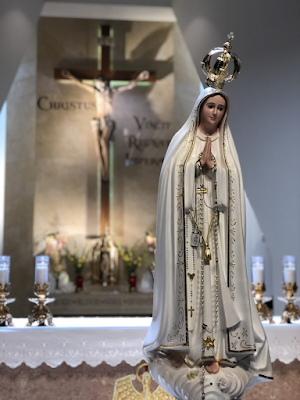
Benedict XVI on Fatima - a prophecy for 2017?


"At a time when the human family was ready to sacrifice all that was most sacred on the altar of the petty and selfish interests of nations, races, ideologies, groups and individuals, our Blessed Mother came from heaven, offering to implant in the hearts of all those who trust in her the Love of God burning in her own heart. At that time it was only to three children, yet the example of their lives spread and multiplied, especially as a result of the travels of the Pilgrim Virgin, in countless groups throughout the world dedicated to the cause of fraternal solidarity. May the seven years which separate us from the centenary of the apparitions hasten the fulfilment of the prophecy of the triumph of the Immaculate Heart of Mary, to the glory of the Most Holy Trinity."

Homily of Pope Benedict XVI during Holy Mass at the Esplanade of the Shrine of Our Lady of Fátima
Thursday, 13 May 2010

Tuesday, March 31, 2015

Ratzinger on the Orthodox Church


http://orthodoxwiki.org/thumb.php?f=Antiochian_local_synod.jpg&width=350“Rome must not require more from the East with respect to the doctrine of primacy than what had been formulated and was lived in the first millennium . . . Rome need not ask for more. Reunion could take place in this context if, on the one hand, the East would cease to oppose as heretical the developments that took place in the West in the second millennium and would accept the Catholic Church as legitimate and orthodox in the form she had acquired in the course of that development, while, on the other hand, the West would recognize the Church of the East as orthodox and legitimate in the form she has always had.”

Joseph Ratzinger, Principles of Catholic Theology, San Francisco, Ignatius, 1987, p. 199.

Friday, March 27, 2015

Archives of the Order (4) - Chapter Generals of Fra. Jobert

http://shoebat.com/wp-content/uploads/2014/04/jerusalem.jpg
THE CHAPTER GENERAL OF 1176
THE PRIVILEGE OF THE SICK TO HAVE WHITE BREAD 
In the Name of the Father and of the Son and of the Holy Ghost. Amen.
  • Let all men know of those who are, and those in the future shall be sons of Holy Mother Church, that I Jobert, Master of the Hospital of Jerusalem, with the good will and unanimous consent of all our brethren assembled in our Common Chapter, before the presence and witness of the passion and resurrection of Our Lord, have given and granted in permanent possession to our blessed lords, that is to say to the poor of the hostels (Xenodocheum) of the Hospital of Jerusalem, and to Brother Steven the Hospitaller at the present time, and to their successors who shall come after them perpetually for all time, two casales, that is to say the casales of St. Mary and Caphaer, with all their possessions and appurtenances within and without, for the provision of white bread which should be given to them forever; and if by chance it should happen that the corn should fail in the casales or be insufficient to provide for the needs of the poor, enough should be taken from the Treasury to purchase white bread and to provide sufficient for the poor; and if should happen that the wheat from the casales should be mixed with evil herbs, good wheat should be taken measure for measure from the granary of the Hospital, and so sufficient should be provided for our lords the poor. And in order that this gift may be established and unaltered forever, we have caused this charter to be sealed with our seal; and if anyone from henceforward would go to contrary to this Holy Commandment, or would distort it, may he be damned with Judas the traitor in everlasting damnation, with Cain and Dathan and Abiron, whom the earth swallowed up, may he be cursed with the curse. Amen.
  • Each loaf should be the weight of two marks, and should be given to two poor persons.
  • This decree was made in the year of the Incarnation of Our Lord 1176. 

THE CHAPTER GENERAL OF 1177

THE CUSTOMS OF THE CHURCH OF THE HOSPITAL OF JERUSALEM

In the Name of the Father and of the Son and of the Holy Ghost. Amen.
These are the customs which should be observed in the House of the Hospital of Jerusalem.
  1. The first morning Mass should not be begun before it is day, nor should the Commander of any house order the priest to chant mass. And no priest should chant mass twice in a day, unless by chance the body of the dead person be there, and then in this manner, first should be chanted the mass for the day, if it be a Sunday or a day of Festival, and afterwards should be chanted that for the dead, if a body be present there. And everywhere where a deceased (brother) of the hospital shall be buried, the day of his death should be written in the calendar. And for thirty days masses should be chanted for his soul. And when the Trental shall be completed, the day the anniversary should always be celebrated for his soul, and when the church where the Trental shall be celebrated has three priests, one should celebrate the Trental, and the other two chant the masses for the day. And if two priests only be there where the Trental should be celebrated, the service should be shared between them, and the gratuity. And when there shall be there no more than one priest, they shall obtain another a stranger to celebrate the service of the Trental.
  2. And when it shall be celebrated, one besant and a new shirt and breeches, according to the custom of the House, should be given to him. And if it be impossible to find a stranger priest. and the priest of the house be without the company of another priest, the Trental should be celebrated in this manner, that is to say that every day he should chant for the dead except on Sundays and days of solemn festival; and then afterwards he should make the commemoration and remembrance for the brother that is departed. But when the thirty days shall be passed, and after the number of days on which commemoration should be made only for the soul of the brother shall be fulfilled by the Trental, and there should be given to the priest the charity aforesaid. And if by chance these things should happen in Lent in the houses where there shall be no more than one priest, let it be postponed until after Easter, and then let celebration be made for the soul of the brother without delay.
  3. And let the brethren always take care to have a light in the church, and let the chalice for administration be of silver, and the censor of silver.
  4. And it is commanded that the bodies of pilgrims or of other Christians, who shall die after the Hour of Vespers, should be left until the next day; and in the Hospital, where they shall have died, let them not lie upon their biers without a light. And the next day before Prime they should be carried to the church, and after Mass should be buried; the biers of the dead should be like those that are in Jerusalem.
  5. The bodies of the brethren should be watched in the church, and the clerics should be around them chanting their psalms, and the tapers should be lighted. Of the charity that is given to the priests for the Trental the house should retain nothing; but for the Trentals of strangers the brethren should retain the half.
  6. For the public and private masses the priests should have nothing for themselves, except so much as the brethren should wish to give them of their own free will.
  7. Of the payments from confessions the sixth part should be given to the priests and the clerics, not by contract but of grace; but in casales where there shall be no burgesses, and no one except one priest, the arrangements aforesaid shall be at the discretion of the Commander of the house, and the gratuity of the clerics he shall give as shall seem good to him.
  8. Of the wills and legacies, which shall be made to vicars up to one besant, the half should be given to them; but the legacies and wills, which shall be left to the Hospital , when they shall be paid over, the brethren should receive them without deduction.