Thursday, February 28, 2019

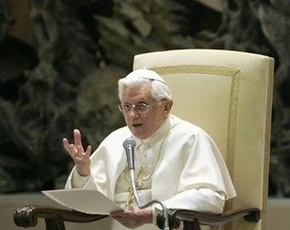
Benedict XVI on the Year of Faith

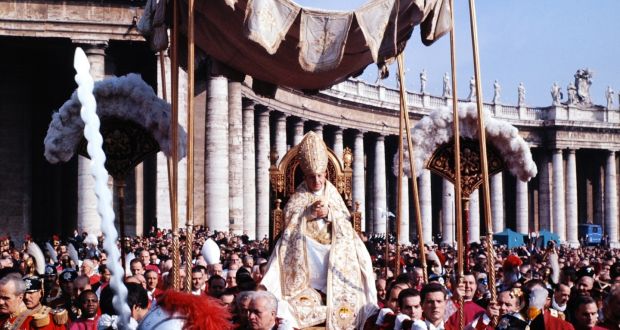
Pope John XXIII riding in procession to St Peter’s Basilica, at start of the Second Vatican Ecumenical Council. Photograph: Paul Schutzer/Time Life Pictures/Getty Images
Pope John XXIII riding in procession to St Peter’s Basilica, at the start of the Second Vatican Ecumenical Council.
 
"The Year of Faith which we launch today is linked harmoniously with the Church’s whole path over the last fifty years: from the Council, through the Magisterium of the Servant of God Paul VI, who proclaimed a Year of Faith in 1967, up to the Great Jubilee of the year 2000, with which Blessed John Paul II re-proposed to all humanity Jesus Christ as the one Saviour, yesterday, today and forever. Between these two Popes, Paul VI and John Paul II, there was a deep and profound convergence, precisely upon Christ as the centre of the cosmos and of history, and upon the apostolic eagerness to announce Him to the world. Jesus is the centre of the Christian faith. The Christian believes in God Whose face was revealed by Jesus Christ. He is the fulfilment of the Scriptures and their definitive interpreter".
 
"Today’s Gospel tells us that Jesus Christ, consecrated by the Father in the Holy Spirit, is the true and perennial subject of evangelisation. ... This mission of Christ, this movement of His continues in space and time, over centuries and continents. It is a movement which starts with the Father and, in the power of the Spirit, goes forth to bring the good news to the poor, in both a material and a spiritual sense. The Church is the first and necessary instrument of this work of Christ because it is united to Him as a body to its head".
 
"Vatican Council II did not wish to deal with the theme of faith in one specific document. It was, however, animated by a desire, as it were, to immerse itself anew in the Christian mystery so as to re-propose it fruitfully to contemporary man. ... In his opening speech Blessed John XXIII presented the principal purpose of the Council in this way: “What above all concerns the Ecumenical Council is this: that the sacred deposit of Christian doctrine be safeguarded and taught more effectively. … Therefore, the principal purpose of this Council is not the discussion of this or that doctrinal theme, a Council is not required for that, ... [but] this certain and immutable doctrine, which is to be faithfully respected, needs to be explored and presented in a way which responds to the needs of our time”.
 
"In the light of these words, we can understand what I myself felt at the time: during the Council there was an emotional tension as we faced the common task of making the truth and beauty of the faith shine out in our time, without sacrificing it to the demands of the present or leaving it tied to the past: the eternal presence of God resounds in the faith, transcending time, yet it can only be welcomed by us in our own unrepeatable today. Therefore I believe that the most important thing ... is to revive in the whole Church that positive tension, that yearning to announce Christ again to contemporary man. But, so that this interior thrust towards the new evangelisation neither remain just an idea nor be lost in confusion, ... I have often insisted on the need to return, as it were, to the “letter” of the Council - that is to its texts - also to draw from them its authentic spirit, and why I have repeated that the true legacy of Vatican II is to be found in them".
 
"The Council did not formulate anything new in matters of faith, nor did it wish to replace what was ancient. Rather, it concerned itself with seeing that the same faith might continue to be lived in the present day, that it might remain a living faith in a world of change. ... The Council Fathers wished to present the faith in a meaningful way; and if they opened themselves trustingly to dialogue with the modern world it is because they were certain of their faith, of the solid rock on which they stood. In the years following, however, many embraced uncritically the dominant mentality, placing in doubt the very foundations of the deposit of faith, which they sadly no longer felt able to accept as truths."
 
"If today the Church proposes a new Year of Faith and a new evangelisation, it is not to honour an anniversary, but because there is more need of it, even more than there was fifty years ago! ... Even the initiative to create a pontifical council for the promotion of the new evangelisation ... is to be understood in this context. Recent decades have seen the advance of a spiritual “desertification”. In the Council’s time it was already possible from a few tragic pages of history to know what a life or a world without God looked like, but now we see it every day around us. ... But it is in starting from the experience of this desert ... that we can again discover the joy of believing, its vital importance for us".
 
"In the desert we rediscover the value of what is essential for living; thus in today’s world there are innumerable signs, often expressed implicitly or negatively, of the thirst for God, for the ultimate meaning of life. And in the desert people of faith are needed who, with their own lives, point out the way to the Promised Land and keep hope alive. Living faith opens the heart to the grace of God which frees us from pessimism. Today, more than ever, evangelising means witnessing to the new life, transformed by God, and thus showing the path".
 
"The journey is a metaphor for life, and the wise wayfarer is one who has learned the art of living, and can share it with his brethren - as happens to pilgrims along the Way of St. James or similar routes which, not by chance, have again become popular in recent years. How come so many people today feel the need to make these journeys? Is it not because they find there, or at least intuit, the meaning of our existence in the world? This, then, is how we can picture the Year of Faith: a pilgrimage in the deserts of today’s world, taking with us only what is necessary: ... the Gospel and the faith of the Church, of which the Council documents are a luminous expression, as is the Catechism of the Catholic Church, published twenty years ago."
 
"Venerable and dear brothers, 11 October 1962 was the Feast of Mary Most Holy, Mother of God. Let us entrust to her the Year of Faith, as I did last week when I went on pilgrimage to Loreto. May the Virgin Mary always shine out as a star along the way of the new evangelisation".
 
Extracts from a homily by Pope Benedict XVI during the course of a Mass celebrated in St. Peter's Square on 11 October 2012.

Friday, February 22, 2019

Benedict XVI on Pope Pius XII


"Here in this place, how could we not remember the Roman Jews who were snatched from their homes, before these very walls, and who with tremendous brutality were killed at Auschwitz? How could one ever forget their faces, their names, their tears, the desperation faced by these men, women and children? The extermination of the people of the Covenant of Moses, at first announced, then systematically programmed and put into practice in Europe under the Nazi regime, on that day tragically reached as far as Rome. Unfortunately, many remained indifferent, but many, including Italian Catholics, sustained by their faith and by Christian teaching, reacted with courage, often at risk of their lives, opening their arms to assist the Jewish fugitives who were being hunted down, and earning perennial gratitude. The Apostolic See (the Holy See under Pius XII helped the Jews) itself provided assistance, often in a hidden and discreet way".
 
Pope Benedict XVI during his visit to the Roman Synagogue on 17 January 2010.

Tuesday, January 22, 2019

John Paul II on salvation in Jesus Christ - 2

Image result for john paul 2

"For those, however, who have not received the Gospel proclamation, as I wrote in the Encyclical Redemptoris Missio, salvation is accessible in mysterious ways, inasmuch as divine grace is granted to them by virtue of Christ's redeeming sacrifice, without external membership in the Church, but nonetheless always in relation to her (cf. RM 10). It is a mysterious relationship. It is mysterious for those who receive the grace, because they do not know the Church and sometimes even outwardly reject her."

John Paul II, General Audience, 31 May 1995

Thursday, January 17, 2019

John Paul II on salvation in Jesus Christ


"Normally, it will be in the sincere practice of what is good in their own religious traditions and by following the dictates of their own conscience that the members of other religions respond positively to God’s invitation and receive salvation in Jesus Christ, even while they do not recognize or acknowledge him as their Saviour." - John Paul II, The Seeds of the Word in the Religions of the World, 9 September, 1998

Sunday, September 2, 2018

Ratzinger on the Church of the Future


"From the crisis of today the Church of tomorrow will emerge—a Church that has lost much.
 
She will become small and will have to start afresh more or less from the beginning.
 
She will no longer be able to inhabit many of the edifices she built in prosperity.
 
As the number of her adherents diminishes, so will she lose many of her social privileges. In contrast to an earlier age, she will be seen much more as a voluntary society, entered only by free decision.

As a small society, she will make much bigger demands on the initiative of her individual members.
 
Undoubtedly she will discover new forms of ministry and will ordain to the priesthood approved Christians who pursue some profession. In many smaller congregations or in self-contained social groups, pastoral care will normally be provided in this fashion.
 
Alongside this, the full-time ministry of the priesthood will be indispensable as formerly.

But in all of the changes at which one might guess, the Church will find her essence afresh and with full conviction in that which was always at her center: faith in the triune God, in Jesus Christ, the Son of God made man, in the presence of the Spirit until the end of the world.
 
In faith and prayer she will again recognize her true center and experience the sacraments again as the worship of God and not as a subject for liturgical scholarship.

The Church will be a more spiritual Church, not presuming upon a political mandate, flirting as little with the Left as with the Right.
 
It will be hard going for the Church, for the process of crystalization and clarification will cost her much valuable energy.
 
It will make her poor and cause her to become the Church of the meek.

The process will be all the more arduous, for sectarian narrow-mindedness as well as pompous self-will will have to be shed.
 
One may predict that all of this will take time. The process will be long and wearisome as was the road from the false progressivism of the eve of the French Revolution—when a bishop might be thought smart if he made fun of dogmas and even insinuated that the existence of God was by no means certain—to the renewal of the nineteenth century.

But when the trial of this sifting is past, a great power will flow from a more spiritualized and simplified Church.

Men in a totally planned world will find themselves unspeakably lonely. If they have completely lost sight of God, they will feel the whole horror of their poverty.
 
Then they will discover the little flock of believers as something wholly new.
 
They will discover it as a hope that is meant for them, an answer for which they have always been searching in secret.

And so it seems certain to me that the Church is facing very hard times.
 
The real crisis has scarcely begun.
 
We will have to count on terrific upheavals.
 
But I am equally certain about what will remain at the end: not the Church of the political cult, which is dead already with Gobel, but the Church of faith.
 
She may well no longer be the dominant social power to the extent that she was until recently; but she will enjoy a fresh blossoming and be seen as man’s home, where he will find life and hope beyond death."

Father Joseph Ratzinger, Faith and the Future, (published originally in German in 1970 as Glaube und Zukunft), republished by the Vatican Press in 2006.


Monday, June 25, 2018

Pope Benedict XVI on Education

Image result for benedict xvi teaching


“Every educational setting can be a place of openness to the transcendent and to others a place of dialogue, cohesiveness and attentive listening, where young people feel appreciated for their personal abilities and inner riches, and can learn to esteem their brothers and sisters. May young people be taught to savour the joy which comes from the daily exercise of charity and compassion towards others and from taking an active part in the building of a more humane and fraternal society”.

Thursday, May 3, 2018

Ratzinger on Kneeling

benedict_kneeling.jpg


It may well be that kneeling is alien to modern culture—insofar as it is a culture,
for this culture has turned away from the faith and no longer knows the One
before whom kneeling is the right, indeed the intrinsically necessary gesture.
The man who learns to believe learns also to kneel, and a faith or a liturgy no
longer familiar with kneeling would be sick at the core. Where it has been lost,
kneeling must be rediscovered, so that, in our prayer, we remain in fellowship
with the apostles and martyrs, in fellowship with the whole cosmos, indeed in
union with Jesus Christ Himself.

Joseph, Cardinal Ratzinger, The Spirit of the Liturgy (San Francisco: Ignatius Press, 2000), p. 194.