Tuesday, January 22, 2019

John Paul II on salvation in Jesus Christ - 2

Image result for john paul 2

"For those, however, who have not received the Gospel proclamation, as I wrote in the Encyclical Redemptoris Missio, salvation is accessible in mysterious ways, inasmuch as divine grace is granted to them by virtue of Christ's redeeming sacrifice, without external membership in the Church, but nonetheless always in relation to her (cf. RM 10). It is a mysterious relationship. It is mysterious for those who receive the grace, because they do not know the Church and sometimes even outwardly reject her."

John Paul II, General Audience, 31 May 1995

Thursday, January 17, 2019

John Paul II on salvation in Jesus Christ


"Normally, it will be in the sincere practice of what is good in their own religious traditions and by following the dictates of their own conscience that the members of other religions respond positively to God’s invitation and receive salvation in Jesus Christ, even while they do not recognize or acknowledge him as their Saviour." - John Paul II, The Seeds of the Word in the Religions of the World, 9 September, 1998

Sunday, September 2, 2018

Ratzinger on the Church of the Future


"From the crisis of today the Church of tomorrow will emerge—a Church that has lost much.
 
She will become small and will have to start afresh more or less from the beginning.
 
She will no longer be able to inhabit many of the edifices she built in prosperity.
 
As the number of her adherents diminishes, so will she lose many of her social privileges. In contrast to an earlier age, she will be seen much more as a voluntary society, entered only by free decision.

As a small society, she will make much bigger demands on the initiative of her individual members.
 
Undoubtedly she will discover new forms of ministry and will ordain to the priesthood approved Christians who pursue some profession. In many smaller congregations or in self-contained social groups, pastoral care will normally be provided in this fashion.
 
Alongside this, the full-time ministry of the priesthood will be indispensable as formerly.

But in all of the changes at which one might guess, the Church will find her essence afresh and with full conviction in that which was always at her center: faith in the triune God, in Jesus Christ, the Son of God made man, in the presence of the Spirit until the end of the world.
 
In faith and prayer she will again recognize her true center and experience the sacraments again as the worship of God and not as a subject for liturgical scholarship.

The Church will be a more spiritual Church, not presuming upon a political mandate, flirting as little with the Left as with the Right.
 
It will be hard going for the Church, for the process of crystalization and clarification will cost her much valuable energy.
 
It will make her poor and cause her to become the Church of the meek.

The process will be all the more arduous, for sectarian narrow-mindedness as well as pompous self-will will have to be shed.
 
One may predict that all of this will take time. The process will be long and wearisome as was the road from the false progressivism of the eve of the French Revolution—when a bishop might be thought smart if he made fun of dogmas and even insinuated that the existence of God was by no means certain—to the renewal of the nineteenth century.

But when the trial of this sifting is past, a great power will flow from a more spiritualized and simplified Church.

Men in a totally planned world will find themselves unspeakably lonely. If they have completely lost sight of God, they will feel the whole horror of their poverty.
 
Then they will discover the little flock of believers as something wholly new.
 
They will discover it as a hope that is meant for them, an answer for which they have always been searching in secret.

And so it seems certain to me that the Church is facing very hard times.
 
The real crisis has scarcely begun.
 
We will have to count on terrific upheavals.
 
But I am equally certain about what will remain at the end: not the Church of the political cult, which is dead already with Gobel, but the Church of faith.
 
She may well no longer be the dominant social power to the extent that she was until recently; but she will enjoy a fresh blossoming and be seen as man’s home, where he will find life and hope beyond death."

Father Joseph Ratzinger, Faith and the Future, (published originally in German in 1970 as Glaube und Zukunft), republished by the Vatican Press in 2006.


Monday, June 25, 2018

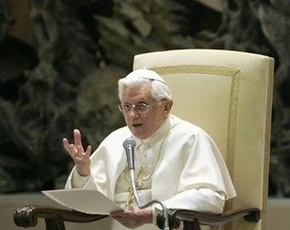
Pope Benedict XVI on Education

Image result for benedict xvi teaching


“Every educational setting can be a place of openness to the transcendent and to others a place of dialogue, cohesiveness and attentive listening, where young people feel appreciated for their personal abilities and inner riches, and can learn to esteem their brothers and sisters. May young people be taught to savour the joy which comes from the daily exercise of charity and compassion towards others and from taking an active part in the building of a more humane and fraternal society”.

Thursday, May 3, 2018

Ratzinger on Kneeling

benedict_kneeling.jpg


It may well be that kneeling is alien to modern culture—insofar as it is a culture,
for this culture has turned away from the faith and no longer knows the One
before whom kneeling is the right, indeed the intrinsically necessary gesture.
The man who learns to believe learns also to kneel, and a faith or a liturgy no
longer familiar with kneeling would be sick at the core. Where it has been lost,
kneeling must be rediscovered, so that, in our prayer, we remain in fellowship
with the apostles and martyrs, in fellowship with the whole cosmos, indeed in
union with Jesus Christ Himself.

Joseph, Cardinal Ratzinger, The Spirit of the Liturgy (San Francisco: Ignatius Press, 2000), p. 194.

Friday, January 19, 2018

Pope Benedict XVI's Prayer to the Holy Face


   "Lord Jesus,
   As the first apostles,
   Whom you asked: “What do you seek?”,
   Accepted your invitation to: “Come and see,”
   Recognizing you as the Son of God,
   The Promised Messiah for the world’s redemption,
   We too, your disciples in this difficult time
   Want to follow you and be your friends,
   Drawn by the brilliance of your face much desired yet hidden.

   Show us, we pray you, your face ever new,
   That mirror, mystery laden, of God’s infinite mercy.
   Grant that we may contemplate it
   With the eyes of our mind and our hearts:
   The Son’s face, radiance of the Father’s glory
   And the imprint of his Nature (cf. Hb 1,3),
   The human face of God that has burst into history
   To reveal the horizons of eternity.
   The silent face of Jesus suffering and risen,
   When loved and accepted changes the heart and life.
   “Your face, Lord, do I seek,
   Do not hide your face from me” (Ps. 27, 8ff).

   How many times through the centuries and millenia has not resounded
   The ardent invocation of the Psalmist among the faithful!
   Lord, with faith, we too repeat the same invocation:
   “Man of suffering, as one from whom others hide their faces” (Is. 53, 3),
   Do not hide your face from us!
   We want to draw from your eyes,
   That look on us with tenderness and compassion.
   The force of love and peace which shows us the way of life,
   And the courage to follow you without fear or compromise,
   So as to be witnesses of your Gospel,
   With concrete signs of acceptance, love and forgiveness.

   O Holy Face of Christ,
   Light that enlightens the darkness of doubt and sadness,
   Life that has defeated forever the force of evil and death,
   O inscrutable gaze
   That never ceases to watch over men and people,
   Face concealed in the Eucharistic signs
   And in the faces of those that live with us,
   Make us God’s pilgrims in this world,
   Longing for the Infinite and ready for the final encounter,
   When we shall see you, Lord, “face to face”(1 Cor. 13, 12),
   And be able to contemplate you forever in heavenly Glory.

   Mary, Mother of the Holy Face,
   Help us have “hands innocent and a heart pure,”
   Hands illumined by the truth of love
   And hearts enraptured by divine beauty,
   That transformed by the encounter with Christ,
   We may gift ourselves to the poor and the suffering,
   Whose faces reflect the hidden presence
   Of your Son Jesus,
   Who lives and reigns forever and ever. Amen!"
 
Benedict XVI, Rome, 1 September 2007, written and sent to the Guardian of the Basilica of the Holy Face in Manoppello (Italy) in memory of his pilgrimage to the Sanctuary a year before, on 1 September 2006.

Sunday, April 16, 2017

Benedict XVI on Easter

Image result for "benedict xvi easter"


“In the resurrection of Jesus, love has been shown to be stronger than death, stronger than evil. Love made Christ descend, and love is also the power by which he ascends. The power by which he brings us with him. In union with his love, borne aloft on the wings of love, as persons of love, let us descend with him into the world’s darkness, knowing that in this way we will also rise up with him. On this night, then, let us pray: Lord, show us that love is stronger than hatred, that love is stronger than death. Descend into the darkness and the abyss of our modern age, and take by the hand those who await you. Bring them to the light! In my own dark nights, be with me to bring me forth! Help me, help all of us, to descend with you into the darkness of all those people who are still waiting for you, who out of the depths cry unto you! Help us to bring them your light! Help us to say the “yes” of love, the love that makes us descend with you and, in so doing, also to rise with you. Alleluia. Amen!” - Benedict XVI, St. Peter's Basilica, 2007 Easter Vigil.