Thursday, December 24, 2015

Benedict XVI on Christmas


"God becomes so close that it is possible to see and touch him. The Church contemplates this ineffable mystery and the liturgical texts of this Season are steeped in wonder and joy; all Christmas carols express this joy. Christmas is the point at which Heaven and earth converge."


Pope Benedict XVI, 4 January 2012, General Audience in Rome.

Wednesday, October 7, 2015

Ratzinger on Modernism

http://arthistoryresources.net/modernism/modernism-images/Descent-Modernists-new.jpg

“The text was, if one may use the label, utterly the product of the 'anti-Modernist' mentality that had taken shape about the turn of the century. The text was written in a spirit of condemnation and negation, which ... had a frigid and even offensive tone to many of the Fathers. And this despite the fact that the content of the text was new to no one. It was exactly like dozens of text-books familiar to the bishops from their seminary days: and in some cases, their former professors were actually responsible for the texts now presented to them.”

...

“The real question behind the discussion can be put this way: Was the intellectual position of ‘anti-Modernism’ — the old policy of exclusiveness, condemnation and defense leading to an almost neurotic denial of all that was new — to be continued? Or would the Church, after it had taken all the necessary precautions to defend the Faith, turn over a new leaf and move on into a new and positive encounter with its own origins, with its brothers and with the world today?”


Father Jospeh Ratzinger, Theological Highlights of Vatican II, (1966, pp. 17-18)

Saturday, September 5, 2015

Ratzinger on Gaudium et Spes


If it is desirable to offer a diagnosis of the text (Gaudium et Spes) as a whole, we might say that (in conjunction with the texts on religious liberty, and world religions) it is a revision of the Syllabus of Pius IX, a kind of countersyllabus ... Let us be content to say here that the text serves as a countersyllabus and, as such, represents on the part of the Church, an attempt at an official reconciliation with the new era inaugurated in 1789. … the one-sidedness of the position adopted by the Church under Pius IX and Pius X in response to the situation created by the new phase of history inaugurated by the French Revolution was, to a large extent, corrected via facti, especially in Central Europe, but there was still no basic statement of the relationship that should exist between the Church and the world that had come into existence after 1789. In fact, an attitude that was largely pre-revolutionary continued to exist in countries with strong Catholic majorities. Hardly anyone will deny today that the Spanish and Italian Concordat strove to preserve too much of a view of the world that no longer corresponded to the facts. Hardly anyone will deny today that, in the field of education and with respect to the historico-critical method in modern science, anachronisms existed that corresponded closely to this adherence to an obsolete Church-state relationship.

 Cardinal Joseph Ratzinger, Principles of Catholic Theology, pp. 381-382.

Wednesday, July 29, 2015

Cardinal Ratzinger on Liturgy - 2

https://c2.staticflickr.com/6/5286/5264390963_d00b8d71ed.jpg
“For fostering a true consciousness in liturgical matters, it is also important that the proscription against the form of liturgy in valid use up to 1970 should be lifted. Anyone who nowadays advocates the continuing existence of this liturgy or takes part in it is treated like a leper; all tolerance ends here. There has never been anything like this in history; in doing this we are despising and proscribing the Church’s whole past. How can one trust her present if things are that way? I must say, quite openly, that I don’t understand why so any of my episcopal brethren have to a great extent submitted to this rule of intolerance, which for no apparent reason is opposed to making the necessary inner reconciliations within the Church.”

God and the World: A Conversation with Peter Seewald, San Francisco: Ignatius Press, 2002, p. 416.

Saturday, July 25, 2015

Prayers of St. Anthony of Padua to Our Lady

http://uploads7.wikiart.org/images/alonzo-cano/vision-of-st-anthony-of-padua-1662.jpg 


We beg you, our Lady and our hope, you, who are the star of the sea, illumine your children, engulfed in the turbulent sea of sin; guide us to the safe harbor of forgiveness, so we may successfully complete the journey of our life with your protection. With his help whom you carried in your womb, and nourished at your holy breasts. To him be honor and glory throughout all ages. Amen.

We ask you, Our Lady, you who are called the morning star, dispel with your light the thick fog of allurements to evil which fills our souls. Like the light of the moon, replenish our emptiness, and dissipate the darkness of our sins, so that we may attain the fullness of eternal life and the light of never diminishing glory. With his help, who made you our light, and although born from you, gave you life. To him be honor and glory from age to age. Amen.

Our Lady, our only hope, we are asking you to illumine our souls with the brilliance of your grace, to cleanse us with the splendor of your purity, to cheer us with the warmth of your presence, and to reconcile us to your Son, that we may be worthy of his glory. With his help who assumed his glorious flesh from you and who wished to live in your womb for nine months. To him be honor and glory through all eternity. Amen.

Lady and Mother of God, your name is like a fortified tower in which every sinner finds refuge and salvation. O sweet name, a name which comforts sinners. O name of blessed hope. You, O Virgin, are in the recesses of the soul. Your name is like a shining light, like a sweet taste in the mouth, like a delightful song in the ears of your children. Amen.

O Mary, you are a throne in which is located the glory of the Father. On this throne Jesus Christ, true Wisdom, took his place, Glory Itself, greater than any of the angels, who lived on earth in our flesh. You, blessed Mary, became the seat of that Glory, Jesus Christ, to whom be honor and praise from age to age. Amen.

Monday, July 20, 2015

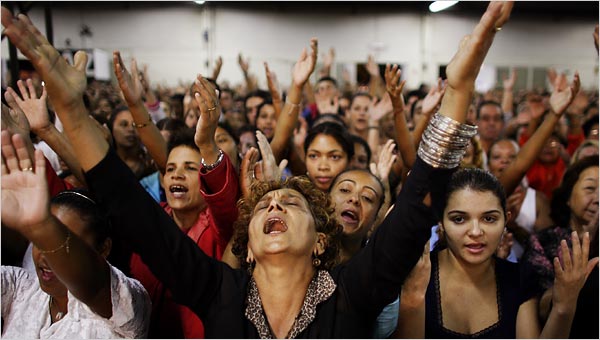
Benedict XVI on Charismatic Renewal


https://keithlannon.files.wordpress.com/2014/04/aaa1.jpg
"Young ecclesial communities are a gift from God and their contributions should be valued and welcomed with trust.…The ecclesial communities which bloomed after the Second Vatican Council, are a unique gift of the Lord and a precious resource for the life of the Church.…The movements and new communities are like an inrush of the Holy Spirit in the Church and in contemporary society. One of the positive elements and aspects of the communities of the Catholic Charismatic Renewal is precisely the importance given by them to the charisms and gifts of the Holy Spirit, and their merit lies in having reminded the Church of the actuality (of these gifts)."
Benedict XVI, on the occasion of the 13th international conference of the Catholic Fraternity of Covenant Charismatic Communities and Fellowships, October 2008).

Tuesday, July 7, 2015

Ratzinger on Silence in Liturgy


"We are realizing more and more clearly that silence is part of the liturgy. We respond, by singing and praying, to the God who addresses us, but the greater mystery, surpassing all words, summons us to silence. It must, of course, be a silence with content, not just the absence of speech and action. We should expect the liturgy to give us a positive stillness that will restore us. Such stillness will not be just a pause, in which a thousand thoughts and desires assault us, but a time of recollection, giving us an inward peace, allowing us to draw breath and rediscover the one thing necessary, which we have forgotten. That is why silence cannot be simply “made”, organized as if it were one activity among many. It is no accident that on all sides people are seeking techniques of meditation, a spirituality for emptying the mind. One of man’s deepest needs is making its presence felt, a need that is manifestly not being met in our present form of the liturgy. For silence to be fruitful, as we have already said, it must not be just a pause in the action of the liturgy. No, it must be an integral part of the liturgical event." 

Josef Ratzinger, The Spirit of the Liturgy, (SF, CA: Ignatius, 2000), p. 209.