Wednesday, July 29, 2015

Cardinal Ratzinger on Liturgy - 2

https://c2.staticflickr.com/6/5286/5264390963_d00b8d71ed.jpg
“For fostering a true consciousness in liturgical matters, it is also important that the proscription against the form of liturgy in valid use up to 1970 should be lifted. Anyone who nowadays advocates the continuing existence of this liturgy or takes part in it is treated like a leper; all tolerance ends here. There has never been anything like this in history; in doing this we are despising and proscribing the Church’s whole past. How can one trust her present if things are that way? I must say, quite openly, that I don’t understand why so any of my episcopal brethren have to a great extent submitted to this rule of intolerance, which for no apparent reason is opposed to making the necessary inner reconciliations within the Church.”

God and the World: A Conversation with Peter Seewald, San Francisco: Ignatius Press, 2002, p. 416.

Saturday, July 25, 2015

Prayers of St. Anthony of Padua to Our Lady

http://uploads7.wikiart.org/images/alonzo-cano/vision-of-st-anthony-of-padua-1662.jpg 


We beg you, our Lady and our hope, you, who are the star of the sea, illumine your children, engulfed in the turbulent sea of sin; guide us to the safe harbor of forgiveness, so we may successfully complete the journey of our life with your protection. With his help whom you carried in your womb, and nourished at your holy breasts. To him be honor and glory throughout all ages. Amen.

We ask you, Our Lady, you who are called the morning star, dispel with your light the thick fog of allurements to evil which fills our souls. Like the light of the moon, replenish our emptiness, and dissipate the darkness of our sins, so that we may attain the fullness of eternal life and the light of never diminishing glory. With his help, who made you our light, and although born from you, gave you life. To him be honor and glory from age to age. Amen.

Our Lady, our only hope, we are asking you to illumine our souls with the brilliance of your grace, to cleanse us with the splendor of your purity, to cheer us with the warmth of your presence, and to reconcile us to your Son, that we may be worthy of his glory. With his help who assumed his glorious flesh from you and who wished to live in your womb for nine months. To him be honor and glory through all eternity. Amen.

Lady and Mother of God, your name is like a fortified tower in which every sinner finds refuge and salvation. O sweet name, a name which comforts sinners. O name of blessed hope. You, O Virgin, are in the recesses of the soul. Your name is like a shining light, like a sweet taste in the mouth, like a delightful song in the ears of your children. Amen.

O Mary, you are a throne in which is located the glory of the Father. On this throne Jesus Christ, true Wisdom, took his place, Glory Itself, greater than any of the angels, who lived on earth in our flesh. You, blessed Mary, became the seat of that Glory, Jesus Christ, to whom be honor and praise from age to age. Amen.

Monday, July 20, 2015

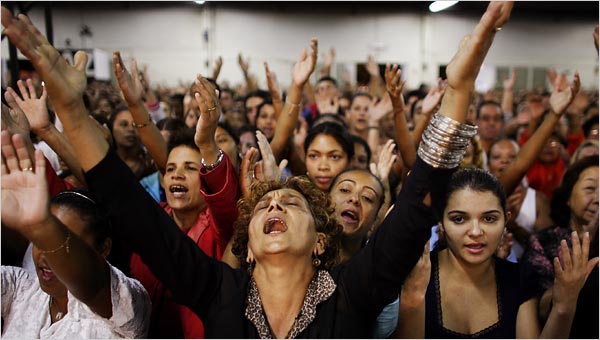
Benedict XVI on Charismatic Renewal


https://keithlannon.files.wordpress.com/2014/04/aaa1.jpg
"Young ecclesial communities are a gift from God and their contributions should be valued and welcomed with trust.…The ecclesial communities which bloomed after the Second Vatican Council, are a unique gift of the Lord and a precious resource for the life of the Church.…The movements and new communities are like an inrush of the Holy Spirit in the Church and in contemporary society. One of the positive elements and aspects of the communities of the Catholic Charismatic Renewal is precisely the importance given by them to the charisms and gifts of the Holy Spirit, and their merit lies in having reminded the Church of the actuality (of these gifts)."
Benedict XVI, on the occasion of the 13th international conference of the Catholic Fraternity of Covenant Charismatic Communities and Fellowships, October 2008).

Tuesday, July 7, 2015

Ratzinger on Silence in Liturgy


"We are realizing more and more clearly that silence is part of the liturgy. We respond, by singing and praying, to the God who addresses us, but the greater mystery, surpassing all words, summons us to silence. It must, of course, be a silence with content, not just the absence of speech and action. We should expect the liturgy to give us a positive stillness that will restore us. Such stillness will not be just a pause, in which a thousand thoughts and desires assault us, but a time of recollection, giving us an inward peace, allowing us to draw breath and rediscover the one thing necessary, which we have forgotten. That is why silence cannot be simply “made”, organized as if it were one activity among many. It is no accident that on all sides people are seeking techniques of meditation, a spirituality for emptying the mind. One of man’s deepest needs is making its presence felt, a need that is manifestly not being met in our present form of the liturgy. For silence to be fruitful, as we have already said, it must not be just a pause in the action of the liturgy. No, it must be an integral part of the liturgical event." 

Josef Ratzinger, The Spirit of the Liturgy, (SF, CA: Ignatius, 2000), p. 209.

Wednesday, June 17, 2015

Quotes by St. Anthony of Padua

Image result for "remains of st. anthony of padua"
Remains of Saint Anthony of Padua, Doctor of the Church
"Grace awaits there where God calls us; if we are not present at this appointments though, we lose the grace which was due to us. "

“The gate of Heaven is low and those who wish to enter must bend down: this was taught to us by Jesus Himself, Who when dying, bowed His head.”

“Human life is similar to a bridge and a bridge is made for crossing and not for remaining upon.”

“Confession is the gate of Heaven. O truly the gate of Heaven and the gate of Paradise, since through it the penitent is invited to kiss the feet, hands and face of God: the feet of His mercy, the hands of His grace and the face of His pardon. O house of God, O gate of Heaven, O confession! Blessed is he who dwells in you! Blessed is he who humbles himself in you! Humble yourselves therefore dearest brethren, and enter through this mystical gate.”

 “The preaching of heretics is impure in comparison with the most pure teachings of the Church… They resemble a beast named Iamia, which has the face of a human and the body of an animal. They, in fact, in order to deceive more easily, show themselves with an amiable appearance saying courteous words, but beneath they are hiding their bad intentions.”

“Let us beseech Jesus Christ, dearest brethren, Who with His humility defeated diabolical pride, that He may grant us the grace to overcome pride and haughtiness of heart with humility, and to show in our attitude a sincere humility, in order thus to reach His glory: by the grace of He Who is the Blessed One for all eternity. Amen!”

Tuesday, May 19, 2015

Saint Francis of Assisi to His Followers before His Death


http://littleportionhermitage.org/wp-content/uploads/2014/10/transitus.jpg 

"Act bravely, my Brethren; take courage, and trust in the Lord. The time is fast approaching in which there will be great trials and afflictions; perplexities and dissensions, both spiritual and temporal, will abound; the charity of many will grow cold, and the malice of the wicked will increase.

The devils will have unusual power, the immaculate purity of our Order, and of others, will be so much obscured that there will be very few Christians who will obey the true Sovereign Pontiff and the Roman Church with loyal hearts and perfect charity. 

At the time of this tribulation a man, not canonically elected, will be raised to the Pontificate, who, by his cunning, will endeavour to draw many into error and death.

Then scandals will be multiplied, our Order will be divided, and many others will be entirely destroyed, because they will consent to error instead of opposing it.

There will be such diversity of opinions and schisms among the people, the religious and the clergy, that, except those days were shortened, according to the words of the Gospel, even the elect would be led into error, were they not specially guided, amid such great confusion, by the immense mercy of God.

Then our Rule and manner of life will be violently opposed by some, and terrible trials will come upon us. Those who are found faithful will receive the crown of life; but woe to those who, trusting solely in their Order, shall fall into tepidity, for they will not be able to support the temptations permitted for the proving of the elect.

Those who preserve their fervour and adhere to virtue with love and zeal for the truth, will suffer injuries and, persecutions as rebels and schismatics; for their persecutors, urged on by the evil spirits, will say they are rendering a great service to God by destroying such pestilent men from the face of the earth. but the Lord will be the refuge of the afflicted, and will save all who trust in Him. And in order to be like their Head, [Christ] these, the elect, will act with confidence, and by their death will purchase for themselves eternal life; choosing to obey God rather than man, they will fear nothing, and they will prefer to perish rather than consent to falsehood and perfidy.

Some preachers will keep silence about the truth, and others will trample it under foot and deny it. Sanctity of life will be held in derision even by those who outwardly profess it, for in those days Jesus Christ will send them not a true Pastor, but a destroyer."

Tuesday, May 12, 2015

Ratzinger on Spontaneity and Creativity in Liturgy


http://blogs.telegraph.co.uk/news/files/2010/09/pope8_1717754c.jpgThe great­ness of the liturgy depends — we shall have to repeat this frequently — on its unspontaneity (Unbeliebigkeit) …. Only respect for the liturgy’s fundamental unspontaneity and pre-existing identity can give us what we hope for: the feast in which the great reality comes to us that we ourselves do not manufacture but receive as a gift. This means that “creativity” cannot be an authentic category for matters liturgical. In any case, this is a word that developed within the Marxist world view. Creativity means that in a universe that in itself is meaningless and came into existence through blind evolution, man can creatively fashion a new and better world.

Modern theo­ries of art think in terms of a nihilistic kind of creativity. Art is not meant to copy anything. Artistic creativity is under the free mastery of man, without being bound by norms or goals and subject to no questions of meaning. It may be that in such visions a cry for freedom is to be heard, a cry that in a world totally in the control of technology becomes a cry for help. Seen in this way, art appears as the final refuge of freedom. True, art has something to do with freedom, but freedom understood in the way we have been describing is empty. It is not redemptive, but makes despair sound like the last word of human existence. This kind of creativity has no place within the liturgy. The life of the liturgy does not come from what dawns upon the minds of individuals and plan­ning groups. On the contrary, it is God’s descent upon our world, the source of real liberation. He alone can open the door to freedom. The more priests and faithful humbly surrender themselves to this descent of God, the more “new” the liturgy will constantly be, and the more true and personal it becomes. Yes, the liturgy becomes personal, true, and new, not through tomfoolery and ba­nal experiments with the words, but through a coura­geous entry into the great reality that through the rite is always ahead of us and can never quite be overtaken.  

Cardinal Ratzinger, The Spirit of the Liturgy, (SF, CA: Ignatius, 2000), p. 170